
This article discusses psychoactive substances intended for adults (18+). If you have a health condition or take medication, consult a doctor before use. Our age policy
Reading CBD Labels and COA Reports: A Buyer's Guide
Definition
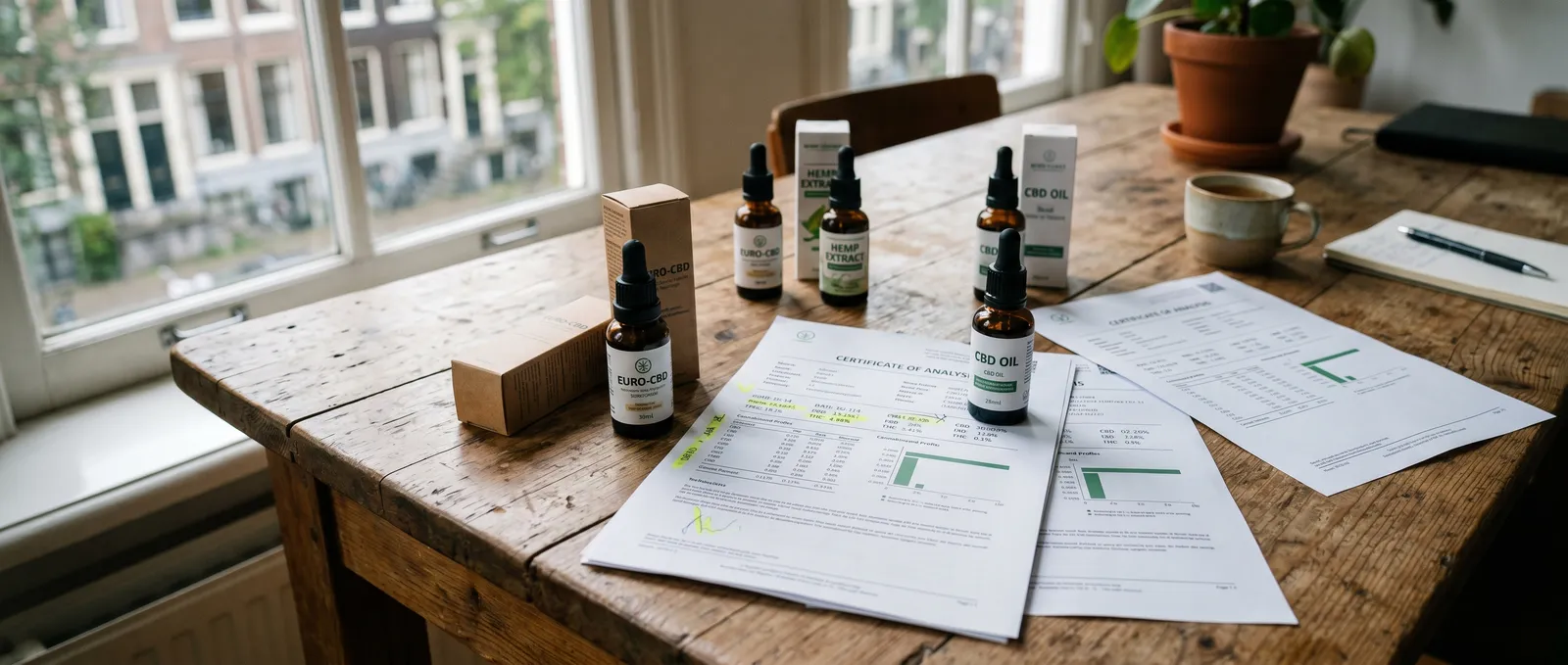
A Certificate of Analysis (COA) is a third-party lab report verifying the cannabinoid content and purity of a CBD product. Roughly 70% of CBD products sold online have been found mislabelled (Bonn-Miller et al., 2017). Reading the COA alongside the product label is the most reliable way to confirm what you're actually buying.
18+ only — this guide covers CBD products intended for adult use.
Reading CBD labels COA documents is a practical skill built on one core concept: a Certificate of Analysis (COA) is a third-party lab report that verifies the cannabinoid content and purity of a CBD product, serving as the factual counterpart to marketing claims on a label. The label tells you what a company wants you to see; the COA tells you what is actually in the bottle. Learning to read both — and to spot the gap between them — takes about five minutes per product once you know what to look for. Before you buy or order any CBD oil, mastering this process protects you from mislabelled products and wasted money.
Why Reading CBD Labels and COA Reports Matters
Independent lab verification matters because mislabelling remains widespread across the CBD market. According to a widely cited study, roughly 70% of CBD products sold online were mislabelled — some containing more CBD than stated, some less, and about 21% containing detectable THC not declared on the label (Bonn-Miller et al., 2017). The European Monitoring Centre for Drugs and Drug Addiction (EMCDDA) has similarly flagged inconsistencies in CBD product labelling across EU member states. The market has improved since those early findings, but mislabelling has not vanished, which is precisely why reading CBD labels COA reports before you order any product remains essential.
Step 1: Start With the Label — Read the Right Number
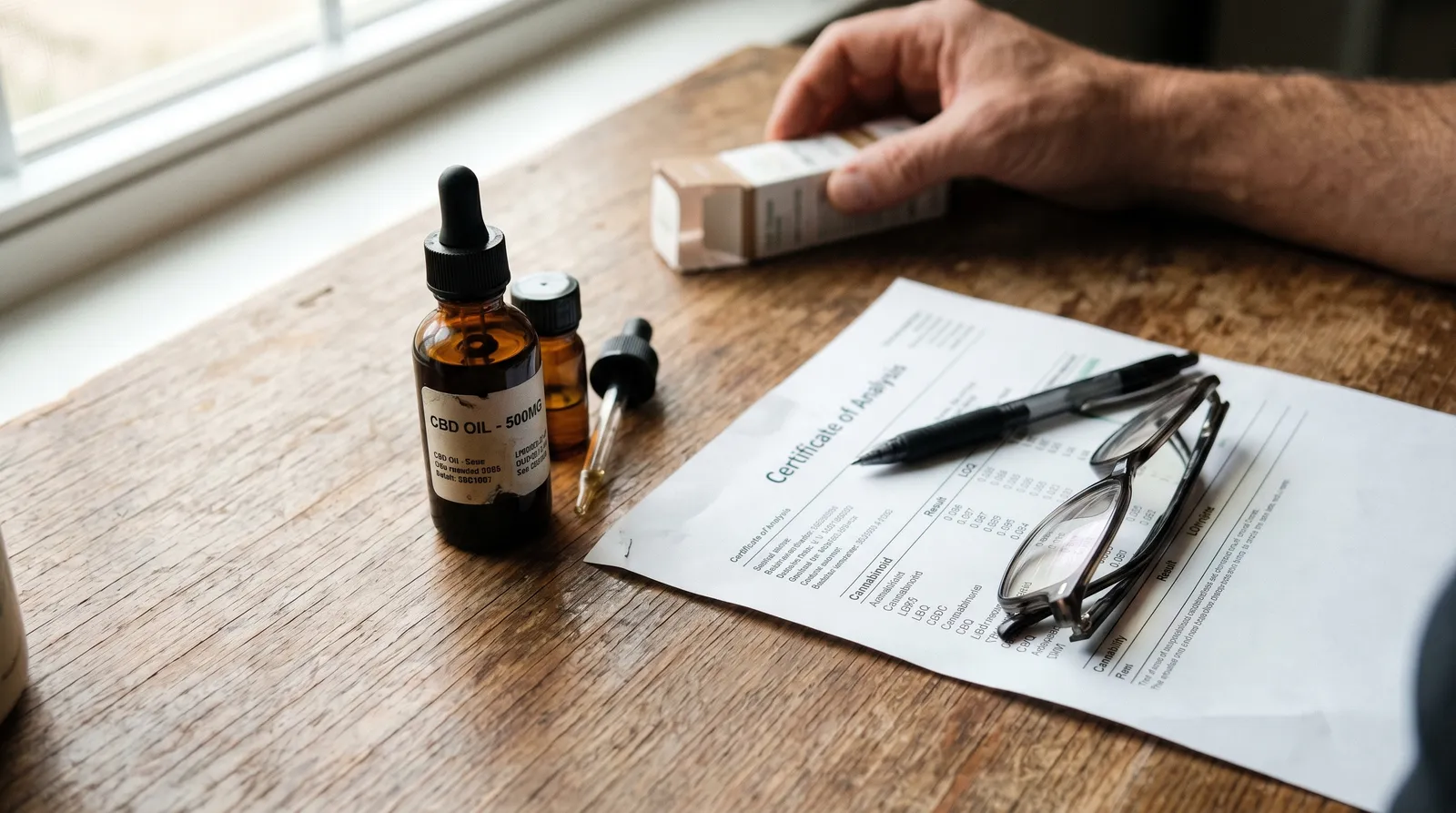
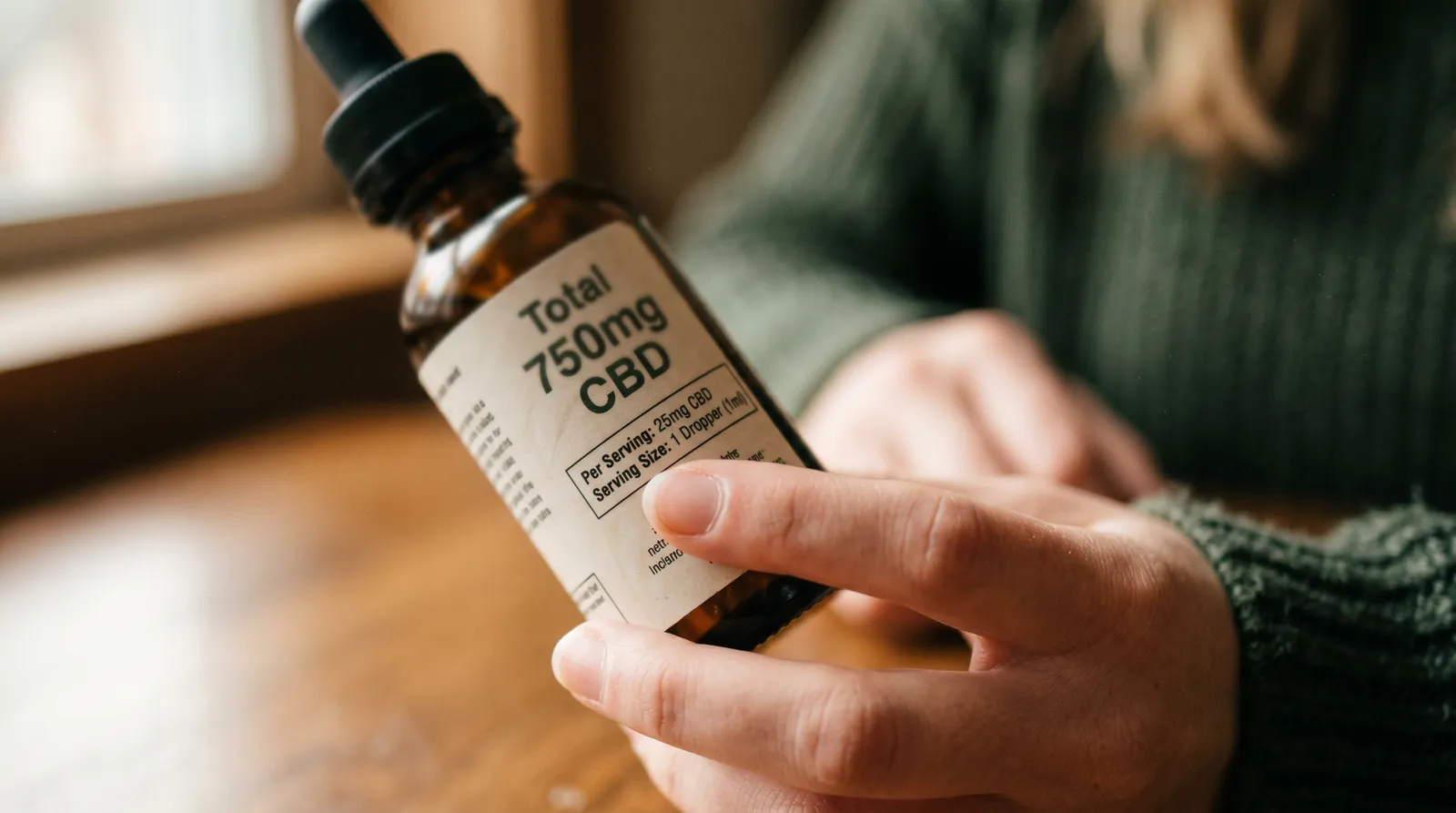
The per-serving milligram figure is the number that actually matters for dosing, not the total-per-container headline. Most CBD labels slap a big milligram number on the front. That number is almost always the total CBD per container, not per dose. A bottle labelled "1500 mg" containing 30 ml with a 1 ml dropper means each serving is roughly 50 mg. If the label only shows the total and never breaks down per-serving content, that is a yellow flag — not necessarily dishonest, but not particularly helpful either.
Look for three things on any label:
- Total CBD per container — the headline number.
- CBD per serving — the number that actually matters for dosing. Clinical studies have used doses ranging from 15 mg to 600 mg daily depending on the condition studied (Millar et al., 2019).
- Spectrum type — full-spectrum, broad-spectrum, or isolate. Full-spectrum contains THC (typically under 0.2% in EU products); broad-spectrum has THC removed but retains other cannabinoids; isolate is pure CBD with everything else stripped out.
If any of those three are missing, the label is incomplete. Move on or demand the COA before you buy.
Step 2: Find the COA
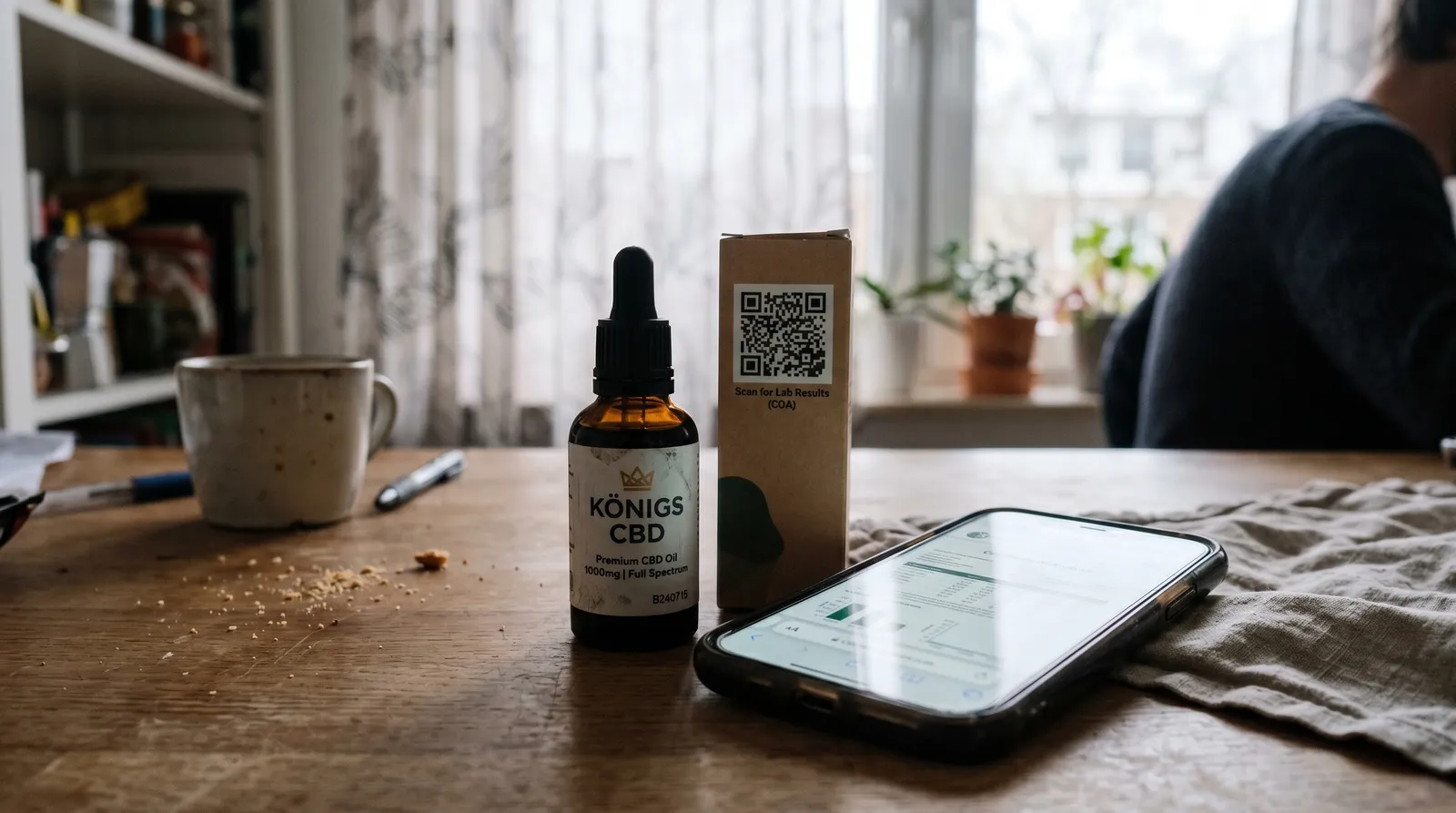
A legitimate COA is published openly, usually accessible via a QR code on the packaging or a batch-number lookup page on the brand's website. Reputable brands make this easy. If a company makes you email customer service and wait three days for a COA, that tells you something about their transparency priorities. When you get a COA, the first thing to check is whether it comes from an independent, third-party laboratory — not a lab owned by the brand itself. Reading CBD labels COA data together is the only way to confirm claims before you order.
Step 3: Check the COA Header
The header tells you whether the COA is legitimate, current, and matched to your specific product. Before you look at any numbers, scan the top of the document. A legitimate COA header contains:
- Lab name and accreditation — look for ISO 17025 accreditation, which is the international standard for testing laboratories. A lab without it is not necessarily bad, but accreditation means their methods have been externally audited.
- Date of testing — COAs older than 12 months are stale. Cannabinoid content can degrade over time, especially in products stored poorly. A 2020 analysis found CBD oil potency dropped measurably after 12 months of storage at room temperature (Fraguas-Sánchez et al., 2020).
- Batch or lot number — this should match the number on your product's packaging. If it does not, the COA may be from a different production run entirely.
- Client name — the brand that commissioned the test. If the brand name on the COA does not match the product in your hand, something is off.
If the report date and test date are listed separately and differ by more than a few weeks, that is normal — labs have backlogs. A gap of several months is less reassuring.
Step 4: Read the Cannabinoid Profile
The cannabinoid panel is the core of the COA, listing concentrations of individual compounds so you can verify the label claim. It typically includes:
| Cannabinoid | What It Tells You | What to Watch For |
|---|---|---|
| CBD (cannabidiol) | The main active compound you are buying | Should be within 10% of the label claim |
| CBDA (cannabidiolic acid) | The raw, unheated precursor to CBD | High CBDA with low CBD suggests incomplete decarboxylation |
| THC (delta-9-THC) | The primary psychoactive cannabinoid | EU limit is 0.2% in most member states; should match label |
| THCA (tetrahydrocannabinolic acid) | Raw precursor to THC | Some labs report total THC as THC + (THCA × 0.877) |
| CBG, CBN, CBC | Minor cannabinoids present in full-spectrum products | Their presence confirms a genuine full-spectrum extract |
One common point of confusion: the difference between CBD and total CBD. Labs often report both. Total CBD accounts for the CBDA that would convert to CBD if heated, using the formula: Total CBD = CBD + (CBDA × 0.877). If a label says "500 mg CBD" but the COA shows 300 mg CBD and 230 mg CBDA, the total CBD is roughly 500 mg — but only if you are heating or consuming the product in a way that triggers decarboxylation. For oils taken sublingually, the CBDA largely stays as CBDA.
Step 5: Check the Contaminant Panels
A complete COA tests for contaminants, not just cannabinoids — this is what separates a useful report from a half-measure. The panels you want to see:
- Heavy metals — hemp is a bioaccumulator, meaning it pulls metals like lead, arsenic, cadmium, and mercury from soil. The European Food Safety Authority sets maximum levels for these in food supplements (EFSA, 2015). Results should read "ND" (not detected) or fall well below action limits.
- Pesticides — a panel typically screening for 60–200+ compounds. You want "ND" across the board. The EU has stricter pesticide residue limits than many other markets.
- Residual solvents — relevant for extracts made with ethanol, butane, or CO₂. Trace amounts within limits are normal; anything above the lab's action level is a fail.
- Microbial contamination — testing for moulds, yeasts, E. coli, and salmonella. Any positive result for pathogens means the product failed.
- Mycotoxins — toxic compounds produced by certain moulds. Not all labs test for these, but good ones do.
If a COA only shows a cannabinoid profile and nothing else, it is an incomplete test. A cannabinoid-only COA tells you what is there but not what should not be there. That is half the picture.
Step 6: Spot the Red Flags
Certain patterns reliably indicate problems, and recognising them quickly saves you from buying a substandard product. After reviewing a fair number of COAs over the years, these stand out:
- No batch number match — the COA exists, but you cannot verify it corresponds to your specific bottle.
- CBD content more than 10% below the label claim — some variance is expected in botanical products, but consistent under-dosing is a problem. A 2022 analysis of European CBD oils found that about 25% of products tested contained less than 90% of the labelled CBD amount (Liebling et al., 2022).
- THC above the declared level — particularly concerning if you are subject to workplace drug testing or live in a jurisdiction with strict THC limits.
- The lab is owned by the brand — "third-party" means independent. If the testing lab shares an address, parent company, or ownership structure with the brand, the independence is compromised.
- Results that look too perfect — every single contaminant reading at exactly 0.000 across all panels can sometimes indicate a template rather than actual test data. Real lab results usually show trace amounts of something, even if well within limits.
We should be upfront about what COA reading cannot do. It cannot tell you how a product will affect you personally, whether the extraction method is optimal, or whether the carrier oil suits your body. It also cannot account for degradation that may have occurred after testing — for instance, if a product sat in a hot warehouse for months. A COA is a snapshot from one moment in time, not a lifetime guarantee.
Putting the Label and the COA Together
The real skill is comparing the two documents side by side to verify every claim before you order. The label says 1000 mg CBD per bottle — does the COA confirm roughly 33 mg/ml in a 30 ml bottle? The label says "full-spectrum" — does the COA show a range of cannabinoids, including trace THC? The label says "THC-free" — does the COA show THC as ND or below the limit of detection?
Discrepancies do not always mean fraud. Small batch variations, different testing methodologies, and the inherent variability of plant-derived products all play a role. But consistent, large discrepancies — or a flat-out refusal to provide a COA — are reasons to find a different product.
Comparing Spectrum Types Side by Side
Full-spectrum, broad-spectrum, and isolate products look quite different on a COA, and understanding these differences helps you get exactly what you want when you buy CBD.
| Feature | Full-Spectrum | Broad-Spectrum | Isolate |
|---|---|---|---|
| CBD present | Yes | Yes | Yes (99%+) |
| THC on COA | Trace (under 0.2%) | ND or below LOD | ND |
| Minor cannabinoids (CBG, CBC, CBN) | Multiple present | Some present | None or negligible |
| Terpenes | Present | May be present | Absent |
| Best for | Entourage effect seekers | Those avoiding any THC | Precise dosing, sensitivity |
If a product labelled "full-spectrum" shows only CBD and nothing else on the COA, it is likely an isolate-based product with a misleading label. Similarly, if a "broad-spectrum" product shows measurable THC, the THC removal process was incomplete. The Azarius CBD oil range, for example, publishes full cannabinoid panels for each batch — something worth checking when you browse our selection.
Azarius COA Checklist Versus Other Brands
Not all brands approach transparency equally, and comparing checklist items reveals meaningful differences in how companies treat reading CBD labels COA verification. We put together a quick comparison based on what we consistently see across the brands we stock versus common online-only sellers:
| Checklist Item | Azarius-Stocked Brands | Typical Online-Only Brand |
|---|---|---|
| COA accessible via QR or website | Yes, per batch | Sometimes; often only on request |
| ISO 17025 accredited lab | Required for listing | Varies widely |
| Full contaminant panels | Heavy metals, pesticides, solvents, microbial | Often cannabinoid-only |
| Batch number on packaging | Always present | Frequently missing |
| COA updated within 12 months | Yes | Often outdated |
How Storage Affects What the COA Promised
A COA reflects product composition at the moment of testing, not at the moment you open the bottle. Cannabinoids degrade when exposed to heat, light, and oxygen. A study on CBD oil stability found that products stored at 40°C lost significant potency within weeks, while those kept cool and dark retained their cannabinoid profile far longer (Fraguas-Sánchez et al., 2020). This means a perfect COA becomes less reliable if the product was shipped in summer heat or stored on a sunlit shelf. When you buy CBD oil, check not just the COA but also the packaging date and storage recommendations. Amber glass bottles and sealed caps help, but nothing replaces proper temperature control during shipping and storage.
CBD Interactions and Further Reading
CBD interacts with several classes of medication, including blood thinners like warfarin, certain antidepressants (SSRIs), and some anti-epileptic drugs, primarily through cytochrome P450 enzyme inhibition (Nasrin et al., 2021). If you are on prescription medication, the Azarius wiki article on CBD drug interactions covers this in detail. For those looking to get started with CBD products, our CBD oil category page provides options from brands that publish complete COAs. The Azarius blog also features a guide to choosing your first CBD product, which complements the reading CBD labels COA skills covered here.
Five minutes with a label and a COA will not make you a chemist. But it will tell you whether the product in your hand matches what is on the box — and whether anyone bothered to check for the things that should not be in there at all.
Last updated: April 2026
Frequently Asked Questions
8 questionsWhat is a Certificate of Analysis for CBD?
How do I check if a CBD COA matches my product?
What is the difference between CBD and total CBD on a lab report?
What contaminants should a CBD COA test for?
How can I tell if a CBD product is mislabelled?
Does full-spectrum CBD always contain THC?
What does per-serving CBD mean versus total CBD per bottle?
How do I verify that a CBD COA comes from a legitimate third-party lab?
About this article


Luke Sholl has been writing about cannabis, cannabinoids, and the broader benefits of nature since 2011, and has personally grown cannabis in home grow tents for more than a decade. That first-hand cultivation experience
This wiki article was drafted with AI assistance and reviewed by Luke Sholl, External contributor since 2026. Editorial oversight by Toine Verleijsdonk.
Medical disclaimer. This content is for informational purposes only and does not constitute medical advice. Consult a qualified healthcare provider before use of any substance.
Last reviewed April 24, 2026
References (2)
- [1]Bonn-Miller, M. O., Loflin, M. J., Thomas, B. F., Marcu, J. P., Hyke, T., & Vandrey, R. (2017). Labeling accuracy of cannabidiol extracts sold online. JAMA, 318(17), 1708-1709. DOI: 10.1001/jama.2017.11909
- [2]Pavlovic, R., Nenna, G., Calvi, L., Panseri, S., Borgonovo, G., Giupponi, L., et al. (2018). Quality traits of cannabidiol oils: cannabinoids content, terpene fingerprint and oxidation stability of European commercially available preparations. Molecules, 23(5), 1230. DOI: 10.3390/molecules23051230
Related Articles

Pinene Alpha and Beta: Aroma, Chemistry & Vaporisation Guide
Pinene is a bicyclic monoterpene occurring as two isomers — α-pinene and β-pinene — and ranks as the most abundant terpene in the plant kingdom.
CBD and Recovery: What the Research Actually Shows
CBD and recovery is a research topic spanning exercise-induced muscle damage, sleep quality, and perceived soreness. As McCartney et al.
CBD Pet Dosing Vet Consultation: Prepare for Your Visit
Veterinary CBD dosing is not a scaled-down version of human dosing — dogs and cats metabolise cannabidiol through different enzymatic pathways and at…
CBD for Cats Veterinary Considerations: Feline Research, Safety and Guidance
Cats metabolise cannabinoids differently from dogs and humans, lacking key glucuronidation enzymes that affect CBD clearance. Deabold et al.
EU Novel Food Regulation CBD: Country Status, EFSA Safety & Guide
EU novel food regulation CBD is a policy framework under EU rule 2015/2283 that classifies cannabidiol extracts as a novel food, requiring safety assessment…
CBD Topical Creams Medical Grade: CE-Marked Class I Explained
CBD topical creams deliver cannabidiol directly to the skin rather than the bloodstream.
Humulene Effects and Aroma Profile | Terpene Guide
Humulene (α-humulene) is a monocyclic sesquiterpene named after Humulus lupulus — hops.
Terpene Entourage Effect: Current Evidence Reviewed
The terpene entourage effect proposes that cannabis terpenes modulate cannabinoid activity, producing different outcomes than isolated compounds alone.
CBD and Skin Conditions: What Research Shows
Cannabidiol (CBD) interacts with the endocannabinoid system expressed in human skin — including CB1 and CB2 receptors on keratinocytes, sebocytes, and…