
This article discusses psychoactive substances intended for adults (18+). If you have a health condition or take medication, consult a doctor before use. Our age policy
EU Novel Food Regulation CBD: Country Status, EFSA Safety & Guide

Definition
EU novel food regulation CBD is a policy framework under EU rule 2015/2283 that classifies cannabidiol extracts as a novel food, requiring safety assessment by EFSA before formal market authorisation. As of the EFSA panel's 2025 update, a provisional safe intake of roughly 2 mg/kg body weight per day has been set for adults (EFSA NDA Panel, 2025). Authorisation applications remain pending, leaving CBD food supplements in a transitional state across EU member states.
What the Novel Food Framework Actually Says
EU novel food regulation CBD is a policy framework that governs how cannabidiol extracts reach consumers, requiring safety assessment before formal market authorisation under the EU 2015/2283 rules. If you have tried to buy a CBD oil, capsule, or gummy anywhere in Europe over the past few years, you have probably bumped into the phrase "novel food." It sounds bureaucratic because it is. But the framework behind it directly shapes which CBD products reach shop shelves, how they are labelled, and whether they can be sold as food supplements in your country. This article unpacks the framework itself, the country-by-country patchwork it has created, and what it all means if you are comparing CBD formats as an adult consumer.

The core idea is simple: any food or food ingredient that was not consumed "significantly" within the EU before 15 May 1997 is classified as a novel food. Hemp seeds and hemp-seed oil have a long consumption history and are generally exempt. Extracts of Cannabis sativa L. that are enriched in cannabidiol (CBD), however, were not part of the European diet before that cut-off date — at least not in the concentrated forms sold today. The European Commission's Novel Food Catalogue lists CBD extracts as novel, meaning they require a safety assessment and formal authorisation before they can be marketed as food or food supplements (European Commission, Novel Food Catalogue, updated 2023).
Status by EU Member State
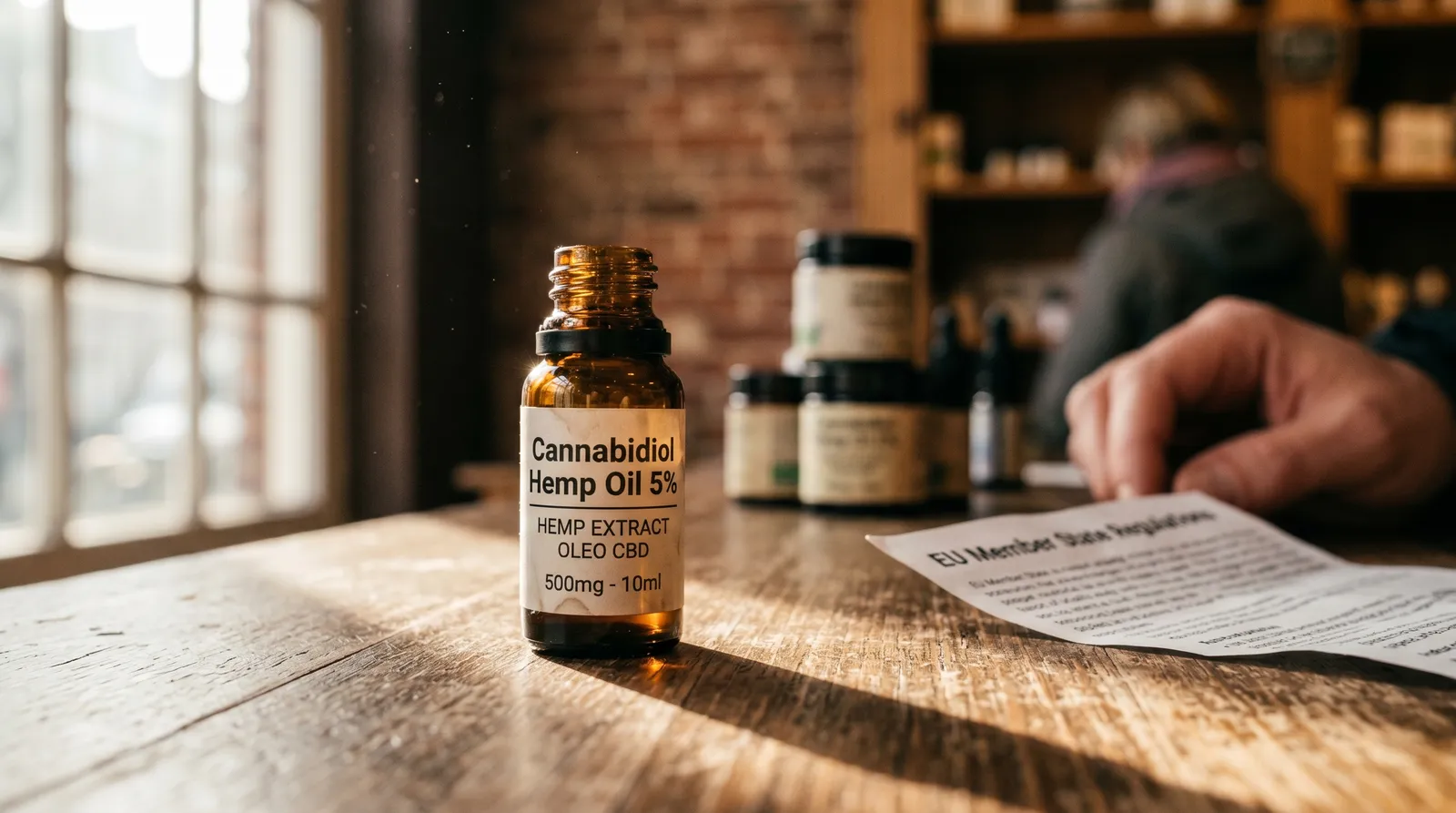
Enforcement of the EU novel food regulation CBD framework varies dramatically from one country to the next. The table below summarises the picture across major EU and EEA markets as of early 2025. A critical caveat: the status changes over time, sometimes quickly. Verify current conditions for your jurisdiction before drawing conclusions.
| Country | Current Status (as of early 2025) | Notable National Approach | Citation |
|---|---|---|---|
| Netherlands | CBD food supplements on sale; enforcement pending novel-food authorisation outcomes | NVWA monitors health claims and THC limits (< 0.05% THC in finished product) | NVWA policy guidance, 2022 |
| Germany | CBD products sold as food supplements; BVL classifies CBD extracts as novel food requiring authorisation | Heilmittelwerbegesetz (HWG) restricts any medicinal advertising language for non-authorised products | BVL Novel Food Catalogue entry, 2023 |
| France | CBD food products permitted under novel-food framework; flower sale banned then partially reinstated by courts | Conseil d'État ruling (2022) overturned blanket ban on CBD flower; DGCCRF enforces labelling | Conseil d'État Decision No. 449919, Jan 2022; DGCCRF guidance, 2023 |
| Italy | CBD oils and supplements available; classification varies by product positioning | Ministry of Health Decree (2020) added CBD to the list of substances under monitoring; AIFA may reclassify if therapeutic framing is used | Italian Ministry of Health Decree, Oct 2020 |
| Spain | CBD oils sold primarily as "topical" or "aromatic" products; oral CBD food supplements in a grey zone | AECOSAN defers to EU novel-food framework; AEMPS treats oral CBD claims as medicinal | AECOSAN guidance note, 2021 |
| Austria | CBD food supplements available; AGES classifies CBD extracts as novel food | National enforcement has been relatively permissive pending EU-level authorisation decisions | AGES Novel Food classification, 2022 |
| Belgium | CBD food supplements sold; FPS Health monitors compliance | THC limit of 0.2% in raw material; finished-product THC must be negligible | FPS Health, Food Chain Safety and Environment, 2023 |
| United Kingdom (post-Brexit) | FSA validated-list process ongoing; products from companies on the validated list may remain on sale | COT/ACNFP set a provisional acceptable daily intake; FSA deadline extensions for validated applicants | FSA CBD validated list, updated 2024; COT Statement, Oct 2023 |
| Sweden | Strict enforcement; CBD food products largely removed from shelves | Livsmedelsverket treats CBD extracts as novel food and has actively enforced removal | Livsmedelsverket position statement, 2021 |
| Denmark | CBD supplements require novel-food authorisation; enforcement active | Danish Veterinary and Food Administration enforces novel-food requirements strictly | DVFA guidance, 2022 |
Note: This table is a snapshot. The status changes over time under the EU 2015/2283 framework and national implementation approaches. Always verify current conditions for your jurisdiction.
The EFSA Safety Assessment — Where Things Stand
EFSA has not yet granted formal authorisation for any CBD novel-food application. For a novel food to receive EU-wide authorisation, the applicant must submit a safety dossier to the European Food Safety Authority (EFSA). EFSA then conducts a scientific risk assessment. Several CBD companies have submitted applications — the European Commission's novel-food application tracker listed over 50 pending CBD-related applications as of mid-2024.

In early 2025, EFSA published an updated statement on the safety of cannabidiol as a novel food. The panel established a provisional safe intake level of approximately 2 mg of CBD per kilogram of body weight per day for adults. For a 70 kg adult, that works out to roughly 140 mg per day (EFSA Panel on Nutrition, Novel Foods and Food Allergens, 2025). That figure is based on the available toxicological and clinical data, including liver-enzyme (ALT) elevation observed in high-dose pharmaceutical CBD trials.
The word "provisional" matters. EFSA flagged data gaps — particularly around long-term exposure at consumer-supplement doses and potential interactions with common medications. The panel noted that CBD inhibits cytochrome P450 enzymes (CYP3A4 and CYP2C19), which are involved in metabolising a wide range of drugs. This is the same metabolic pathway flagged by the so-called "grapefruit warning": if a medication label says "do not take with grapefruit," CBD may interact with it too. Talk to your doctor before combining CBD with any prescription medication.
Until EFSA completes full authorisations and the European Commission formally approves specific CBD novel-food applications, the status of CBD food supplements remains transitional — technically unauthorised at EU level, but tolerated to varying degrees by national authorities. The EUDA (formerly EMCDDA) has noted this patchwork enforcement pattern across member states in its monitoring reports (EMCDDA, Cannabis policy: status and recent developments, 2023).
What Novel Food Status Means for the Product on the Shelf
Novel-food classification affects CBD products in three practical ways that determine what you can actually order and what the label should say.
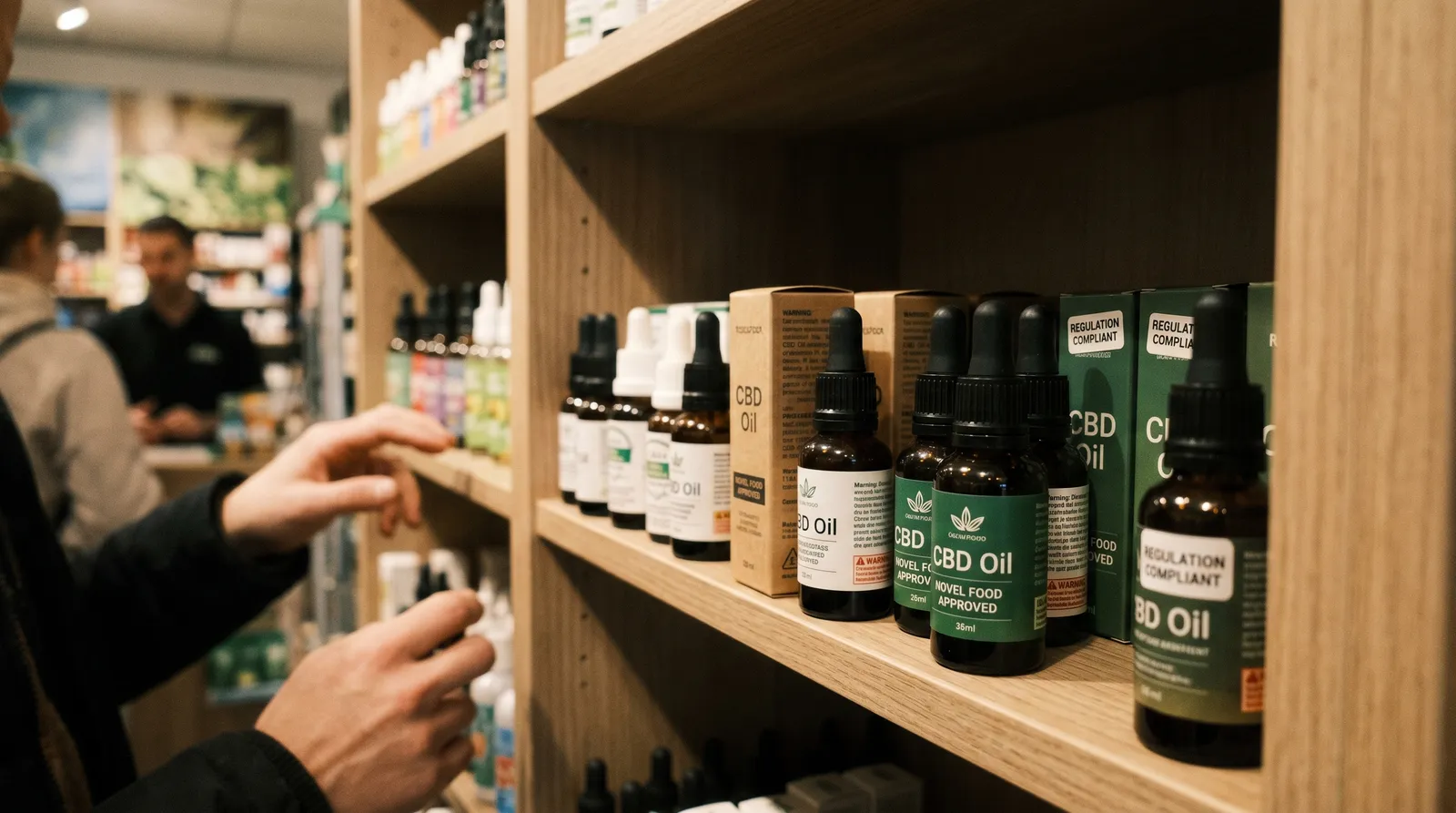
- Labelling. Products sold as food supplements must comply with EU rule 1169/2011 on food information to consumers. That means a full ingredients list, nutritional declaration where applicable, and — critically — no health claims that have not been authorised by EFSA under the EU Nutrition and Health Claims framework (EC) No 1924/2006. As of 2025, zero health claims have been authorised for CBD. None. Some brands use phrases like "supports sleep" or "relieves stress" on their packaging — these are examples of non-compliant wording identified by the European Commission (EC Register of Nutrition and Health Claims, 2024), because EFSA has not evaluated or authorised any such claims for CBD. Similarly, any label stating "cures insomnia" would be a medicinal claim requiring pharmaceutical authorisation, according to the same EC guidance. Any product label making such unverified claims is technically non-compliant with EU food-supplement labelling requirements.
- THC limits. The EU's common agricultural policy sets a maximum THC content of 0.3% in industrial hemp cultivars (raised from 0.2% in 2023 under EU rule 2021/2115). However, finished consumer products are subject to national THC limits, which vary. The Netherlands, for example, applies a stricter threshold of 0.05% THC in finished products. Germany and Austria broadly follow the 0.2% raw-material standard. These limits determine whether a full-spectrum CBD extract — which naturally contains trace THC — can be sold in a given market.
- Product format. The novel-food classification applies specifically to CBD when it is intended for ingestion — oils, capsules, gummies, drinks, edibles. Topical products (creams, balms) fall under the EU Cosmetics framework (EC) No 1223/2009 instead, which has its own set of requirements. Vape products sit under the Tobacco Products Directive (2014/40/EU) in most member states, though national implementation varies. The pathway you care about depends on how you plan to use the product.
The UK Divergence After Brexit
The United Kingdom now runs its own parallel process through the Food Standards Agency (FSA), separate from the EU framework. In 2020, the FSA announced that CBD food products would need novel-food authorisation, and set a deadline for companies to submit applications. Those that applied and made the FSA's "validated list" were permitted to keep products on sale while their applications were assessed.
In October 2023, the UK's Committee on Toxicity (COT) and the Advisory Committee on Novel Foods and Processes (ACNFP) published a joint statement establishing a provisional acceptable intake of 10 mg of CBD per day for healthy adults — significantly lower than the EFSA figure of ~2 mg/kg/day (COT/ACNFP Statement, October 2023). The COT based this on a more conservative interpretation of the liver-safety data. The FSA has not yet finalised its position, and the validated-list process remains ongoing. For UK-based shoppers, this means the picture is still shifting.
What Novel Food Status Does Not Tell You
The framework governs market access and safety thresholds. It does not tell you which CBD concentration to choose, whether oil or capsules suit your routine better, or how bioavailability differs between sublingual and oral formats. Those are format-education questions covered elsewhere — see the articles on CBD oil percentages explained, CBD bioavailability by format, and CBD oil vs capsules for detailed breakdowns. If you want to get a practical sense of how different CBD products compare, those guides are a better starting point than any policy document.
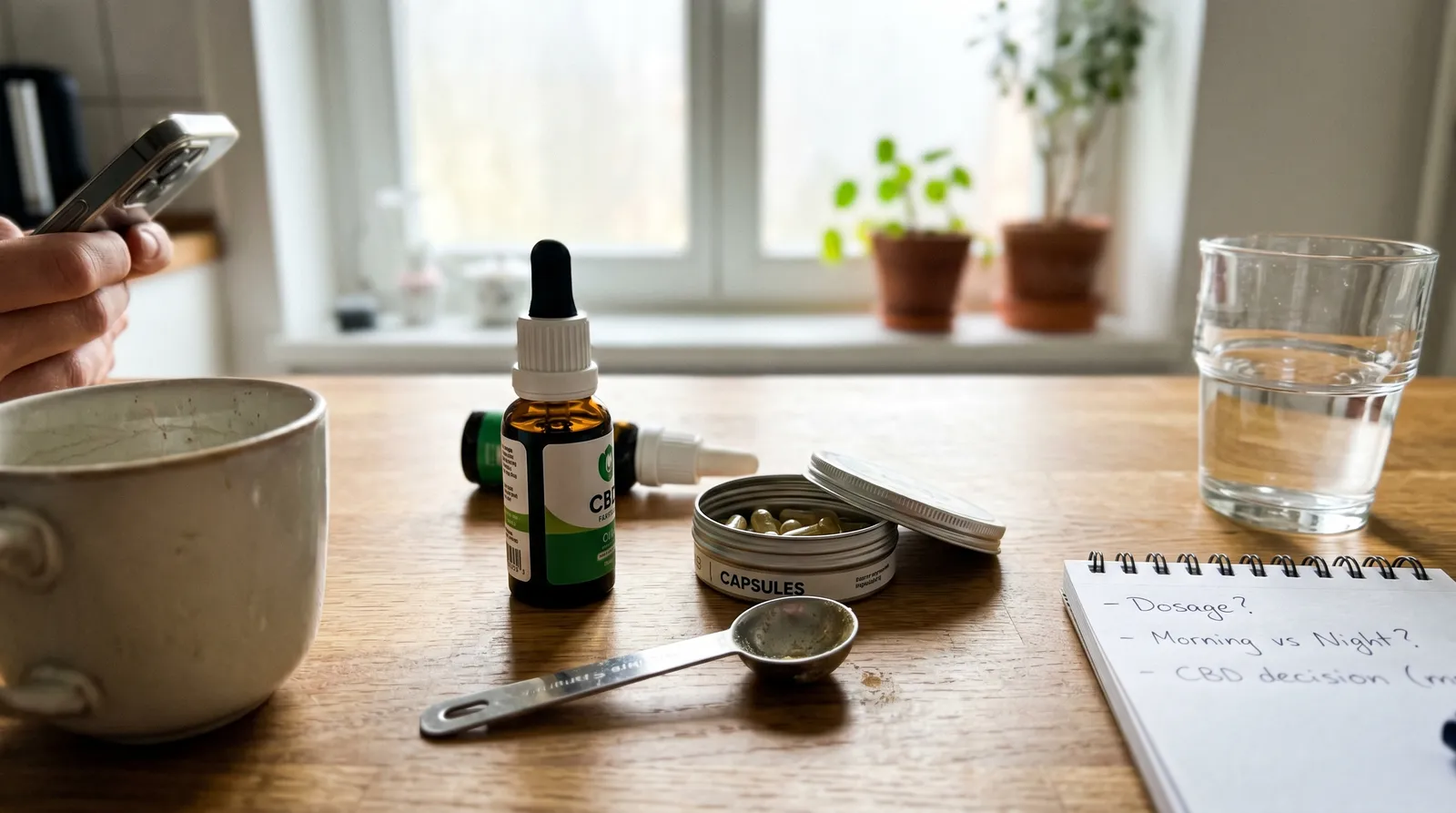
The framework also does not address the one question most shoppers actually want answered: "does CBD do anything?" That is a research question, not a policy one, and the evidence base is still developing. EFSA's safety assessment is about toxicological risk, not efficacy. The two are separate processes, and conflating them is one of the most common misunderstandings in the CBD space. We are honest about this limitation: no retailer, including us, can tell you CBD will produce a specific effect, because the science is not there yet for most consumer-supplement use cases.
Comparing CBD Formats Under the Novel Food Framework
Different CBD product formats face different compliance requirements under the EU novel food regulation CBD framework, which can affect what you find available to buy in your market. Here is a quick comparison:

| Format | Applicable Framework | Novel Food Relevant? | Key Consideration |
|---|---|---|---|
| CBD oil (sublingual) | Novel Food (EU 2015/2283) | Yes | Most common format; labelling must list CBD per serving |
| CBD capsules | Novel Food (EU 2015/2283) | Yes | Fixed dose per capsule; easier to track intake against EFSA provisional limit |
| CBD gummies | Novel Food (EU 2015/2283) | Yes | Often contain added sugars; check full ingredients list |
| CBD topical cream | Cosmetics (EC 1223/2009) | No | Not ingested; different safety and labelling requirements |
| CBD vape liquid | Tobacco Products Directive (2014/40/EU) | No | National implementation varies widely; not a food product |
If you are deciding whether to order a CBD oil, capsule, or gummy, the novel-food classification applies equally to all three. The practical differences — onset time, bioavailability, convenience — are covered in our format comparison articles rather than in policy documents.
Practical Takeaways for Shoppers
- Check the label. A compliant CBD food supplement should list CBD content per serving, a full ingredients list, and a batch or lot number. If it makes unverified wellness claims, that is a red flag under EU food-supplement labelling requirements — those claims are not authorised.
- Know your country's approach. Enforcement varies. A product on sale in the Netherlands may not be available in Sweden or Denmark. If you are ordering across borders within the EU, the conditions of your destination country apply.
- Understand the THC threshold. Full-spectrum CBD products contain trace amounts of THC within permitted limits. Those limits differ by country. If you are subject to workplace drug testing, even trace THC within permitted thresholds may register on a sensitive screening test.
- Topicals and vapes are different categories. If your interest is in a CBD cream or vape pen rather than an oil or gummy, different frameworks apply — cosmetics and tobacco-products directives respectively, not novel-food requirements.
- The situation is not static. EFSA's provisional safe-intake figure, the pending novel-food applications, and the UK's parallel FSA process all mean that the picture in 2026 may look different from today. Bookmark your national food-safety authority's CBD guidance page and check back periodically.
- Buy from transparent brands. When you order CBD products, look for brands like Cibdol that publish third-party lab reports (certificates of analysis) for each batch. This is the simplest way to verify that what is on the label matches what is in the bottle.
This article is consumer education. The status of CBD products varies by EU member state and changes over time under the EU 2015/2283 framework and national approaches. Verify current conditions for your jurisdiction.
Important: This article is consumer education and is not medical advice. CBD products are food supplements, not medicines. Research on CBD is ongoing and evidence remains limited or mixed for many topics. Talk to your doctor before use if you are pregnant, breastfeeding, taking medication, scheduled for surgery, or living with a health condition. Keep CBD products out of reach of children and pets.
This article has been reviewed for factual and editorial accuracy by Toine Verleijsdonk (Cibdol brand manager) and Joshua Askew (Editorial Director). It has NOT been reviewed by a licensed medical practitioner and does not constitute medical advice.
References
- EU 2015/2283 of the European Parliament and of the Council of 25 November 2015 on novel foods. Official Journal of the European Union, L 327/1.
- European Commission Novel Food Catalogue — Cannabis sativa L. entry (updated 2023).
- EFSA Panel on Nutrition, Novel Foods and Food Allergens (NDA). Statement on the safety of cannabidiol (CBD) as a novel food: updated assessment. EFSA Journal, 2025.
- Committee on Toxicity of Chemicals in Food, Consumer Products and the Environment (COT) and Advisory Committee on Novel Foods and Processes (ACNFP). Joint statement on cannabidiol (CBD), October 2023.
- EU rule 1169/2011 on the provision of food information to consumers. Official Journal of the European Union, L 304/18.
- EC framework 1924/2006 on nutrition and health claims made on foods. Official Journal of the European Union, L 404/9.
- EU rule 2021/2115 establishing support for strategic plans (CAP reform — hemp THC threshold increase to 0.3%).
- Conseil d'État (France), Decision No. 449919, January 2022 — partial annulment of the interministerial decree banning CBD flower.
- Millar SA, Stone NL, Yates AS, O'Sullivan SE. A systematic review on the pharmacokinetics of cannabidiol in humans. Frontiers in Pharmacology. 2018;9:1365. DOI: 10.3389/fphar.2018.01365.
- EMCDDA (European Monitoring Centre for Drugs and Drug Addiction). Cannabis policy: status and recent developments. Lisbon, 2023.
- European Commission Register of Nutrition and Health Claims Made on Foods, 2024.
Last updated: April 2026
Frequently Asked Questions
11 questionsHas EFSA approved CBD as a novel food?
Why can I buy CBD oil in the Netherlands but not in Sweden?
Does the novel food framework apply to CBD creams and topicals?
What is the difference between the UK FSA and EU EFSA CBD safe-intake levels?
Does the 0.3% THC hemp limit apply to finished CBD products?
Can I order CBD food supplements from another EU country?
What should I look for on a CBD product label?
Is CBD the same as medical cannabis?
How does the EU novel food regulation CBD process work for applicants?
What is the difference between full-spectrum and broad-spectrum CBD under novel-food rules?
Where can I buy CBD oil that meets EU novel-food labelling standards?
About this article


Luke Sholl has been writing about cannabis, cannabinoids, and the broader benefits of nature since 2011, and has personally grown cannabis in home grow tents for more than a decade. That first-hand cultivation experience
This wiki article was drafted with AI assistance and reviewed by Luke Sholl, External contributor since 2026. Editorial oversight by Toine Verleijsdonk.
Medical disclaimer. This content is for informational purposes only and does not constitute medical advice. Consult a qualified healthcare provider before use of any substance.
Last reviewed April 26, 2026
Related Articles

Pinene Alpha and Beta: Aroma, Chemistry & Vaporisation Guide
Pinene is a bicyclic monoterpene occurring as two isomers — α-pinene and β-pinene — and ranks as the most abundant terpene in the plant kingdom.

CBD and Recovery: What the Research Actually Shows
CBD and recovery is a research topic spanning exercise-induced muscle damage, sleep quality, and perceived soreness. As McCartney et al.

CBD Pet Dosing Vet Consultation: Prepare for Your Visit
Veterinary CBD dosing is not a scaled-down version of human dosing — dogs and cats metabolise cannabidiol through different enzymatic pathways and at…

CBD for Cats Veterinary Considerations: Feline Research, Safety and Guidance
Cats metabolise cannabinoids differently from dogs and humans, lacking key glucuronidation enzymes that affect CBD clearance. Deabold et al.
CBD Topical Creams Medical Grade: CE-Marked Class I Explained
CBD topical creams deliver cannabidiol directly to the skin rather than the bloodstream.
Humulene Effects and Aroma Profile | Terpene Guide
Humulene (α-humulene) is a monocyclic sesquiterpene named after Humulus lupulus — hops.

Terpene Entourage Effect: Current Evidence Reviewed
The terpene entourage effect proposes that cannabis terpenes modulate cannabinoid activity, producing different outcomes than isolated compounds alone.
CBD and Skin Conditions: What Research Shows
Cannabidiol (CBD) interacts with the endocannabinoid system expressed in human skin — including CB1 and CB2 receptors on keratinocytes, sebocytes, and…

CBD and Stress: What Research Actually Shows
Cannabidiol (CBD) has been studied in a growing number of human trials measuring stress-related outcomes — from cortisol levels to subjective anxiety under…