
This article discusses psychoactive substances intended for adults (18+). If you have a health condition or take medication, consult a doctor before use. Our age policy
Endocannabinoid System Explained: Receptors & Anandamide

Definition
The endocannabinoid system (ECS) is a cell-signalling network of receptors, endogenous lipid-based molecules, and enzymes found across virtually all vertebrates. First characterised in the early 1990s (Matsuda et al., 1990; Devane et al., 1992), it regulates homeostasis through retrograde neurotransmission and immune-cell modulation — and it is the reason plant cannabinoids interact with human physiology at all.
What Is the Endocannabinoid System?
The endocannabinoid system explained in its simplest terms is a cell-signalling network that maintains internal balance across virtually every organ system in the human body. First identified in the early 1990s by researchers investigating how cannabis produces its effects, the endocannabinoid system turned out to be far older than the plant itself — it evolved roughly 600 million years ago and appears in all vertebrates, from zebrafish to humans (McPartland et al., 2006). Its job, broadly speaking, is to keep internal conditions stable: a biological thermostat that nudges things back toward balance when they drift too far in one direction. The European Monitoring Centre for Drugs and Drug Addiction (EMCDDA) has noted the growing scientific interest in this system as researchers work to understand how exogenous cannabinoids interact with endogenous signalling pathways.

Three components make up the endocannabinoid system: endocannabinoids (signalling molecules your body produces on demand), receptors (the locks those molecules fit into), and enzymes (the cleanup crew that breaks endocannabinoids down once they have done their work). Understanding how these three pieces interact is the foundation for understanding why plant-derived cannabinoids like cannabidiol (CBD) from Cannabis sativa L. interact with human physiology at all.
| Component | Examples | Primary Role |
|---|---|---|
| Receptors | CB1, CB2, GPR55, TRPV1 | Receive and transmit signals on cell surfaces |
| Endocannabinoids | Anandamide (AEA), 2-AG | Lipid-based signalling molecules synthesised on demand |
| Enzymes | FAAH, MAGL | Break down endocannabinoids after use |
The Two Main Receptors: CB1 and CB2
CB1 and CB2 are the two primary receptor types in the endocannabinoid system, and they differ mainly in where they sit in the body and which signals they prioritise. CB1 receptors were characterised in 1990 by Matsuda and colleagues at the National Institute of Mental Health (Matsuda et al., 1990). They are concentrated most densely in the central nervous system — the brain and spinal cord — particularly in areas associated with motor control, memory processing, and emotional regulation such as the basal ganglia, hippocampus, and amygdala. CB1 receptors also appear, at lower density, in peripheral tissues including the gut, liver, and adipose tissue.
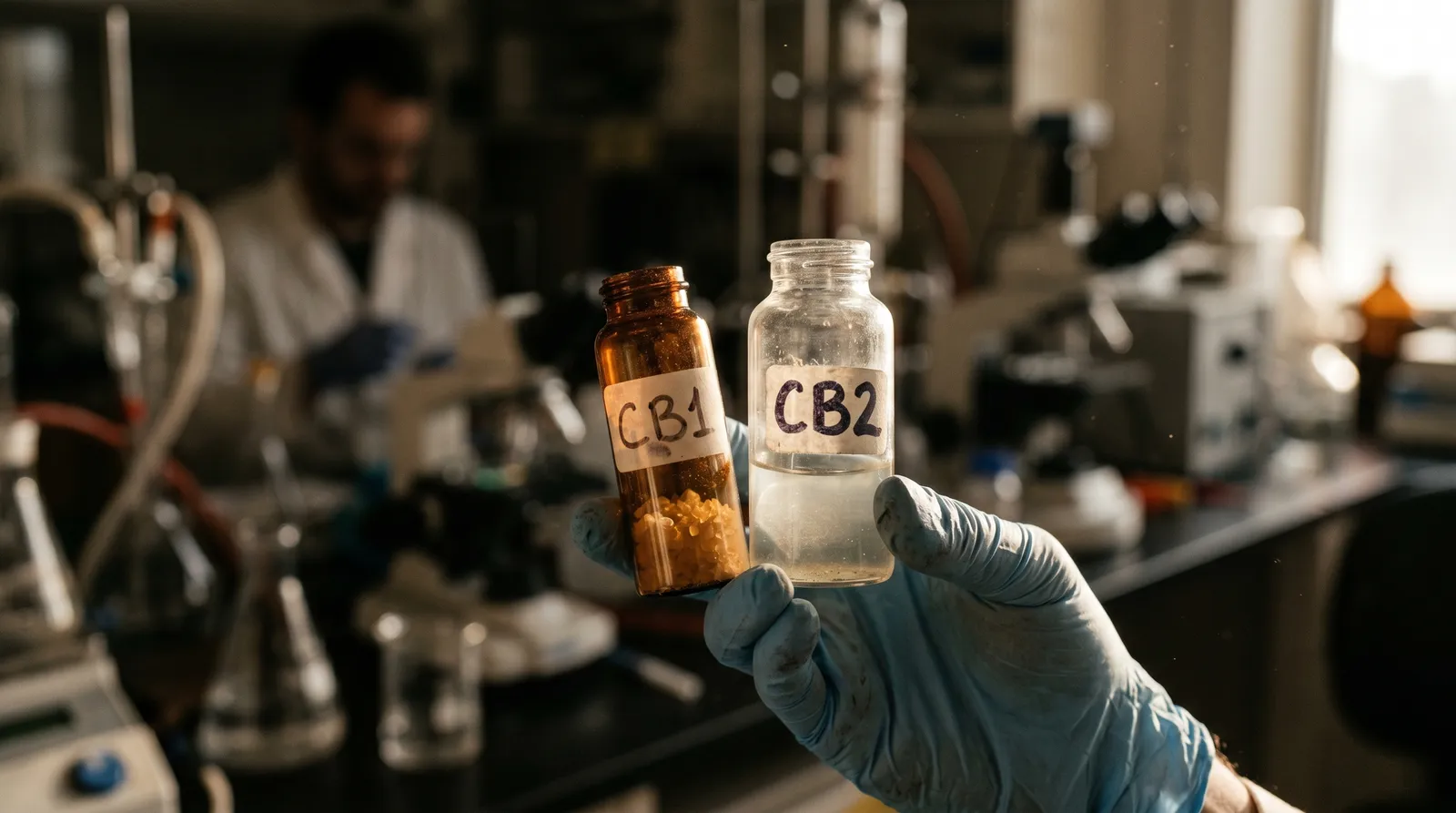
CB2 receptors were identified two years later, in 1993 (Munro et al., 1993). Their distribution is quite different. CB2 sits primarily on immune cells — macrophages, B-cells, T-cells — and in peripheral organs like the spleen. For years, CB2 was considered an exclusively peripheral receptor, but more recent imaging work has detected CB2 expression in the brainstem and microglial cells of the central nervous system as well (Atwood & Mackie, 2010), though at far lower levels than CB1.
Both receptors are G-protein-coupled receptors (GPCRs), meaning they sit on the cell surface and, when activated, trigger a cascade of intracellular events rather than letting molecules pass directly into the cell. Think of them less as doors and more as doorbells: pressing the button does not open the door, but it sets off a chain of activity inside the house.
There is growing evidence for additional receptor targets beyond CB1 and CB2. GPR55, sometimes called the "orphan receptor," responds to certain cannabinoids (Ryberg et al., 2007). TRPV1 — a receptor better known for detecting capsaicin heat — also interacts with anandamide. The picture is more complex than two neat locks and two neat keys, but CB1 and CB2 remain the best-characterised components of the endocannabinoid system explained in current scientific literature.
| Feature | CB1 | CB2 |
|---|---|---|
| Year identified | 1990 | 1993 |
| Primary location | Central nervous system (brain, spinal cord) | Immune cells, spleen, peripheral organs |
| Key brain regions | Basal ganglia, hippocampus, amygdala | Brainstem, microglia (low density) |
| Agonist profile of anandamide | Partial agonist | Lower affinity binding |
| Agonist profile of 2-AG | Full agonist | Full agonist |
Anandamide: The Bliss Molecule
Anandamide is the first endocannabinoid ever discovered, isolated in 1992 from pig brain tissue by Raphael Mechoulam and his team at the Hebrew University of Jerusalem (Devane et al., 1992). Its name comes from the Sanskrit word ānanda meaning bliss. Its chemical name — N-arachidonoylethanolamine, abbreviated AEA — is less poetic but more precise. Anandamide is a fatty acid derivative synthesised on demand from arachidonic acid in cell membranes. Unlike classical neurotransmitters such as serotonin or dopamine, which are pre-made and stored in vesicles waiting to be released, anandamide is built at the moment it is needed and broken down almost immediately afterward.

Anandamide is a partial agonist at CB1, meaning it activates the receptor but not to its maximum capacity. It also binds CB2, though with lower affinity. This partial-agonist profile is one reason anandamide produces subtler signalling than tetrahydrocannabinol (THC), the plant cannabinoid that acts as a more potent CB1 agonist. Anandamide's effects are also kept brief by the enzyme fatty acid amide hydrolase (FAAH), which breaks it down into arachidonic acid and ethanolamine within minutes of its release (Cravatt et al., 1996).
Interestingly, a small percentage of the European population carries a genetic variant (FAAH C385A) that reduces FAAH activity, resulting in naturally higher circulating anandamide levels. A 2015 study found that carriers of this variant reported lower anxiety scores on standardised measures (Dincheva et al., 2015) — though the relationship between anandamide levels and subjective experience is not straightforward, and many other variables are involved.
2-AG: The Other Endocannabinoid
2-arachidonoylglycerol (2-AG) is the most abundant endocannabinoid in the brain, present at concentrations roughly 170 times higher than anandamide (Sugiura et al., 2006). Discovered independently by Mechoulam's group and Sugiura's group in 1995, 2-AG is a full agonist at both CB1 and CB2 — it activates the receptors more completely than anandamide does. Its primary degradation enzyme is monoacylglycerol lipase (MAGL), not FAAH.

Where anandamide appears to function as a fine-tuning signal, 2-AG seems to handle heavier-duty signalling — particularly in retrograde neurotransmission, where a postsynaptic neuron sends 2-AG backward across the synapse to tell the presynaptic neuron to dial down its activity. This retrograde mechanism is one of the endocannabinoid system's primary tools for preventing excessive neuronal firing.
Retrograde Signalling: How the ECS Works in Practice
Retrograde signalling is the mechanism by which the endocannabinoid system corrects overactive neural circuits in real time. Classical neurotransmission runs in one direction: neuron A releases a chemical that crosses the synapse and activates neuron B. The endocannabinoid system runs backward. When neuron B is overstimulated, it synthesises endocannabinoids (primarily 2-AG) from its own membrane lipids and sends them back across the synapse to CB1 receptors on neuron A. This tells neuron A to reduce its output — a built-in volume knob (Wilson & Nicoll, 2001).
This retrograde mechanism operates in both excitatory and inhibitory circuits, which means the ECS can dampen overactive signalling regardless of whether the original signal was "go" or "stop." The result is a system that promotes homeostasis — not by pushing physiology in one direction, but by correcting whichever direction has gone too far.
Where Plant Cannabinoids Fit In
Plant cannabinoids interact with the same endocannabinoid system explained above, but they behave differently from the molecules your body makes. THC, for instance, is a partial agonist at CB1 with higher binding affinity than anandamide and a much longer half-life, because human enzymes break it down far more slowly than they break down endocannabinoids (Pertwee, 2008).

CBD does not bind CB1 or CB2 with significant affinity. Instead, research suggests it acts through several indirect mechanisms: it may inhibit FAAH, thereby slowing anandamide breakdown and temporarily raising anandamide tone (Bisogno et al., 2001); it modulates GPR55 and TRPV1; and it appears to act as a negative allosteric modulator at CB1, subtly changing the receptor's shape so that other agonists (including THC) bind less effectively (Laprairie et al., 2015). The pharmacology is still being mapped — CBD's interaction with the ECS is real but indirect, and characterising it as simply "binding to cannabinoid receptors" would be inaccurate.
This distinction matters for anyone reading about CBD products. If you want to explore how CBD interacts with your own endocannabinoid system, you can buy CBD oil from brands like Cibdol that provide third-party lab reports confirming cannabinoid content. The ECS is not a single switch that plant cannabinoids flip on or off. It is a distributed signalling network, and different cannabinoids modulate it through different pathways, at different intensities, with different durations. The research is active and far from settled — a 2020 review noted that CBD has been reported to interact with over 65 molecular targets, many outside the classical ECS (Ibeas Bih et al., 2015), though the physiological significance of each interaction at consumer-relevant doses remains an open question.
The Clinical Endocannabinoid Deficiency Hypothesis
Clinical endocannabinoid deficiency (CED) is a speculative hypothesis suggesting that some conditions involve chronically low endocannabinoid tone. Proposed by neurologist Ethan Russo in 2001 (Russo, 2004), the idea remains unproven, though Russo updated the hypothesis in 2016 with additional observational data (Russo, 2016). It is worth knowing about because it appears frequently in popular CBD writing, often stated as established fact rather than as the working hypothesis it actually is. The evidence base is preliminary, and no diagnostic test for endocannabinoid deficiency currently exists.

Endocannabinoid System Compared to Other Signalling Networks
The endocannabinoid system is often discussed in isolation, but comparing it to other neurotransmitter systems highlights what makes it unusual. Most signalling networks — serotonergic, dopaminergic, GABAergic — operate in the forward direction: a presynaptic neuron releases a transmitter that acts on the postsynaptic cell. The ECS is one of very few systems that routinely signals backward, giving the receiving neuron a way to regulate its own input.

| Feature | Endocannabinoid System | Serotonergic System | Dopaminergic System |
|---|---|---|---|
| Signal direction | Retrograde (backward) | Anterograde (forward) | Anterograde (forward) |
| Transmitter synthesis | On demand from membrane lipids | Pre-made and stored in vesicles | Pre-made and stored in vesicles |
| Primary transmitters | Anandamide, 2-AG | Serotonin (5-HT) | Dopamine |
| Breakdown speed | Seconds to minutes | Reuptake and MAO metabolism | Reuptake and COMT/MAO metabolism |
| Primary function | Homeostatic modulation | Mood, appetite, sleep regulation | Reward, motivation, motor control |
This comparison also shows an honest limitation of current ECS research: because the endocannabinoid system modulates so many other systems simultaneously, isolating its specific contribution to any single physiological outcome is methodologically challenging. Researchers at the Beckley Foundation have noted that this complexity is one reason translating preclinical cannabinoid findings into clinical applications has been slower than many anticipated.
Practical Context for CBD Users
Understanding the endocannabinoid system explained at this level of detail gives useful context when choosing CBD products, but it does not replace individual experience or professional guidance. The mechanistic picture — CBD inhibiting FAAH, modulating allosteric sites, interacting with TRPV1 — is drawn largely from cell-culture and animal studies. Human data at food-supplement doses remains limited and often conflicting, which is something we are upfront about at Azarius.

If you are new to CBD and want to get started, products like Cibdol CBD Oil offer a straightforward entry point with clearly labelled cannabinoid concentrations. For those who prefer capsules or topicals, the same endocannabinoid system principles apply regardless of delivery method — the route of administration affects onset time and bioavailability, not the underlying receptor pharmacology.
We genuinely do not know everything about how supplemental CBD modulates the ECS in living humans at the doses people actually take. That gap between mechanism and real-world outcome is the honest centre of the conversation. The ECS is real, it does interact with plant cannabinoids, and the science is genuinely interesting — but translating receptor-binding data into confident statements about what a given CBD oil does in your body at a given dose is a step the research has not yet reliably taken.
What We Know and What We Do Not
The endocannabinoid system is well established as a biological system — CB1, CB2, anandamide, 2-AG, FAAH, and MAGL are not speculative. Retrograde signalling via endocannabinoids is documented in hundreds of studies. What remains less clear is the precise clinical significance of modulating this system through exogenous cannabinoids at the doses present in consumer products. Most mechanistic research uses isolated cell cultures or animal models; human data at food-supplement doses (as opposed to pharmaceutical doses used in clinical trials) is limited and often conflicting.
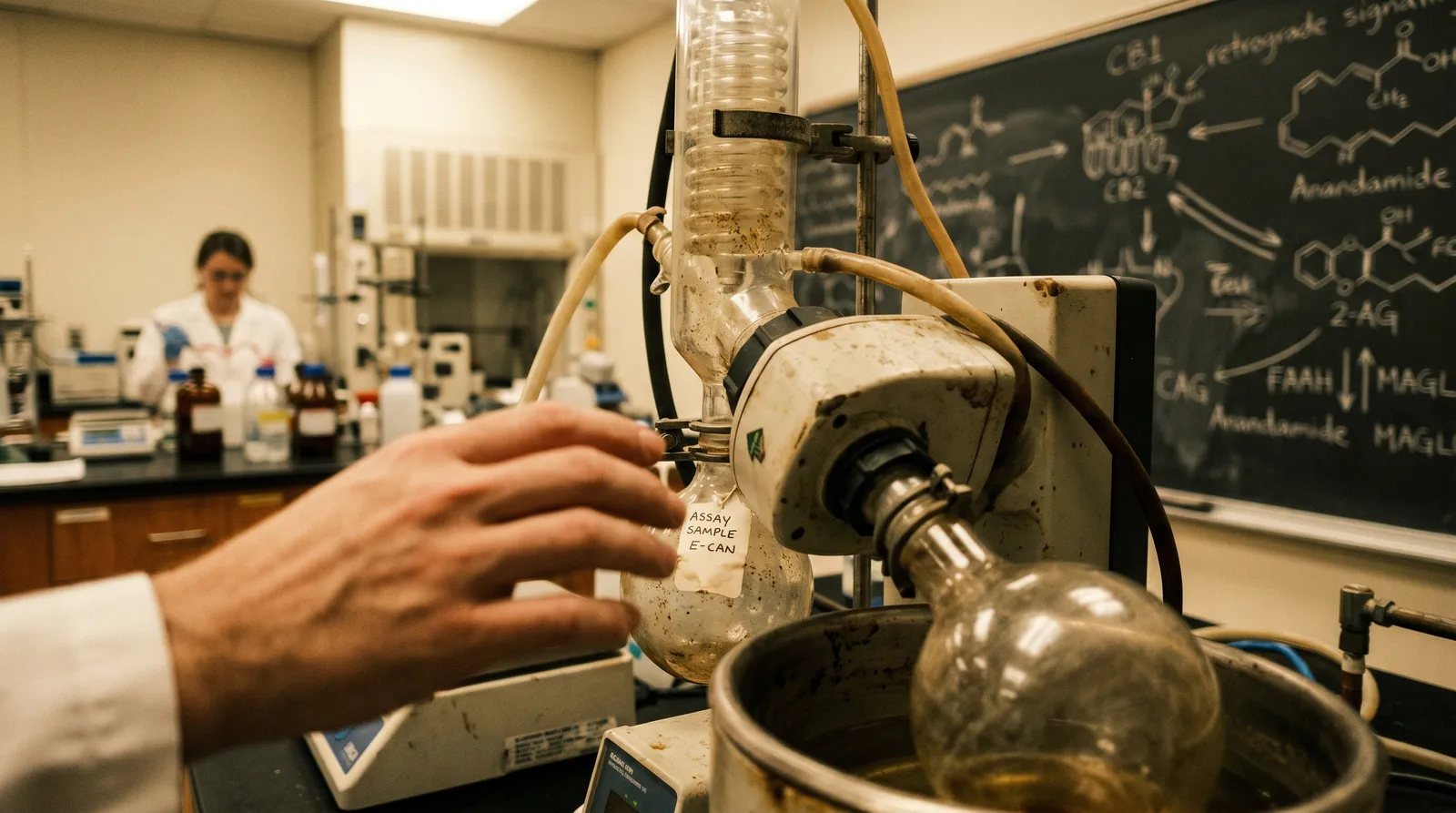
That gap between mechanism and real-world outcome is the honest centre of the conversation. The ECS is real, it does interact with plant cannabinoids, and the science is genuinely interesting — but translating receptor-binding data into confident statements about what a given CBD oil does in your body at a given dose is a step the research has not yet reliably taken.
---This article has been reviewed for factual and editorial accuracy by Toine Verleijsdonk (Cibdol brand manager) and Joshua Askew (Editorial Director). It has NOT been reviewed by a licensed medical practitioner and does not constitute medical advice.
Important: This article is consumer education and is not medical advice. CBD products are food supplements, not medicines. Research on CBD is ongoing and evidence remains limited or mixed for many topics. Talk to your doctor before use if you are pregnant, breastfeeding, taking medication, scheduled for surgery, or living with a health condition. Keep CBD products out of reach of children and pets.
References
- Atwood, B.K. & Mackie, K. (2010). CB2: a cannabinoid receptor with an identity crisis. British Journal of Pharmacology, 160(3), 467–479. DOI: 10.1111/j.1476-5381.2010.00729.x
- Bisogno, T. et al. (2001). Molecular targets for cannabidiol and its synthetic analogues. British Journal of Pharmacology, 134(4), 845–852. DOI: 10.1038/sj.bjp.0704327
- Cravatt, B.F. et al. (1996). Molecular characterization of an enzyme that degrades neuromodulatory fatty-acid amides. Nature, 384, 83–87. DOI: 10.1038/384083a0
- Devane, W.A. et al. (1992). Isolation and structure of a brain constituent that binds to the cannabinoid receptor. Science, 258(5090), 1946–1949. DOI: 10.1126/science.1470919
- Dincheva, I. et al. (2015). FAAH genetic variation enhances fronto-amygdala function in mouse and human. Nature Communications, 6, 6395. DOI: 10.1038/ncomms7395
- Ibeas Bih, C. et al. (2015). Molecular targets of cannabidiol in neurological disorders. Neurotherapeutics, 12(4), 699–730. DOI: 10.1007/s13311-015-0377-3
- Laprairie, R.B. et al. (2015). Cannabidiol is a negative allosteric modulator of the cannabinoid CB1 receptor. British Journal of Pharmacology, 172(20), 4790–4805. DOI: 10.1111/bph.13250
- Matsuda, L.A. et al. (1990). Structure of a cannabinoid receptor and functional expression of the cloned cDNA. Nature, 346, 561–564. DOI: 10.1038/346561a0
- McPartland, J.M. et al. (2006). Evolutionary origins of the endocannabinoid system. Gene, 370, 64–74. DOI: 10.1016/j.gene.2005.11.004
- Munro, S. et al. (1993). Molecular characterization of a peripheral receptor for cannabinoids. Nature, 365, 61–65. DOI: 10.1038/365061a0
- Pertwee, R.G. (2008). The diverse CB1 and CB2 receptor pharmacology of three plant cannabinoids. British Journal of Pharmacology, 153(2), 199–215. DOI: 10.1038/sj.bjp.0707442
- Russo, E.B. (2004). Clinical endocannabinoid deficiency (CECD). Neuro Endocrinology Letters, 25(1–2), 31–39. PMID: 15159679
- Russo, E.B. (2016). Clinical endocannabinoid deficiency reconsidered. Cannabis and Cannabinoid Research, 1(1), 154–165. DOI: 10.1089/can.2016.0009
- Ryberg, E. et al. (2007). The orphan receptor GPR55 is a novel cannabinoid receptor. British Journal of Pharmacology, 152(7), 1092–1101. DOI: 10.1038/sj.bjp.0707460
- Sugiura, T. et al. (2006). Biochemistry, pharmacology and physiology of 2-arachidonoylglycerol. Progress in Lipid Research, 45(5), 405–446. DOI: 10.1016/j.plipres.2006.03.003
- Wilson, R.I. & Nicoll, R.A. (2001). Endogenous cannabinoids mediate retrograde signalling at hippocampal synapses. Nature, 410, 588–592. DOI: 10.1038/35069076
Last reviewed: 2025-07-25
Last updated: April 2026
Frequently Asked Questions
7 questionsWhat is the difference between anandamide and 2-AG?
Does CBD bind directly to CB1 or CB2 receptors?
What is clinical endocannabinoid deficiency?
Do all animals have an endocannabinoid system?
How does retrograde signalling work in the endocannabinoid system?
What enzymes break down endocannabinoids and how do they work?
What are CB1 and CB2 receptors and where are they located in the body?
About this article


Luke Sholl has been writing about cannabis, cannabinoids, and the broader benefits of nature since 2011, and has personally grown cannabis in home grow tents for more than a decade. That first-hand cultivation experience
This wiki article was drafted with AI assistance and reviewed by Luke Sholl, External contributor since 2026. Editorial oversight by Toine Verleijsdonk.
Medical disclaimer. This content is for informational purposes only and does not constitute medical advice. Consult a qualified healthcare provider before use of any substance.
Last reviewed April 25, 2026
Related Articles

Pinene Alpha and Beta: Aroma, Chemistry & Vaporisation Guide
Pinene is a bicyclic monoterpene occurring as two isomers — α-pinene and β-pinene — and ranks as the most abundant terpene in the plant kingdom.

CBD and Recovery: What the Research Actually Shows
CBD and recovery is a research topic spanning exercise-induced muscle damage, sleep quality, and perceived soreness. As McCartney et al.

CBD Pet Dosing Vet Consultation: Prepare for Your Visit
Veterinary CBD dosing is not a scaled-down version of human dosing — dogs and cats metabolise cannabidiol through different enzymatic pathways and at…

CBD for Cats Veterinary Considerations: Feline Research, Safety and Guidance
Cats metabolise cannabinoids differently from dogs and humans, lacking key glucuronidation enzymes that affect CBD clearance. Deabold et al.

EU Novel Food Regulation CBD: Country Status, EFSA Safety & Guide
EU novel food regulation CBD is a policy framework under EU rule 2015/2283 that classifies cannabidiol extracts as a novel food, requiring safety assessment…
CBD Topical Creams Medical Grade: CE-Marked Class I Explained
CBD topical creams deliver cannabidiol directly to the skin rather than the bloodstream.
Humulene Effects and Aroma Profile | Terpene Guide
Humulene (α-humulene) is a monocyclic sesquiterpene named after Humulus lupulus — hops.

Terpene Entourage Effect: Current Evidence Reviewed
The terpene entourage effect proposes that cannabis terpenes modulate cannabinoid activity, producing different outcomes than isolated compounds alone.
CBD and Skin Conditions: What Research Shows
Cannabidiol (CBD) interacts with the endocannabinoid system expressed in human skin — including CB1 and CB2 receptors on keratinocytes, sebocytes, and…