
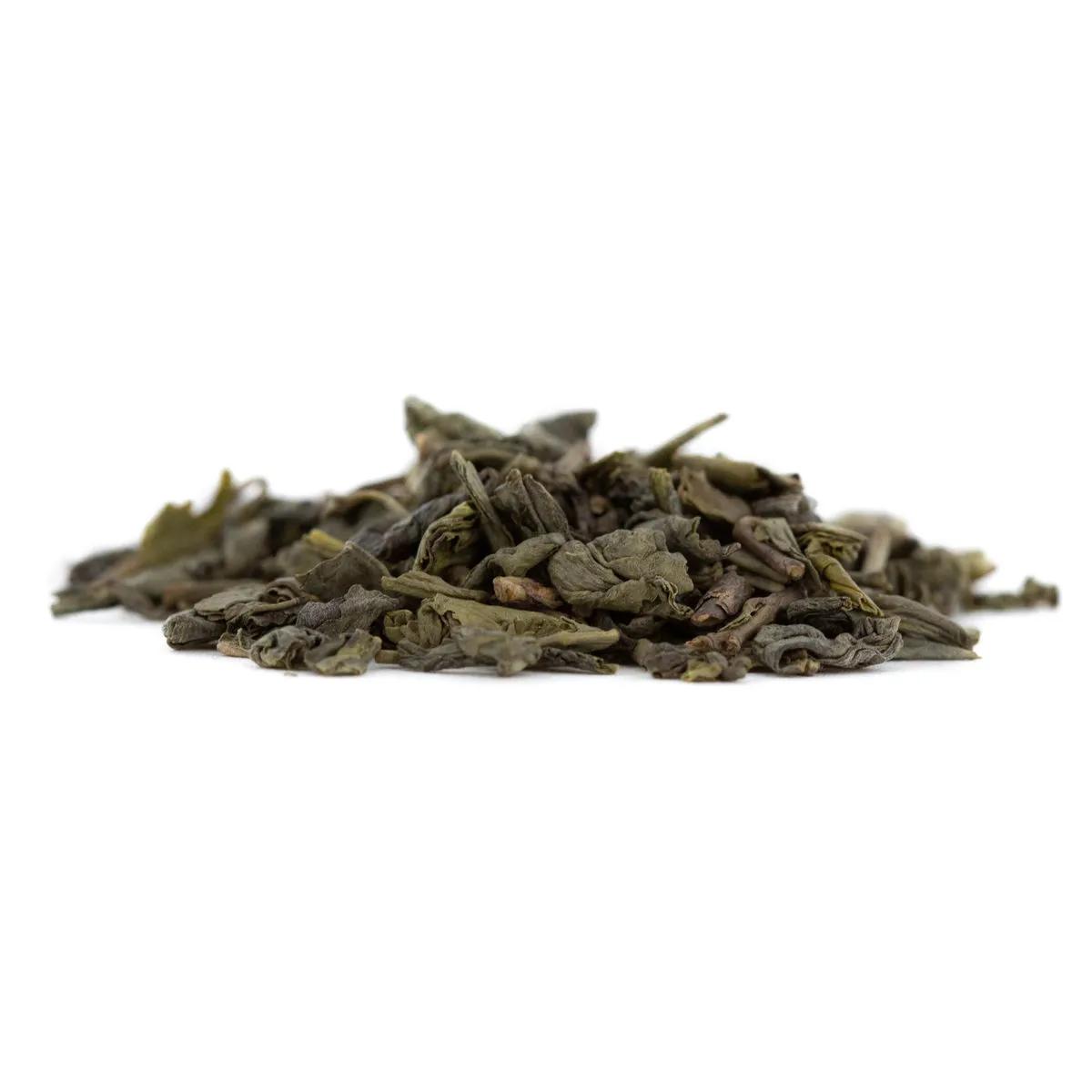
Gunpowder Tea — Tang Dynasty Green Tea in Pellet Form
Gunpowder tea is a Chinese green tea made from tightly rolled Camellia sinensis leaves that unfurl when steeped in hot water, releasing a distinctly smoky, nutty brew. Originating in the Zhejiang Province during the Tang Dynasty (618–907 AD), this is one of the oldest continuously produced tea styles on the planet — and it's still going strong over a thousand years later. The pellet shape isn't just for show: rolling the withered leaves into small, dense balls preserves freshness and flavour far longer than loose-leaf alternatives. Each pellet is good for up to five infusions, which makes a 100g bag go further than you'd expect.
| Specification | Detail |
|---|---|
| Botanical name | Camellia sinensis |
| Origin | Zhejiang Province, China |
| Tea type | Green tea (rolled pellet) |
| Form | Dried, tightly rolled pellets |
| Pack size | 100 g |
| SKU | SM0206 |
| Suggested serving | 1 level teaspoon (~2 g) per 240 ml |
| Reinfusions | Up to 5 per serving |
| Steep time | 2–3 minutes at 70–80 °C |
| Taste profile | Smoky, nutty, slightly vegetal |
Why Gunpowder Green Tea Deserves a Spot in Your Cupboard
Most green teas lose their punch within a few months of opening. Gunpowder tea's tightly rolled pellets slow oxidation, meaning the leaves stay aromatic and flavourful much longer than flat-leaf varieties. Crack open the bag and you'll catch a whiff of roasted grain with a slight smokiness underneath — that's how you know the pellets are still fresh. If they smell flat or papery, the tea's past its best.
We've been stocking gunpowder tea for years, and the most common feedback from customers is surprise at the body of the brew. This isn't a delicate, grassy sip — it has weight. The smoky, nutty character stands up well on its own, but if you find the flavour a touch assertive, a spoonful of honey rounds things off nicely. Some regulars blend it into smoothies or use it as a base for Moroccan-style mint tea, which is arguably where gunpowder green tea really shines.
One honest limitation: because the pellets are so tightly compressed, they need a moment to open up. If you're used to the instant colour burst of a teabag, the first 30 seconds in the cup can look underwhelming. Give it time. By the 2-minute mark the water turns a rich golden-green and the flavour develops fully. Rushing it with boiling water (100 °C) will scorch the leaves and turn the brew bitter — stick to 70–80 °C for the best results.
What Makes Gunpowder Tea Interesting Beyond the Flavour
Green tea has been the subject of thousands of studies, and gunpowder tea specifically has caught researchers' attention for its chemical profile. According to a 2023 study on catechin composition, gunpowder green tea showed higher total phenolic content and greater CUPRAC (cupric ion reducing antioxidant capacity) and ORAC values compared to several other green tea formats (PMC, 2023). In plain language: the rolling process appears to concentrate certain antioxidant compounds rather than diminish them.
The catechins in green tea — particularly ECG and EGCG — have drawn significant research interest. According to a review in Molecules, green tea catechins may positively affect brain function, improving cognitive performance, mood, and concentration, while the presence of L-theanine modulates caffeine's stimulant effect (PMC, 2020). That's the reason a cup of green tea tends to feel different from a cup of coffee — alert but not jittery, at least in moderate amounts.
Research has also looked at green tea polyphenols in broader contexts. According to a study published in Frontiers in Microbiology, the polyphenols in green tea are associated with potential protective effects against cardiovascular concerns (PMC, 2019). And a large-scale observational study found that cumulative tea consumption was associated with a lower risk of liver cancer compared to non-tea drinkers (PMC, 2023). None of this means gunpowder tea is medicine — but the body of research on Camellia sinensis is substantial enough to make a daily cup feel like a reasonable habit.
How to Brew Gunpowder Green Tea
- Boil fresh water and let it cool to 70–80 °C. If you don't have a thermometer, let the kettle sit for 2–3 minutes after boiling — that gets you close enough.
- Measure 1 level teaspoon (roughly 2 g) of gunpowder pellets per 240 ml cup. For a stronger brew, add more tea rather than steeping longer — extra time just increases bitterness.
- Pour the water over the pellets and watch them slowly unfurl. Steep for 2–3 minutes. The liquid should turn a clear golden-green.
- Strain or remove the leaves. Taste it plain first, then add honey if you want to soften the smoky edge.
- Don't toss the leaves. Add another 30 seconds to the steep time for each subsequent infusion — most pellets are good for up to 5 rounds. The flavour shifts subtly with each pour, getting lighter and more floral.
Gunpowder tea makes an excellent base for blended brews. Pair it with dried peppermint for a traditional Moroccan-style mint tea, or try it alongside other loose herbs from our vape herbs and botanicals range. A fine-mesh tea strainer or infuser ball keeps the pellets contained and makes multiple infusions effortless.
Gunpowder Tea at a Glance — Quick Comparison
| Feature | Gunpowder Green Tea | Loose-Leaf Sencha | Matcha Powder |
|---|---|---|---|
| Leaf form | Rolled pellets | Flat needle-shaped leaves | Stone-ground powder |
| Flavour profile | Smoky, nutty, full-bodied | Grassy, light, slightly sweet | Rich, umami, creamy |
| Reinfusions | Up to 5 | 2–3 | Single use |
| Brew temperature | 70–80 °C | 70–80 °C | 70–80 °C (whisked) |
| Preparation effort | Low — steep and strain | Low — steep and strain | Medium — sift and whisk |
| Shelf stability | High (pellets slow oxidation) | Moderate | Low (oxidises quickly once opened) |
| Best for | Daily drinkers who want body and smokiness | Those who prefer a lighter, gentler cup | Ritual-focused preparation, full leaf consumption |
Frequently Asked Questions
What is gunpowder tea?
Gunpowder tea is a green tea from China's Zhejiang Province where withered Camellia sinensis leaves are rolled into small, tight pellets. The name likely comes from the pellets' resemblance to gunpowder grains. When steeped in hot water, the balls unfurl and release a smoky, nutty brew. Production dates back to the Tang Dynasty (618–907 AD).
Why is it called gunpowder tea?
The most widely accepted explanation is that the small, dark, tightly rolled pellets look like grains of gunpowder. When Europeans first encountered this tea in the 16th century, the resemblance was apparently too obvious to ignore, and the name stuck.
How much caffeine does gunpowder tea contain?
Roughly 35–40 mg per 240 ml cup, comparable to other green teas. The dense pellet form makes it easy to use more leaf than intended, which increases caffeine content. If you're sensitive, measure carefully — 2 g per cup is the standard.
How many times can you reinfuse gunpowder tea pellets?
Up to five times. Add about 30 seconds to the steep time for each subsequent infusion. The flavour shifts from smoky and robust in the first cup to lighter and more floral by the fourth or fifth.
Can you cold-brew gunpowder tea?
Yes. Use the same ratio (2 g per 240 ml) and steep in cold water for 4–6 hours in the fridge. Cold brewing produces a smoother, less astringent cup with slightly less caffeine extraction. The smoky notes become subtler, letting the nutty sweetness come through.
Does gunpowder tea taste bitter?
Only if you brew it wrong. Water above 80 °C or steep times longer than 3 minutes pull out excess tannins, which cause bitterness. Keep the temperature at 70–80 °C and time it properly. If you still find it strong, a touch of honey smooths things out.
Is gunpowder tea good for Moroccan mint tea?
It's the traditional base. The smoky body of gunpowder green tea pairs brilliantly with fresh spearmint. Brew the gunpowder pellets first, then add a generous handful of mint leaves and sweeten to taste. It's one of the best uses for this tea.
Last updated: April 2026