RAW Cone Tips Maestro — Pre-Scored Rolling Tips for a Proper Cone Shape
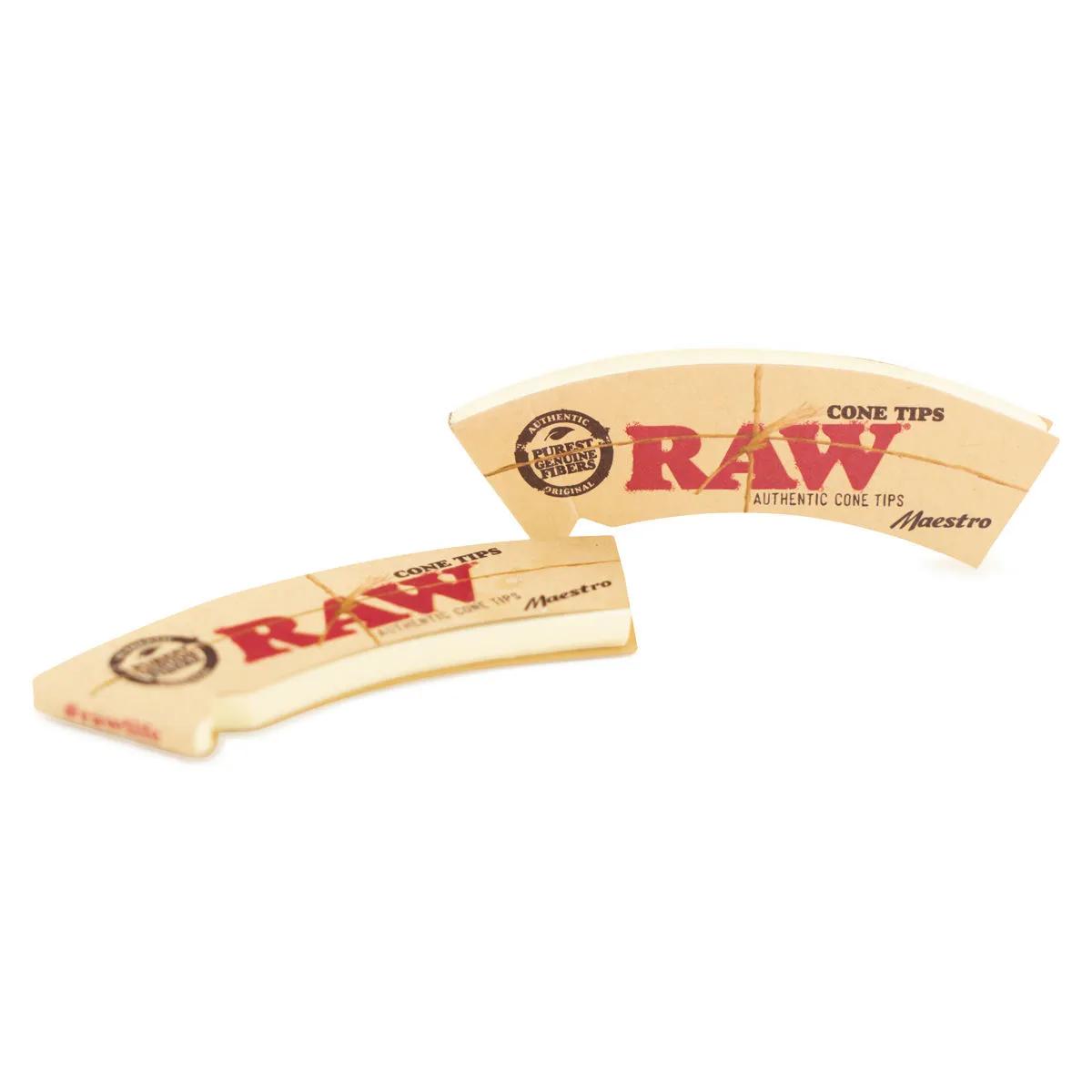
The RAW Cone Tips Maestro is a booklet of 32 pre-perforated rolling tips designed to give you a consistent cone-shaped filter every time you roll. RAW built these with inner score lines that guide your fold into a "W" or "Z" pattern before you roll the tip into shape — no guesswork, no wonky cones, no filters that collapse halfway through a session.
What Makes These RAW Cone Tips Different from Standard Roaches
Standard roach card gives you a blank rectangle and leaves the rest to your fingers. The Maestro tips come with perforated lines already pressed into the card, so you fold along them to create an internal accordion shape — a "W" or "Z" — that holds its structure inside the cone. That internal shape stops herb from pulling through into your mouth and keeps airflow open right to the last draw.
The card itself is unbleached. You can feel the difference — it has a slightly rougher, more fibrous texture compared to glossy white card. No chlorine, no dyes, just natural plant fibres. RAW has built their entire brand around this approach, and the Maestro tips are one of the tidier expressions of it. They're thinner than you'd expect from a filter tip, which makes them easier to roll tightly without bulking out the end of your joint.
One honest limitation: if you've got your own folding technique dialled in and you like a flat concertina filter, these perforations might actually get in your way. The score lines are designed for cone rolling specifically. If you prefer a straight cylindrical tip, the standard RAW tips without perforations are a better match. The Maestro is purpose-built for cones — that's its strength and its constraint.
| Spec | Value |
|---|---|
| Brand | RAW |
| Product | Cone Tips Maestro |
| SKU | HS0457 |
| Tips per booklet | 32 |
| Material | Unbleached natural fibres |
| Feature | Inner perforations for guided folding |
| Tip shape | Cone (when rolled as intended) |
| Fold patterns | "W" or "Z" accordion |
Complete your rolling setup with RAW Classic King Size Slim papers — the unbleached, ultra-thin papers that pair naturally with these Maestro tips. If you want a grinder that produces an even, fluffy consistency for cone packing, the RAW Life Grinder is worth a look.
Why You Actually Want Pre-Scored Rolling Tips
We've watched people roll thousands of joints over the years, and the filter tip is where most of them go wrong. Either it's too loose and collapses when you draw, or it's rolled so tight that airflow chokes off completely. The cone shape adds another layer of difficulty — you need the tip narrower at one end and wider where it meets the paper, which is genuinely tricky to do freehand with a flat piece of card.
The Maestro tips solve this by doing the measuring for you. The perforations are spaced so that when you fold along them, the resulting accordion naturally forms a tighter core that fans out into a wider opening. Roll that into a cone and you get a structurally sound filter that doesn't need to be re-adjusted every few minutes. It's a small thing, but it's the difference between a joint that smokes evenly and one that canoes or clogs.
At under a euro per booklet, this is the kind of accessory you throw in the basket and forget about until you actually use it — and then wonder why you ever bothered tearing up business cards. Thirty-two tips last a decent while too, especially if you're not rolling daily.
How to Use RAW Cone Tips Maestro
- Tear one tip from the booklet along the top perforation. Each tip separates cleanly.
- Fold along the inner perforated lines to create a "W" or "Z" shape. You'll feel the score lines — they guide your fingers naturally. Alternatively, strip off the perforated section entirely, fold your preferred accordion shape freehand, then continue to step 3.
- Starting from the folded accordion end, roll the remaining flat card around it into a cone shape. The accordion should sit at the narrow end of the cone.
- Let the tip expand slightly to its natural tension — don't force it flat. It should hold its shape on its own.
- Place the cone tip at the end of your rolling paper and pack or roll your joint around it. The wider end of the cone faces the herb, the narrow end faces your mouth.
- Once rolled, the internal "W" or "Z" structure blocks loose material from pulling through while keeping airflow smooth and consistent.