We'll only email you about this product — no marketing.
Boost Buddy CO2 Boost — Passive CO2 for Small Grow Spaces
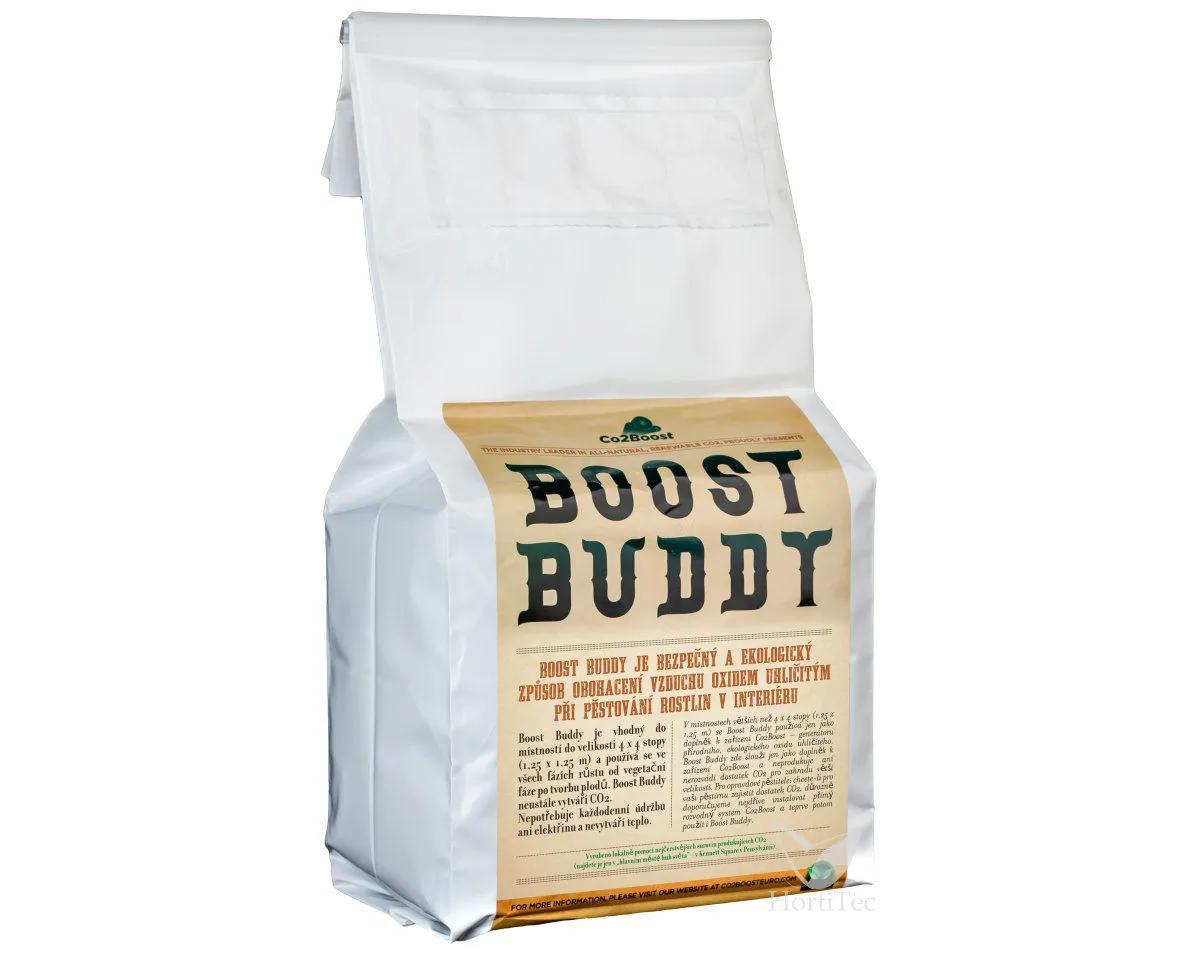
The Boost Buddy is the simplest CO2 boost for grow tent setups that need elevated carbon dioxide without electricity, tanks, or regulators. This self-contained CO2 generator feeds your plants a steady stream of carbon dioxide using a blend of 15 organic ingredients that naturally produce CO2 through microbial activity — then turns into compost when the 6-month lifespan is up. Designed for grow tents and greenhouses up to 1.2 x 1.2 metres, there are no bottles, no regulators, no refills. Just open the lid and let it work. Buy the Boost Buddy when you're ready to push a healthy grow further without adding complexity.
Why CO2 Supplementation Matters in a Small Grow Space
Ambient CO2 in a sealed grow tent sits around 400 ppm, but plants can use up to 1,200–1,500 ppm before hitting diminishing returns. That means in a closed tent with decent lighting and nutrients, CO2 is often the bottleneck you didn't know you had. The difference between 400 ppm and even 800 ppm can mean visibly thicker stems, faster vegetative growth, and denser canopy coverage. According to EMCDDA-referenced agricultural research and findings echoed by the Beckley Foundation's broader plant science reviews, elevated CO2 during the light cycle directly accelerates photosynthetic rates in enclosed cultivation environments. We've seen growers blame their lights or their feed schedule when the real issue was stale, CO2-depleted air sitting around the leaves.
The catch? Most CO2 systems — compressed tanks, burners, electronic controllers — are built for large commercial rooms. They're overkill for a 1.2 x 1.2 m tent, both in cost and in complexity. You don't need a solenoid valve and a digital controller when you've got four plants in a corner. That's exactly the gap the Boost Buddy fills as a CO2 boost for grow tent setups that are compact and sealed.
One honest limitation: passive CO2 bags and buckets don't give you precise ppm control the way a tank-and-regulator setup does. You can't dial in exactly 1,000 ppm and hold it there. What you get is a consistent, gentle elevation above ambient levels — enough to make a real difference in a small, enclosed space, but not a replacement for a full injection system in a 3 x 3 m room. For tents up to 1.2 x 1.2 m, though, the Boost Buddy is the best passive CO2 option we carry. It outperforms homemade sugar-and-yeast setups by a wide margin — no fermentation smell, no daily babysitting, no sticky mess when the bottle tips over.
What's Inside the Boost Buddy
The Boost Buddy contains a proprietary blend of 15 organic ingredients — including mycelium substrates, organic carbon sources, and microbial cultures — that produce CO2 as a metabolic byproduct. It's essentially a living system in a bucket. You'll notice a faint earthy, mushroom-compost smell if you lean in close — not unpleasant, just organic. The bucket itself weighs a solid few kilos and feels dense, like a packed bag of potting soil. Nothing flimsy about it.
Because the ingredients are all organic, the Boost Buddy is fully compostable once it's spent. After 6 months of continuous CO2 output, tip the contents into your compost bin or mix it into your garden soil. Zero waste. Compare that to the pile of empty CO2 canisters or the electricity bill from running a CO2 burner — the environmental argument is straightforward. If you want a CO2 boost for grow tent cultivation that leaves no trace, this is it.
| Specification | Detail |
|---|---|
| Coverage area | Up to 1.2 x 1.2 metres |
| Active lifespan | 6 months continuous |
| Ingredients | 15 organic compounds (microbial CO2 generation) |
| Electricity required | None |
| Maintenance | None |
| Post-use disposal | Fully compostable |
| SKU | GS0026 |
How to Use the Boost Buddy
Setting up the Boost Buddy takes under two minutes with no tools or electricity required. Follow these steps to get your CO2 boost for grow tent cultivation running immediately.
- Remove the Boost Buddy from its packaging. Keep the bucket upright — the contents are packed and settled for transport.
- Open the lid or ventilation holes as directed on the bucket. The microbial process begins producing CO2 immediately upon exposure to air.
- Place the Boost Buddy inside your grow tent or greenhouse, ideally at canopy height or slightly above. CO2 is heavier than air and will sink downward over the plants.
- Keep your grow space reasonably sealed during the light cycle to let CO2 levels build. Some air exchange is fine — you still need fresh air — but a tent that's wide open will vent the CO2 before your plants can use it.
- No refilling, no stirring, no electricity. The Boost Buddy runs continuously for up to 6 months.
- Once output tapers off after 6 months, empty the spent contents into your compost heap or garden bed. The organic matter breaks down naturally.
Boost Buddy vs. Other CO2 Methods
The Boost Buddy outperforms DIY fermentation setups and costs a fraction of compressed CO2 systems for spaces up to 1.2 x 1.2 m. There are broadly three ways to add a CO2 boost to a grow tent: passive organic generators like the Boost Buddy, DIY fermentation setups (sugar, yeast, water), and compressed CO2 with a regulator. Here's how they stack up.
| Method | Setup effort | Maintenance | Lifespan | Precision | Cost over 6 months |
|---|---|---|---|---|---|
| Boost Buddy | Open lid, place in tent | None | 6 months | Moderate (passive) | One-time purchase |
| DIY yeast/sugar | Mix bottles, attach tubing | Remix every 1–2 weeks | 1–2 weeks per batch | Low and inconsistent | Ongoing (sugar, yeast) |
| Compressed CO2 tank | Tank, regulator, solenoid, controller | Refill tank, calibrate | Varies by tank size | High (adjustable ppm) | Tank refills + equipment |
For a small tent, the Boost Buddy hits the sweet spot. The compressed tank route costs several times more in equipment alone and is frankly designed for bigger rooms. The DIY route works in theory but falls apart in practice — inconsistent output, fruit flies, and the smell of fermenting sugar in your grow room. We'd pick the Boost Buddy over a DIY setup every time for anything under 1.5 x 1.5 m. Order the Boost Buddy alongside your other grow essentials to get the most out of your next cycle.
Complete your setup: pair the Boost Buddy with a clip-on circulation fan to distribute CO2 evenly across your canopy. If you're running a small tent, check out our 80x80 or 100x100 grow tents and complete grow kits in the Climate Control section — the Boost Buddy slots right in alongside your existing ventilation.
Frequently Asked Questions
How much CO2 does the Boost Buddy produce?
The Boost Buddy provides a continuous, passive CO2 output designed to elevate levels above the ambient 400 ppm within a 1.2 x 1.2 m space. It won't hit the 1,200–1,500 ppm range of a compressed tank system, but it consistently raises CO2 enough to support faster growth in a small, reasonably sealed tent.
Does the Boost Buddy need electricity or batteries?
No. The CO2 is generated by microbial activity inside the organic blend — a biological process, not a mechanical one. No power source, no wiring, no moving parts. You literally open it and place it in your tent.
Can I use the Boost Buddy in a larger grow space?
It's rated for spaces up to 1.2 x 1.2 metres. In a bigger room, the CO2 disperses too quickly to maintain elevated levels. For anything larger, you'd want to either use multiple units or step up to a compressed CO2 system with a regulator.
Does the Boost Buddy smell?
There's a mild earthy, composty scent if you put your nose right up to it — think damp forest floor. It's not strong enough to notice from across the room, and it won't affect the smell of your plants. Nothing like the yeasty stink of a DIY sugar fermentation setup.
When should I run the Boost Buddy — lights on or lights off?
During the light cycle. Plants only use CO2 for photosynthesis when light is available. Research into greenhouse supplementation suggests the best window is from 1–2 hours after lights on until 2–3 hours before lights off. Since the Boost Buddy runs continuously, good ventilation during the dark period will clear excess CO2.
Is the Boost Buddy safe to use in an enclosed tent?
Yes. The CO2 output is gentle and passive — nowhere near the levels that would cause issues in a small room. Standard grow tent ventilation is more than enough. Just don't seal yourself inside a tent with one for hours on end, which is good advice for any enclosed growing space regardless.
What do I do with the Boost Buddy after 6 months?
Compost it. The spent organic material breaks down naturally and makes a decent soil amendment. The bucket itself is recyclable. No hazardous waste, no special disposal needed.
Last updated: April 2026