
This article discusses psychoactive substances intended for adults (18+). If you have a health condition or take medication, consult a doctor before use. Our age policy
SCROG Screen of Green: Cannabis Training Guide
Definition
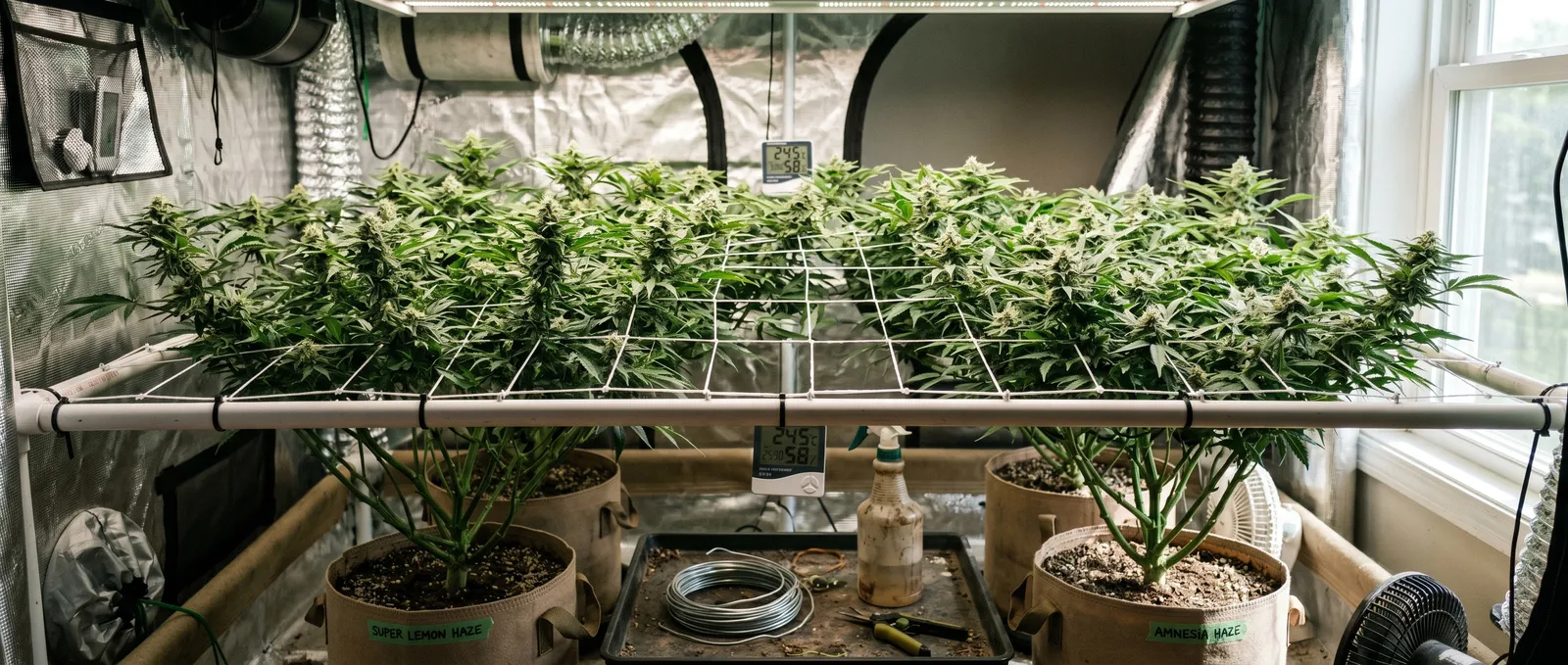
SCROG (Screen of Green) is a cannabis training method that weaves branches through a horizontal mesh during late veg and early flower, flattening the canopy so every bud site hits the 600–1,000 PPFD light range that drives flower development (Chandra et al., 2015). It maximises yield per watt in small indoor spaces.
Adult use only — this guide is written for adults aged 18 and over. Cannabis cultivation rules vary by country and region and change frequently. This guide is educational.
SCROG screen of green is a cannabis training method that weaves branches through a horizontal mesh during late veg and early flower, flattening the canopy so light hits every bud site evenly. It's one of the highest yield-per-watt techniques available to indoor growers with limited vertical space. Done properly, a single photoperiod plant can fill an 80x80 tent with an even carpet of colas instead of one dominant top and a pile of sad popcorn underneath. Growers who buy quality genetics and get the veg timing right consistently outperform those chasing fancy nutrients — order your seeds early so you can get the veg phase started without delay.
This guide walks through the actual steps — screen setup, timing, tucking, and when to stop. We'll also flag where SCROG goes wrong, because the failure modes are more instructive than the theory.
Why the screen works (brief)
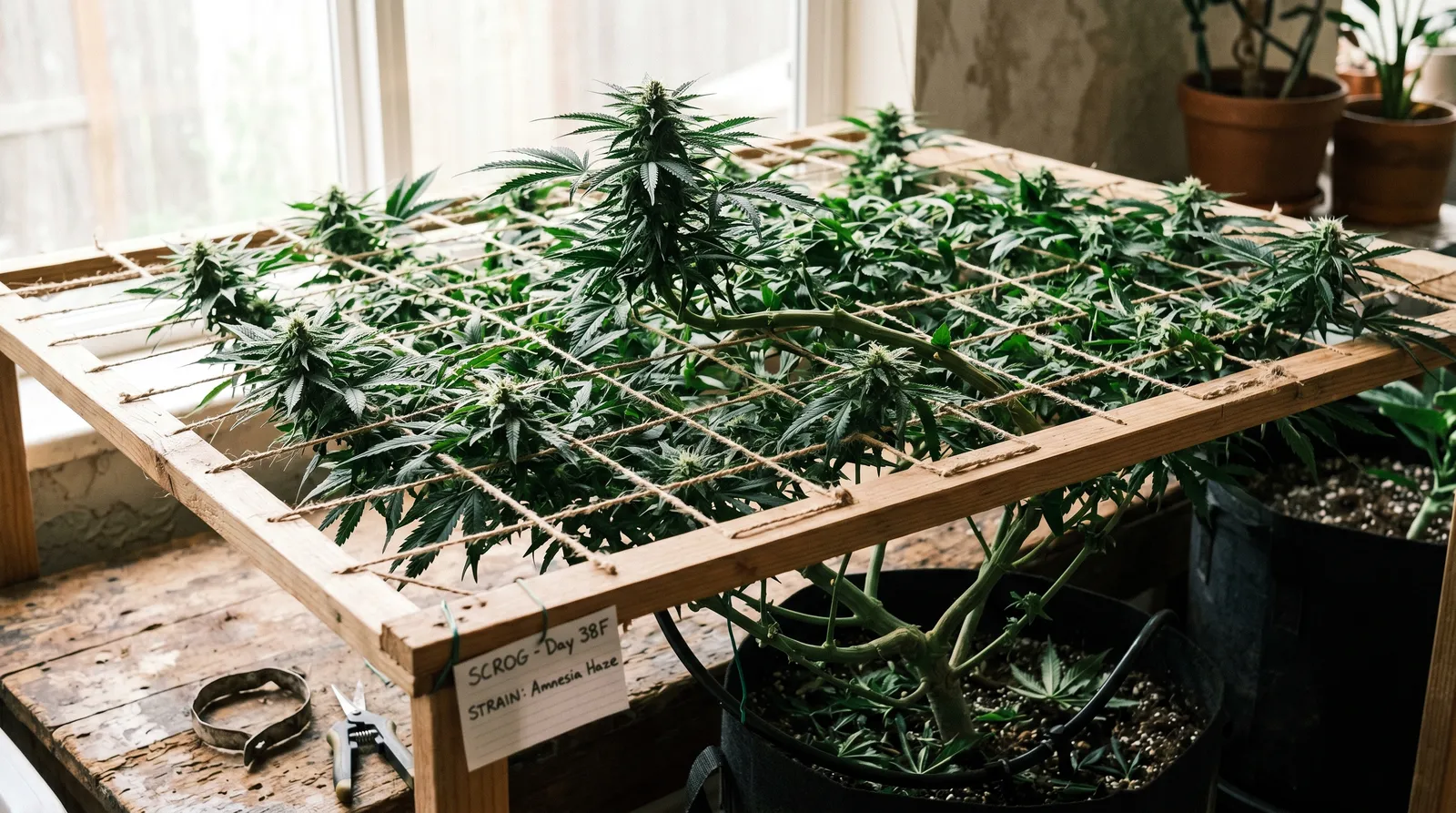
The screen works because it defeats apical dominance — the top cola hogs hormones and light, leaving lower branches underdeveloped. A horizontal screen at canopy height breaks that hierarchy. By pulling every branch out to the edges of the grid, you expose more bud sites to direct light. Published PPFD targets for flowering cannabis sit around 600–1,000 µmol/m²/s (Chandra et al., 2015); SCROG lets you deliver that intensity to 30+ tops instead of 3–4, which is where the yield bump comes from.
It's a photoperiod technique in practice. Autoflowers flower on age and have short, unpredictable veg windows — by the time you've woven the screen, they're already stretching into flower. Stick to feminised or regular photoperiod seeds if SCROG is the plan.
SCROG at a glance
The SCROG screen of green method sits between SOG and untrained growing on nearly every axis. The table below compares them so you can see where the technique pays off.
| Parameter | SCROG | SOG | Untrained |
|---|---|---|---|
| Plants per m² | 1–4 | 12–20 | 1–4 |
| Veg time | 4–8 weeks | 1–2 weeks | 3–5 weeks |
| Training effort | High (daily tucking) | None | None |
| Flower time | 8–10 weeks | 8–9 weeks | 8–10 weeks |
| Yield per plant | Very high | Low | Medium |
| Yield per m² | High | High | Medium |
Step 1: Pick genetics that actually suit the screen
Genetics decide roughly 60% of your SCROG outcome before you ever touch the screen. You want:
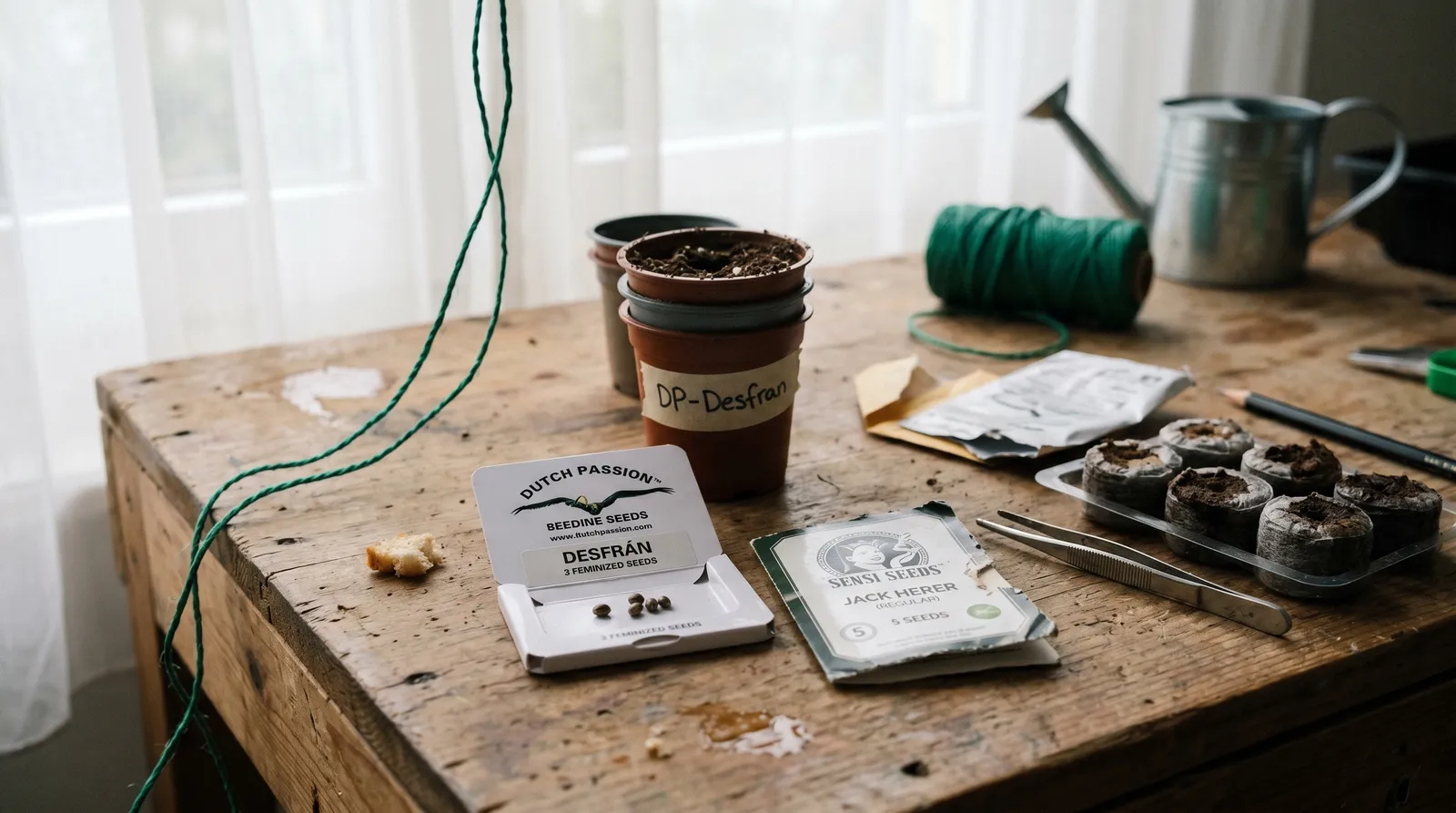
- Stretchy, sativa-leaning hybrids — they respond well to bending and fill screen space fast. Think Amnesia Haze types, Jack Herer crosses, Super Silver Haze lineage.
- Flexible stems — indicas that stay squat and woody (classic Kush phenotypes) are harder to weave and tend to snap.
- Low plant counts — SCROG typically runs 1–4 plants per screen. One plant trained well can fill a 1m² screen given enough veg time.
Breeder names worth knowing here: Dutch Passion's Desfrán and Sensi Seeds' Jack Herer are both classic SCROG candidates because of their branch structure. If you buy seeds with SCROG in mind, check breeder documentation for stretch ratios before committing.
Step 2: Build or buy the screen
Grid size matters more than material. Squares should be 5–10cm (2–4 inches). Smaller squares give more control but make tucking fiddly; larger squares allow branches to slip through and undo your work.
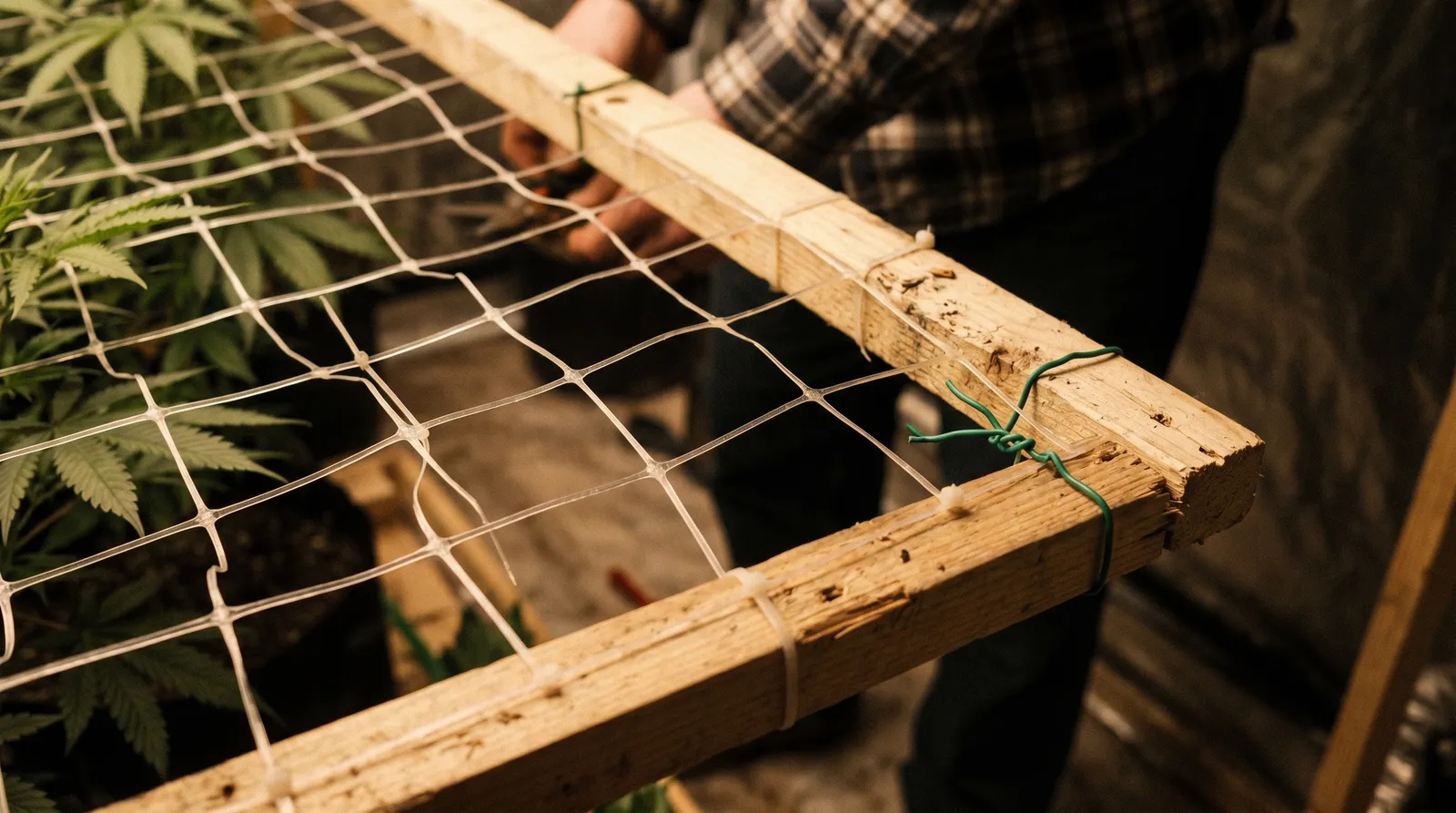
Materials:
- Trellis netting — cheap, disposable, 5cm squares. Plastic or soft nylon. Fine for one grow.
- Rigid PVC frame with stretched string — reusable, tensionable, DIY-friendly.
- Bamboo + garden twine — the tent-floor classic. Works if you're careful.
Height: mount the screen 20–40cm above the top of the pot. In an 80x80 tent with a 1m veg height, 25cm is a sensible starting point. Too low and you can't tuck under it; too high and plants punch through before the screen does anything useful.
Step 3: Veg long enough, top early
SCROG eats veg time — plan for 4–8 weeks minimum. You need a bushy plant with 4–8 main branches before the screen goes anywhere near the canopy. That means:
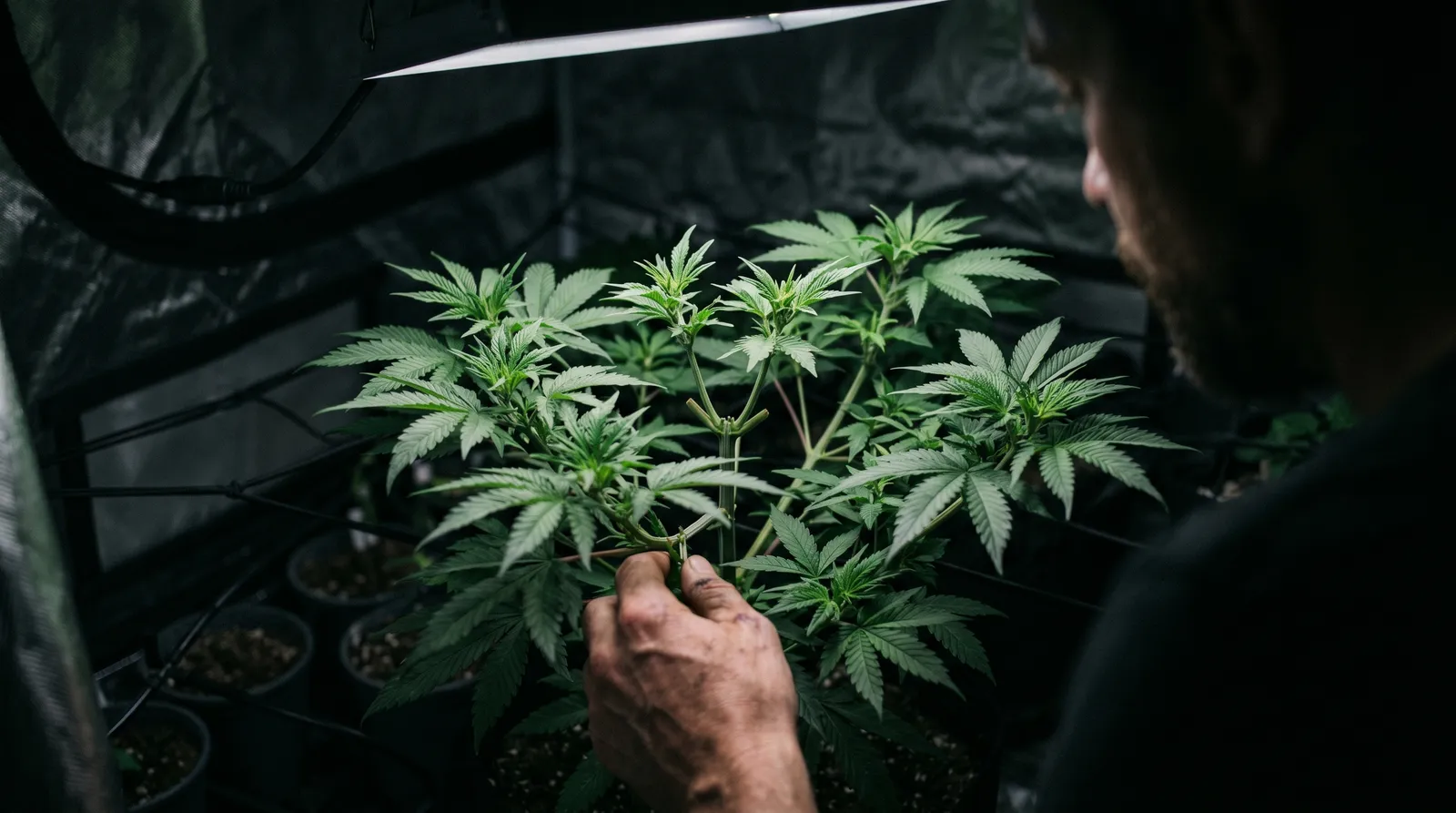
- Top at the 4th–5th node to encourage lateral growth.
- Top again 1–2 weeks later for more branch sites (optional — depends on plant vigour).
- Veg for 4–8 weeks under 18/6 light, until the plant sits roughly two-thirds of the way up to the screen.
Vegetative VPD target: ~0.8–1.1 kPa, PPFD 400–600 µmol/m²/s. Underfed or under-lit plants in veg produce weak stems that snap when you bend them — the number one SCROG disaster in our experience.
Step 4: Weave, tuck, repeat
Start weaving once branches reach the screen by pulling them horizontally through the squares. Work outward from the centre — the strongest branches go to the corners, weaker ones stay closer to the middle where light intensity is highest anyway.
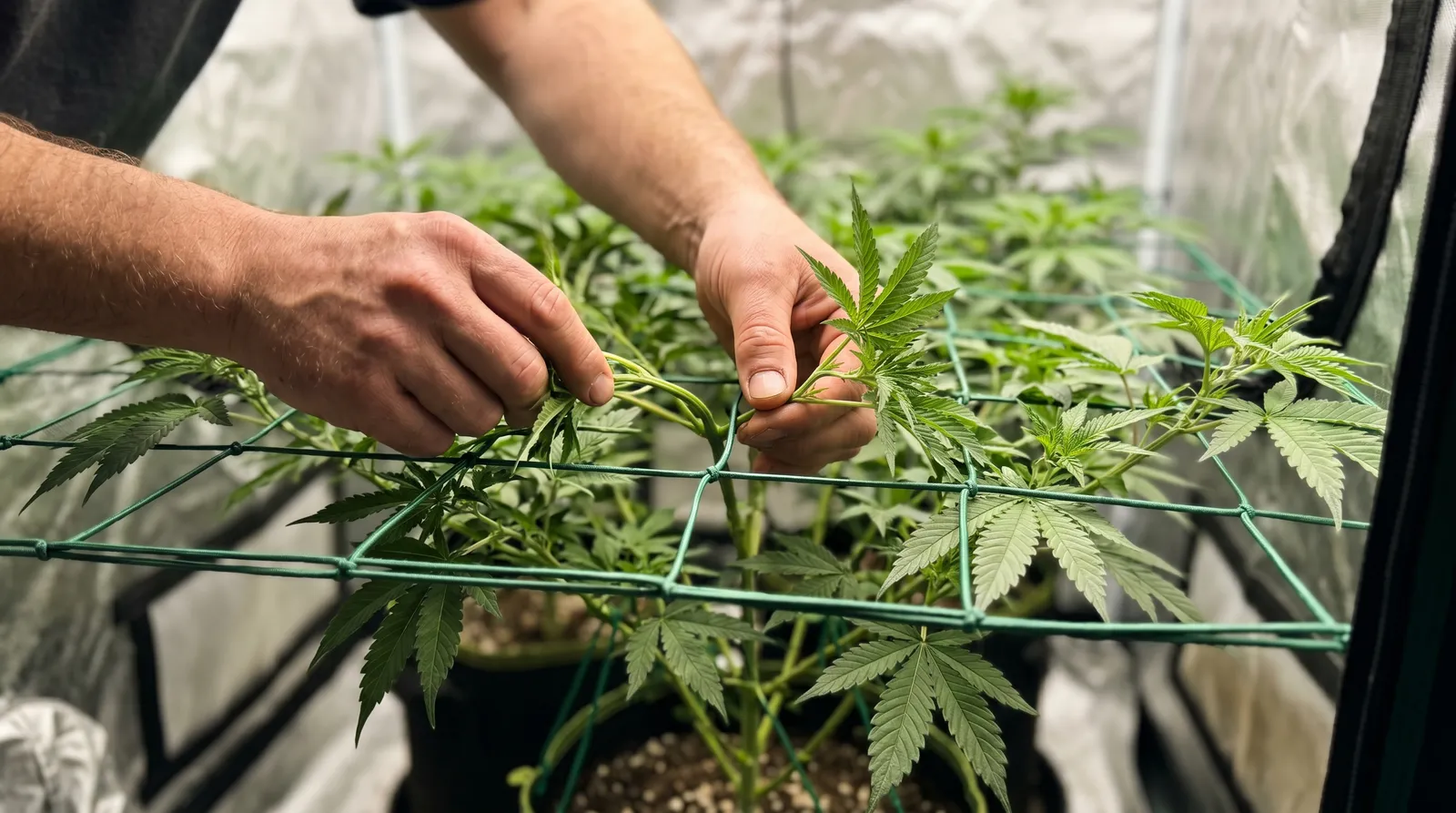
The routine during the stretch:
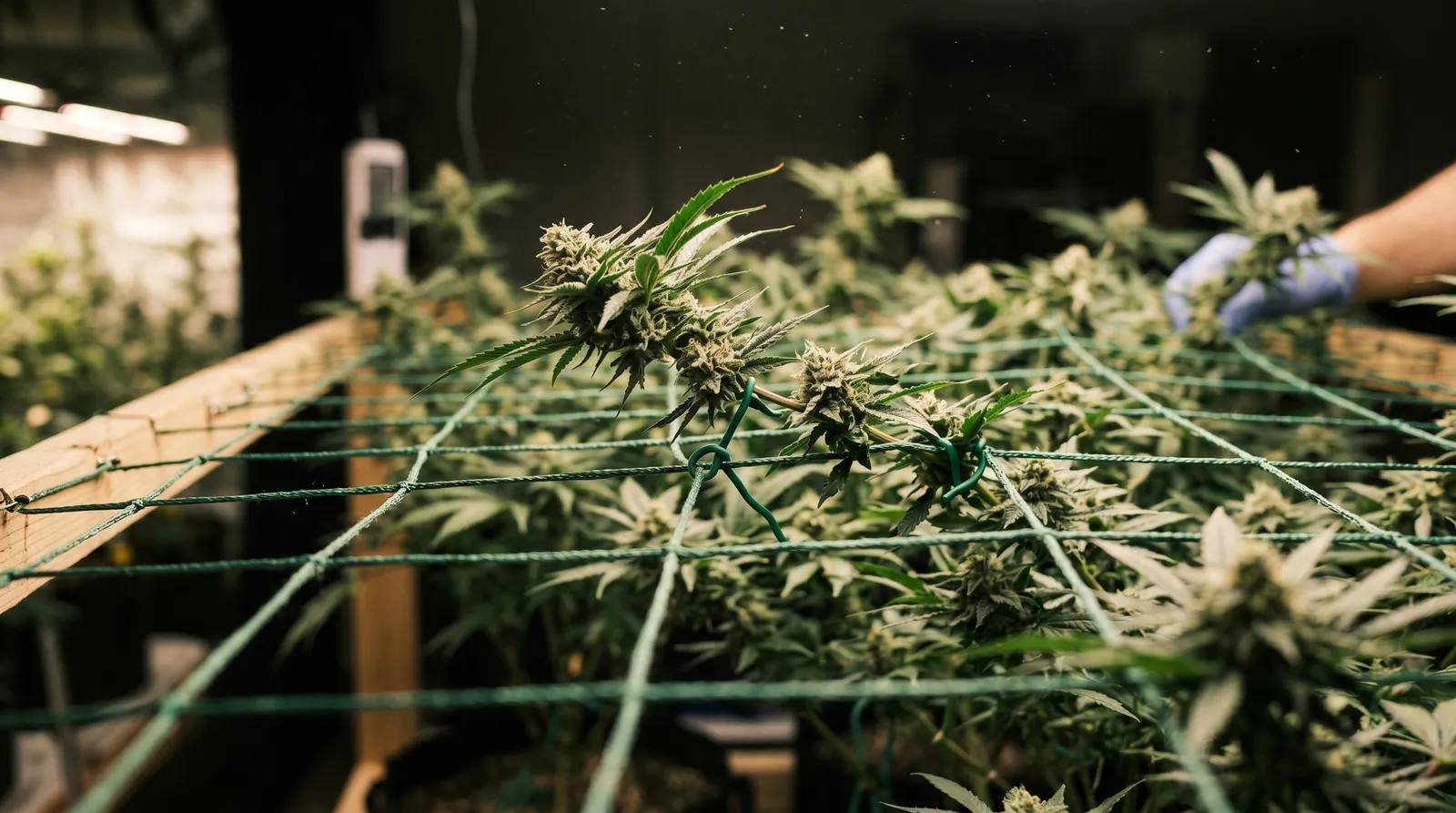
- Every 1–2 days, tuck any branch poking more than 5cm above the screen back under or through to the next square.
- Keep the canopy flat — if one cola is racing ahead, bend it sideways and tie it down.
- Remove any growth below the screen that won't receive direct light (lollipopping). Everything under the canopy becomes a humidity trap and larf.
Be gentle. If a stem creaks, stop, support it with tape, and come back tomorrow. Supercropping (intentionally crushing the stem) is a different technique and not part of SCROG — don't mix them up mid-panic. Honest limitation: we can't tell you exactly how many tucks your specific plant needs; phenotype variation within the same pack of seeds is wider than most beginner guides admit.
Step 5: Flip to 12/12 and stop weaving
Flip timing is the make-or-break moment. Cannabis stretches 1.5–3x its veg height in the first 2–3 weeks of 12/12. That stretch is what fills the screen. Flip when the canopy is ~60–70% filled — the stretch will finish the job.
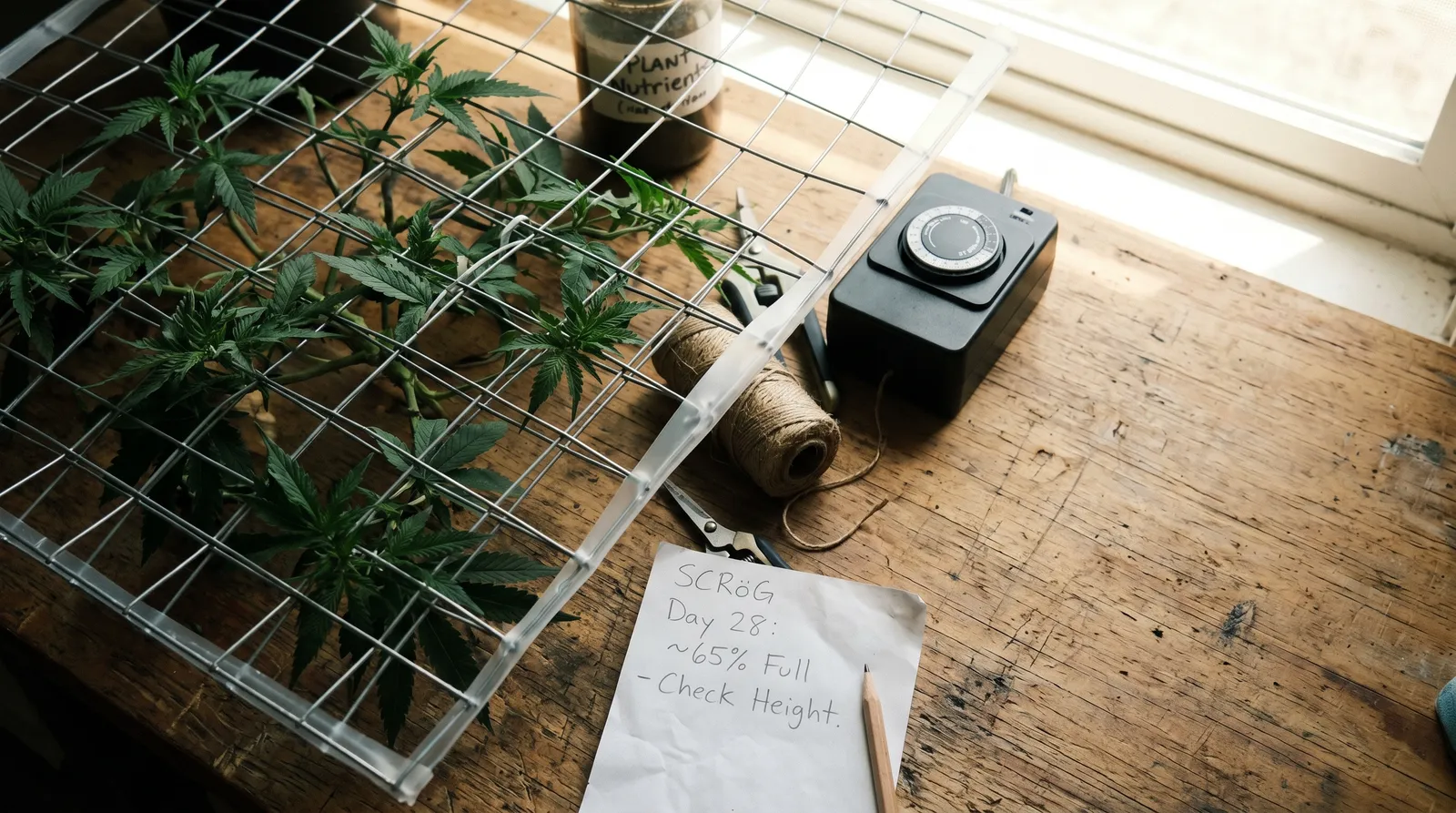
During the first 2 weeks of flower:
- Keep tucking daily. Branches will try to go vertical hard.
- Defoliate fan leaves shading bud sites — but leave enough foliage for the plant to photosynthesise. Aggressive "schwazzing" has mixed evidence and we're cautious about recommending it.
By the end of week 3 of flower, stop training. Bud sites are forming and handling them now causes stress, hermies, or snapped branches loaded with flower. Let the screen hold everything in place for the remaining 6–8 weeks.
Flowering VPD: ~1.0–1.5 kPa, PPFD 600–1,000 µmol/m²/s (higher ranges only with CO2 supplementation, per Chandra et al., 2008).
Common SCROG mistakes
Most SCROG failures trace back to five repeat offenders.
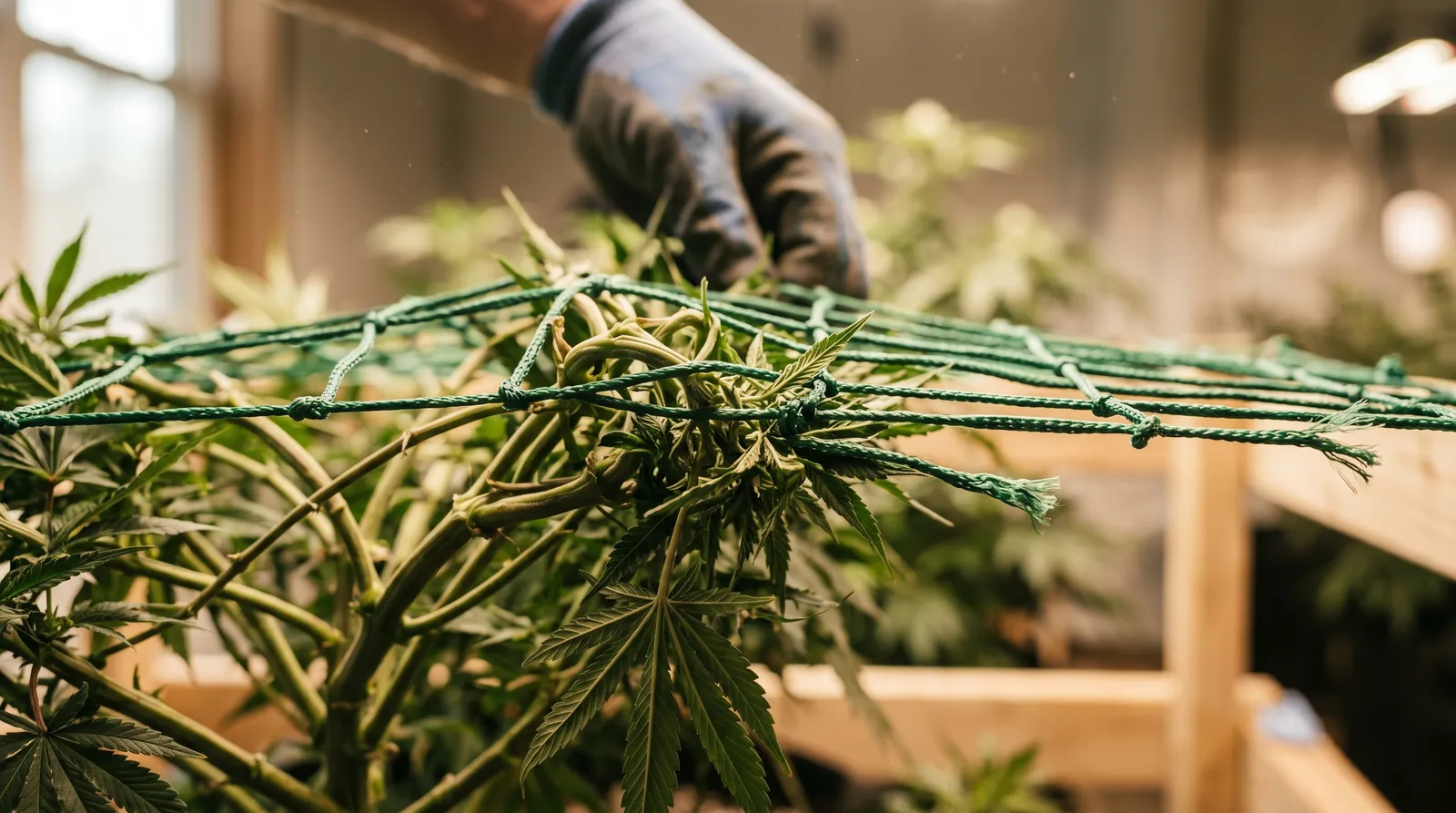
- Screen too small for the plant count. One vigorous photoperiod plant fills 80x80. Cramming four in there creates a tangle you can't manage.
- Flipping too early. See above. Veg patience is the entire game.
- Ignoring airflow under the canopy. Dense horizontal canopies trap humidity. RH above 60% in late flower invites botrytis. Oscillating fans below and above the screen, always.
- Training autoflowers. Possible but not recommended — the veg window is too short and stressed autos finish small regardless of what you do to them.
- Heavy defoliation late. Removing big fan leaves in week 5 of flower stresses the plant at the worst possible time.
SCROG vs SOG — quick clarification
Sea of Green (SOG) is the opposite philosophy: many small plants (12–20 per m²), minimal veg (1–2 weeks), no training, harvest in ~9 weeks of flower. SCROG is few plants, long veg, heavy training, same flower time. SOG suits growers with flexible plant allowances and fast clone turnover; SCROG suits growers with tight plant caps who want maximum yield per plant. Local plant-count rules often decide this for you.
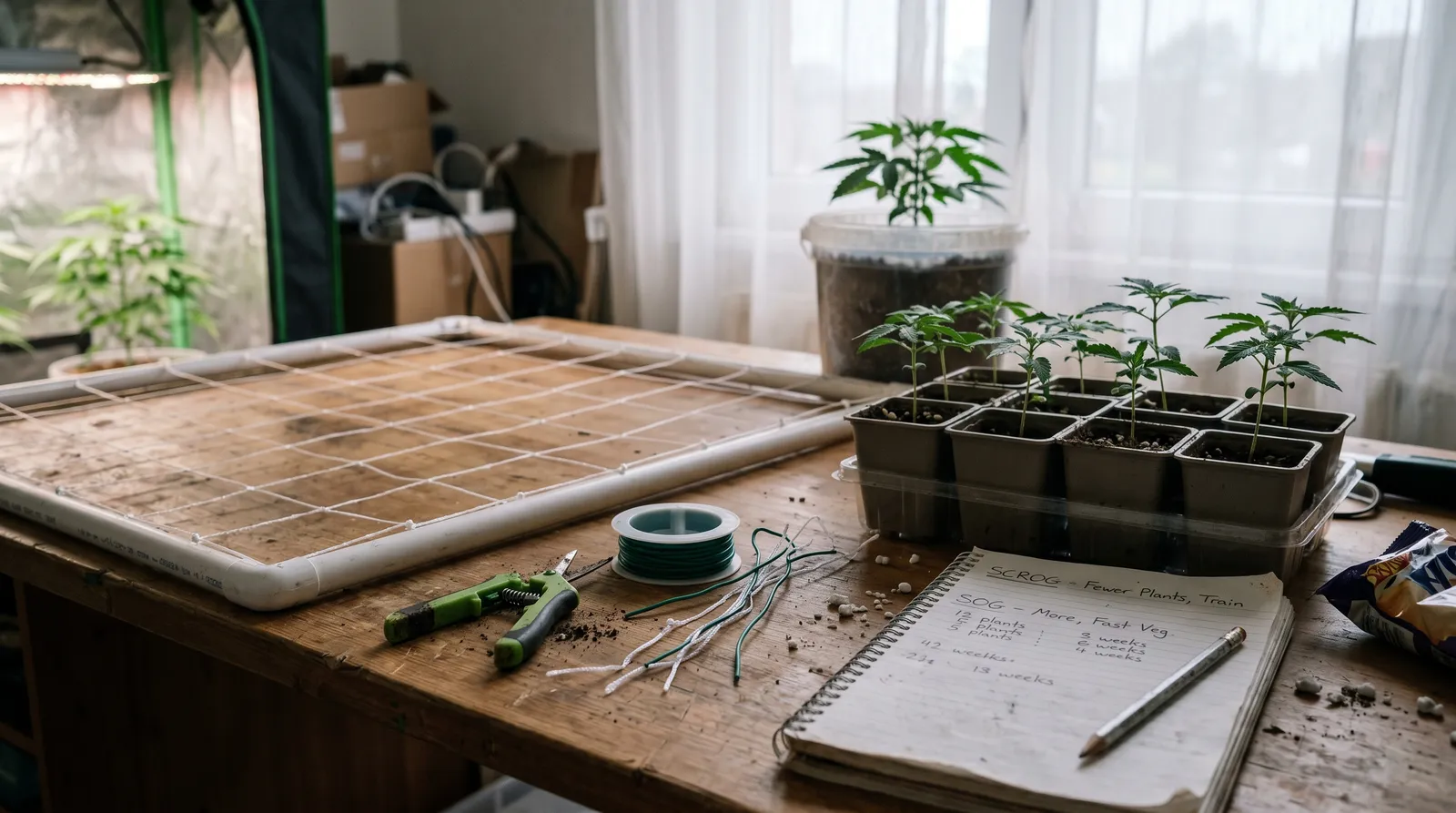
Interactions with other training methods: SCROG combines well with LST and topping. Avoid combining SCROG with main-lining (the structure conflicts) or with late-flower supercropping (you'll break colas).
This guide is for educational purposes only and does not constitute professional horticultural or medical advice. Always verify requirements for your specific situation before acting on any information here. Always grow responsibly and follow the rules in your area.
Last updated: April 2026
Frequently Asked Questions
8 questionsWhen should I install the SCROG screen?
Can you SCROG autoflowering cannabis?
How many plants per SCROG screen?
What's the difference between SCROG and SOG?
When should I stop tucking SCROG branches?
Does SCROG work with LED lights?
What is the best screen grid size for SCROG?
What are the most common SCROG mistakes to avoid?
About this article


Luke Sholl has been writing about cannabis, cannabinoids, and the broader benefits of nature since 2011, and has personally grown cannabis in home grow tents for more than a decade. That first-hand cultivation experience
This wiki article was drafted with AI assistance and reviewed by Luke Sholl, External contributor since 2026. Editorial oversight by Adam Parsons.
Medical disclaimer. This content is for informational purposes only and does not constitute medical advice. Consult a qualified healthcare provider before use of any substance.
Last reviewed April 24, 2026
References (6)
- [1]Chandra, S., Lata, H., Khan, I.A. & ElSohly, M.A. (2008). Photosynthetic response of Cannabis sativa L. to variations in photosynthetic photon flux densities, temperature and CO2 conditions. Physiology and Molecular Biology of Plants, 14(4), 299–306.
- [2]Chandra, S., Lata, H., Mehmedic, Z., Khan, I.A. & ElSohly, M.A. (2015). Light dependence of photosynthesis and water vapor exchange characteristics in different high Δ9-THC yielding varieties of Cannabis sativa L. Journal of Applied Research on Medicinal and Aromatic Plants, 2(2), 39–47.
- [3]EMCDDA (2023). European cannabis cultivation overview. European Monitoring Centre for Drugs and Drug Addiction.
- [4]Beckley Foundation (2022). Cannabis policy and cultivation science briefing.
- [5]Royal Queen Seeds Grow Guide (2023). SCROG technique documentation. Breeder reference material.
- [6]Sensi Seeds Grow Guide (2023). Screen of Green methodology. Breeder reference material.
Related Articles
Cannabis Hermaphrodite: Identify, Prevent, Act
A cannabis hermaphrodite is a female plant that develops male pollen sacs or banana-shaped anthers (nanners), self-pollinating and seeding your harvest.
DIY Cannabis Fertilizer: Homemade Nutrient Guide
DIY cannabis fertilizer guide: compost, teas, banana ferments and feed schedules, with safety notes and cited research for home growers.
What To Do With Male Cannabis Plants: 6 Practical Uses
What to do with male cannabis plants: identify, isolate, breed, extract, or compost. A practical 6-step guide with sourcing and safety notes.
Mushroom Grow Kit Temperature & Humidity: Full Setup Guide
A temperature humidity control grow kit is the small set of climate tools — hygrometer, heat mat, humidifier or perlite tray — that keeps a mushroom fruiting…
When to Harvest Mushrooms: Veil Break Timing Explained
Harvest timing veil break is a cultivation technique that uses the tearing of the partial veil on maturing Psilocybe cubensis to mark peak alkaloid content.
First Grow Checklist: What You Need for Mushroom Kits
A first grow checklist is the short list of supplies and environmental conditions needed to run a home psilocybin mushroom kit from inoculated substrate to…
Sclerotia vs Fruit Bodies: Cultivation Comparison
Sclerotia and fruit bodies are two different life stages of Psilocybe fungi: sclerotia are hardened underground mycelial storage bodies (the 'magic…
Storing Dried Mushrooms Long Term: Full Guide
Storing dried mushrooms long term means keeping well-dried Psilocybe fruit bodies in airtight, opaque containers with desiccant, cool and dark, to slow…
Drying Mushrooms Air Desiccant Oven: Methods Compared
Drying mushrooms air desiccant oven refers to the three home methods for reducing fresh fruit bodies from ~90% water to cracker-dry (<5%). Gotvaldová et al.