
This article discusses psychoactive substances intended for adults (18+). If you have a health condition or take medication, consult a doctor before use. Our age policy
Cannabis Pests Spider Mites Thrips Gnats: Home IPM Guide
Definition
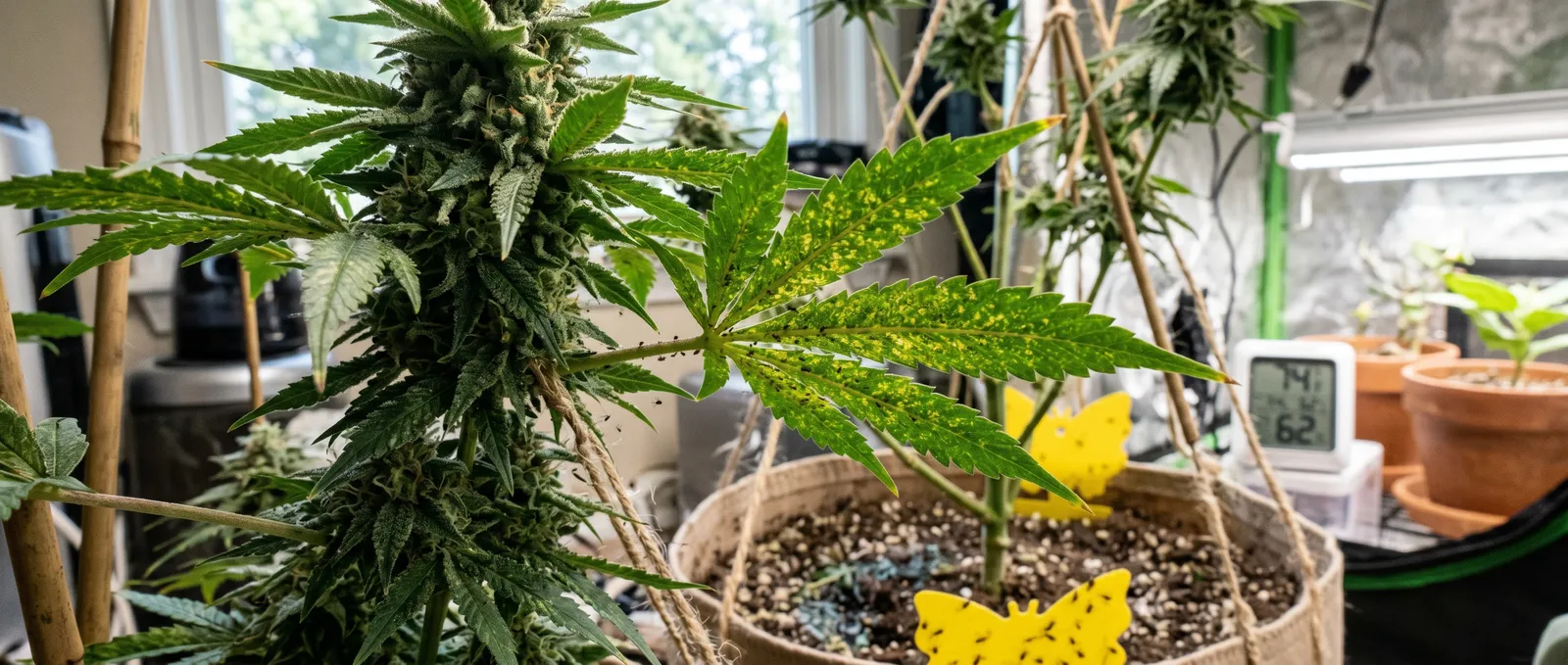
Cannabis pests spider mites thrips gnats is shorthand for the three most common pests in home cannabis tents. Each has a distinct damage pattern and a different biological control. Integrated pest management — prevention, monitoring, predators, narrow-spectrum sprays — outperforms reactive pesticide use, which McPartland & Clarke (2000) linked to residues on smoked material. EMCDDA cultivation surveys note rising indoor home grows across Europe.
This guide is written for adults growing at home.
Cannabis pests spider mites thrips gnats is a cluster of tent invaders that damages indoor crops fast and requires integrated pest management to control. Spider mites shred leaves from the underside and can destroy a flowering canopy in under two weeks. Thrips leave silver streaks and black specks on foliage. Fungus gnats are mostly a seedling and root-zone problem, but their larvae will chew fine root hairs and stunt young plants. Integrated pest management (IPM) — a layered approach combining prevention, monitoring, biological controls, and targeted sprays — is the framework every serious home grower ends up adopting, because reaching for a broad-spectrum pesticide in week 5 of flower is how you ruin a harvest.
Spider mites: the tent-killers
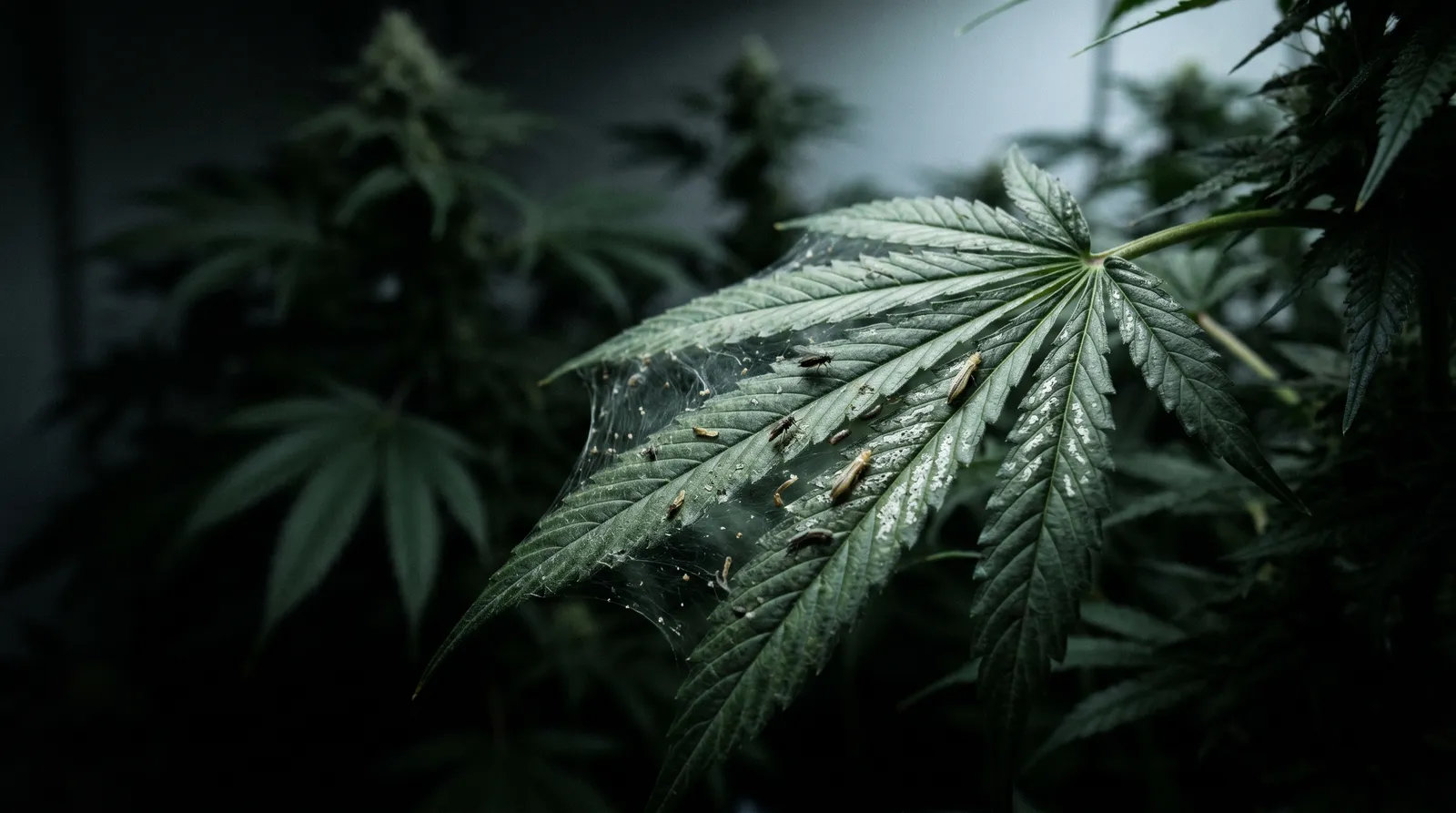
Two-spotted spider mites (Tetranychus urticae) are the single most destructive pest in indoor cannabis, and they are arachnids rather than insects. They live on the underside of leaves, pierce plant cells, and suck out the contents. Early signs: tiny yellow or white stipples on the top of leaves, visible under a loupe. Later signs: webbing between leaflets, bronzed leaves, and — if you are really behind — a dusty sheen of live mites crawling across your colas.
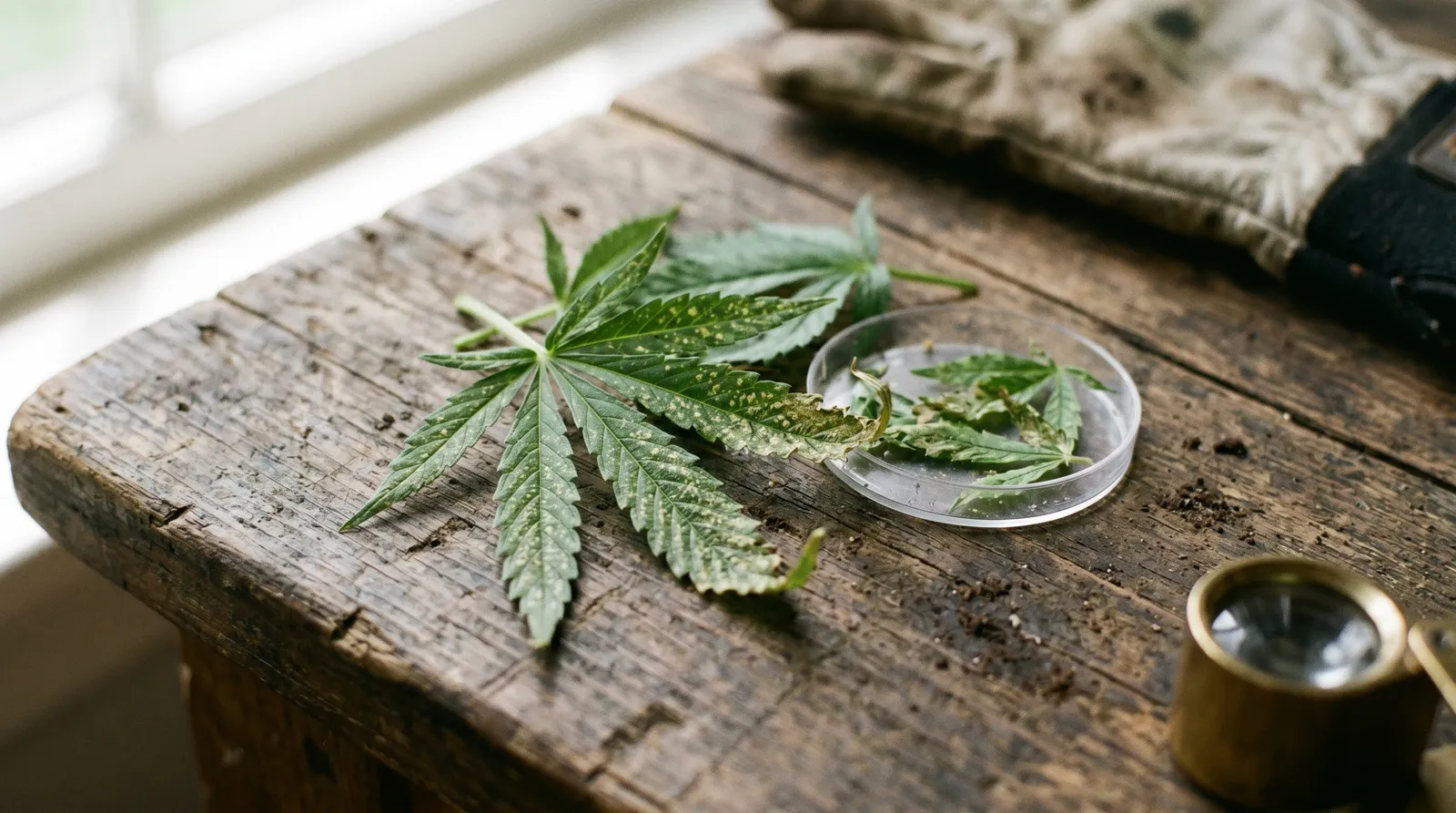
Their reproduction speed is the problem. At 27°C a female lays around 100 eggs and a new generation matures in roughly 7 days (Van Leeuwen et al., 2010). A population doubles faster than most growers check their plants. Lower temperatures and higher humidity slow them down — keeping flowering tents around 24–26°C and 50–60% RH (which also sits in the 1.0–1.5 kPa VPD window) makes life harder for them.
Biological control works well in enclosed tents. Phytoseiulus persimilis is the go-to predator: it eats nothing but spider mites and their eggs, and at release rates of 20–50 predators per m² it can clear a light infestation in 2–3 weeks (Koppert technical sheets). Growers can buy sachets from specialist suppliers. For sprays, insecticidal soap or a 1% neem-oil-and-surfactant mix aimed at the leaf undersides knocks down adults, but neem has a hard cutoff: stop at least 3 weeks before flower, and never spray buds. Residues in smoked material are not something you want.
Thrips: silver streaks and black dots
Thrips are slender insects 1–2 mm long that rasp the leaf surface and drink the sap. Western flower thrips (Frankliniella occidentalis) is the species most home growers encounter. The damage signature is distinctive: silvery or bronze patches on upper leaf surfaces, speckled with tiny black dots of frass. Heavy infestations leave leaves looking dried and papery.
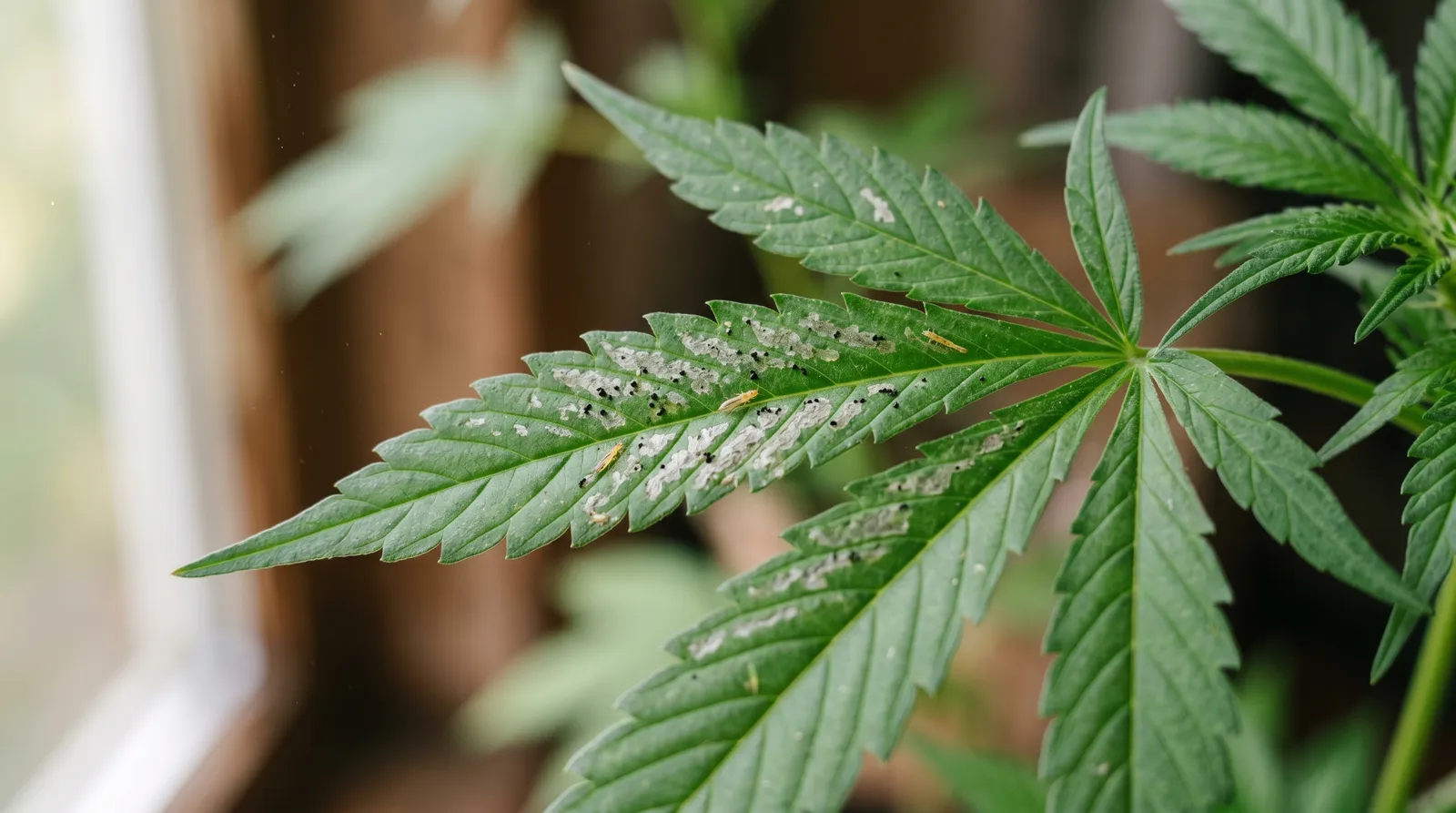
Blue sticky traps pull adults out of the air and double as monitoring tools — if traps go from clean to spotted in a week, you have a thrips problem. Amblyseius swirskii and Neoseiulus cucumeris are predatory mites that feed on thrips larvae in the substrate and on foliage; they also tolerate lower humidity better than Phytoseiulus, which matters in a dry European winter grow (EMCDDA cultivation surveys note rising indoor grow numbers across the region). Spinosad (derived from a soil bacterium) is the spray of choice for vegetative plants — effective on thrips, relatively short residual, but still not something to use once pistils are showing.
Thrips also vector tospoviruses in commercial horticulture, and while cannabis-specific virus transmission data is thin, the interaction is documented in ornamentals (Rotenberg et al., 2015). Translation: don't let them establish.
Fungus gnats: the wet-substrate problem
Fungus gnats (Bradysia spp.) are those little black flies that jump up when you water a seedling. The adults are mostly annoying, but the larvae — small translucent maggots with black heads — live in the top 2–3 cm of wet medium and feed on fungi, organic matter, and fine root hairs. In seedlings and young clones, larval feeding can cause real stunting and an entry point for Pythium root rot.
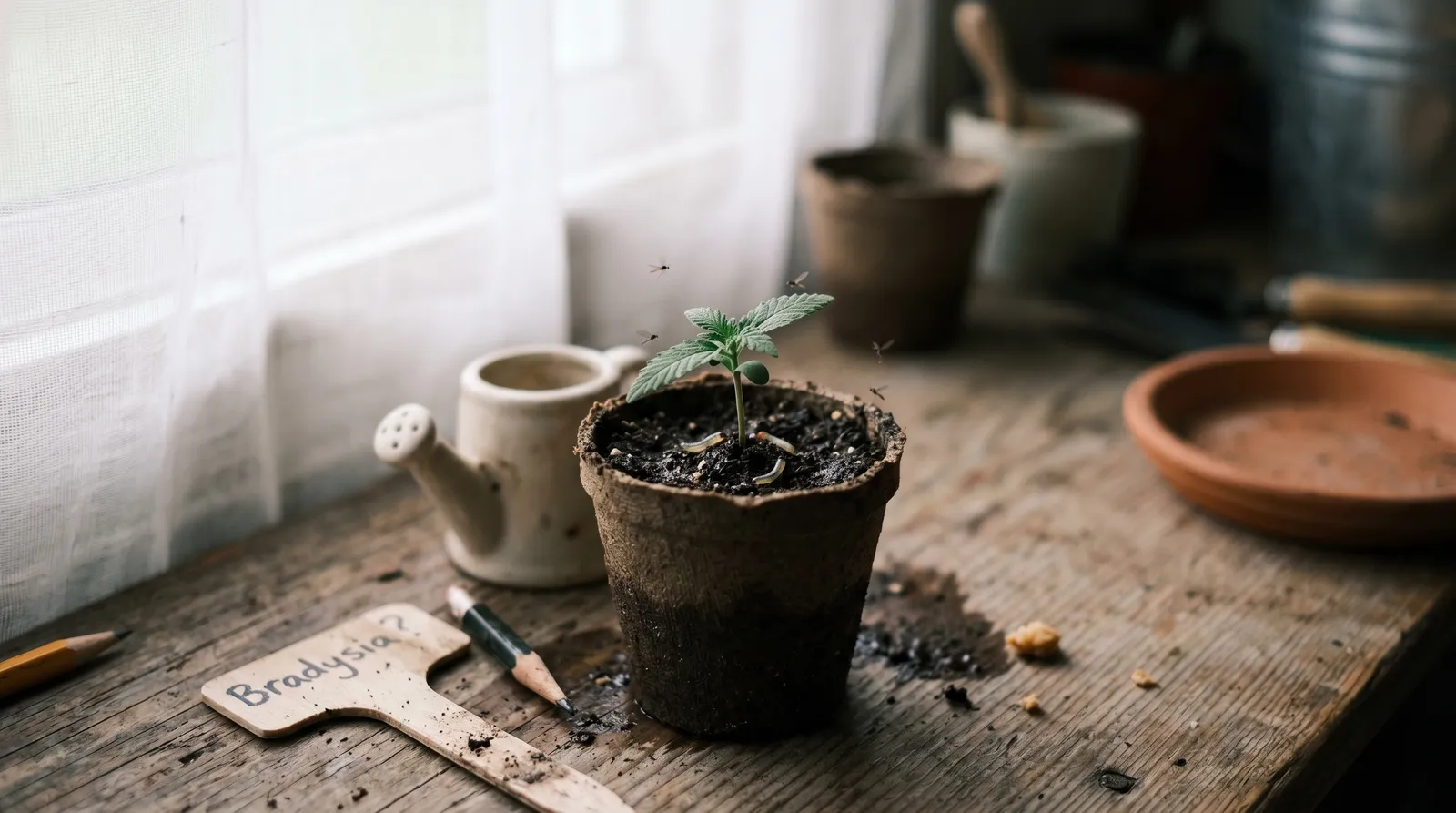
The fix is almost entirely cultural: let the top of your substrate dry between waterings. Gnats need moist organic matter in the top layer to complete their life cycle. Coco coir with a 1–2 cm dry surface, or soil watered from below, breaks the cycle within a fortnight. For extra pressure, yellow sticky traps catch adults, Bacillus thuringiensis israelensis (BTi) drenches kill larvae on contact, and the predatory soil mite Stratiolaelaps scimitus (formerly Hypoaspis miles) eats larvae and pupae at about 25 mites per pot, applied once.
An IPM framework that actually works
Integrated pest management is the order in which you do things, not a single product you buy. In a home tent the practical sequence looks like this:
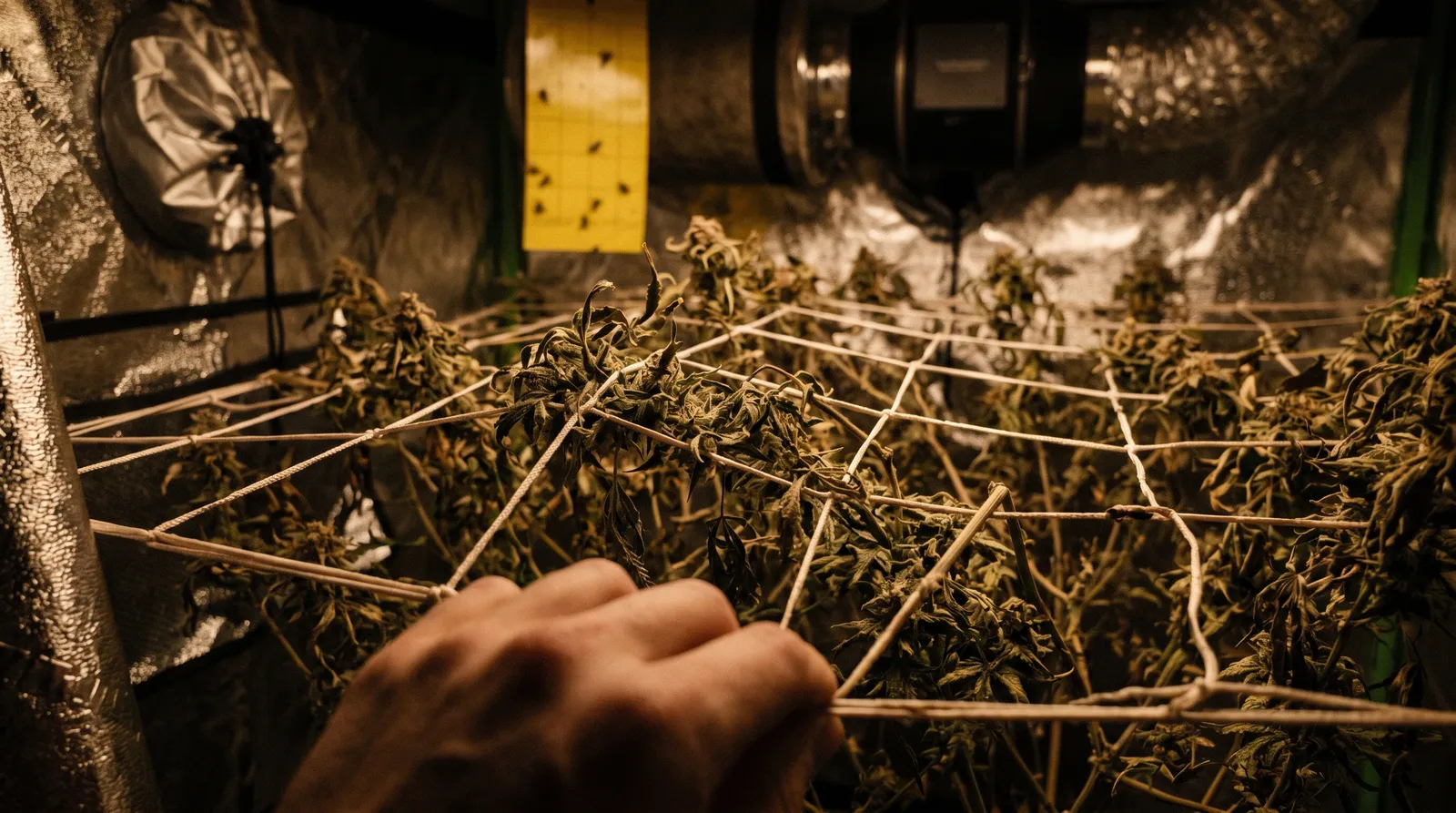
- Prevent. Quarantine new clones for 10–14 days. Change clothes after visiting other grows. Don't bring houseplants into the tent room.
- Monitor. Yellow sticky traps at canopy height for gnats and thrips, blue for thrips specifically. Check leaf undersides with a 30x loupe once a week.
- Intervene biologically first. Predatory mites and BTi work and leave no residue on flowers.
- Spray narrow-spectrum only if needed. Insecticidal soap, neem (veg only), spinosad (veg only). Avoid pyrethroids and anything systemic.
- Never spray buds. Once flowering starts, biological controls and environmental adjustment are your only tools. Pesticide residues on smoked material are a genuine health concern (McPartland & Clarke, 2000).
Quick reference: pest, sign, response
The three most common cannabis pests — spider mites, thrips, and fungus gnats — each have a distinct early sign, preferred biological predator, and a safe vegetative-stage spray, summarised below.
| Pest | Early sign | Biological control | Safe spray (veg only) |
|---|---|---|---|
| Spider mites (T. urticae) | Yellow stipple on upper leaves, fine webbing | Phytoseiulus persimilis, 20–50/m² | Insecticidal soap, 1% neem oil |
| Western flower thrips | Silvery streaks, black frass dots | Amblyseius swirskii, N. cucumeris | Spinosad |
| Fungus gnats (Bradysia) | Small flies at substrate, stunted seedlings | Stratiolaelaps scimitus, ~25/pot | BTi drench, dry-back |
What not to do
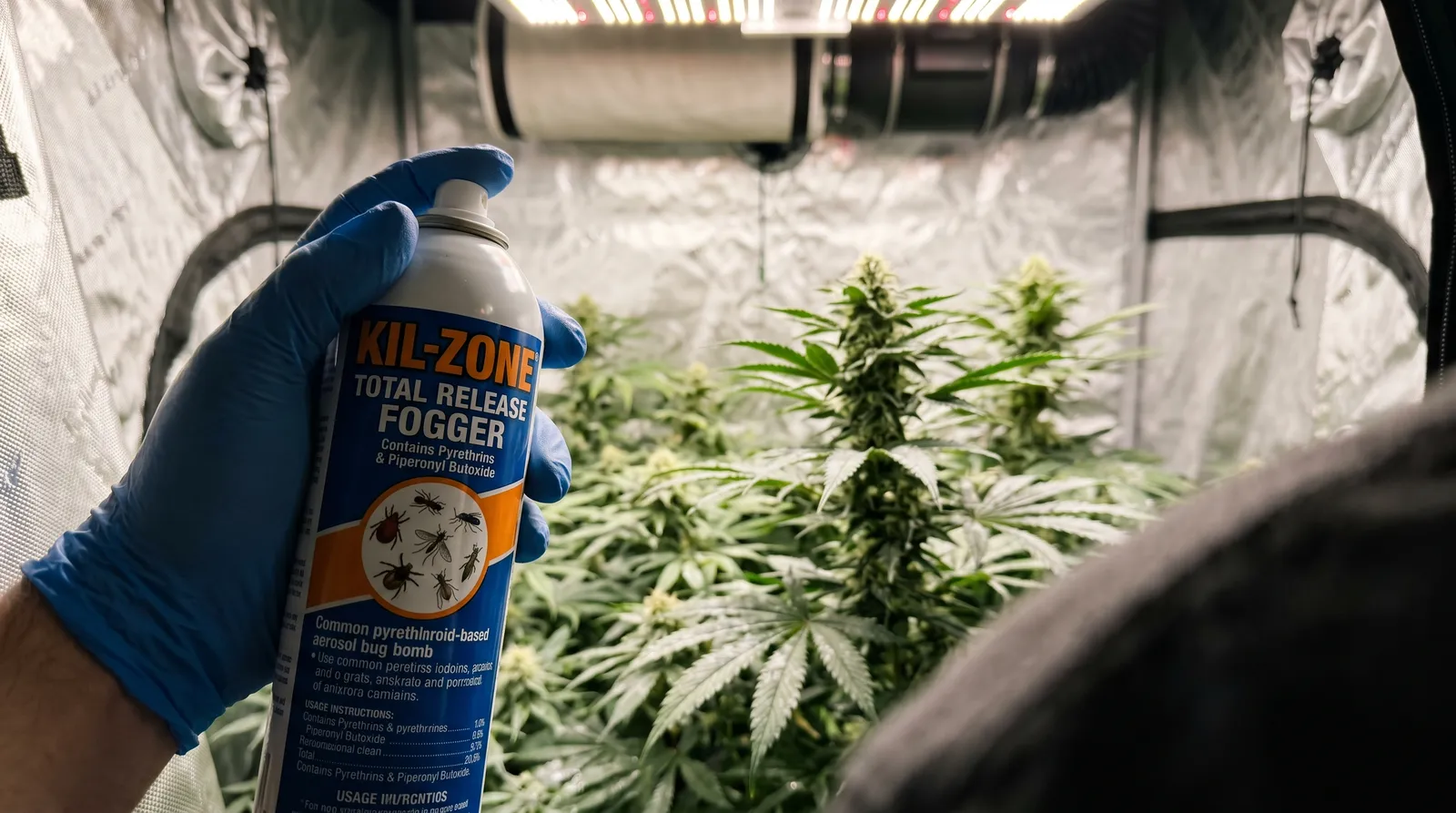
Three inputs to avoid in a home tent are systemic neonicotinoids, pyrethroid bug bombs, and late-flower sprays of any kind. First, systemic neonicotinoids (imidacloprid, acetamiprid) translocate into flower tissue and persist. Second, pyrethroid bug bombs flatten the beneficial microbiome on leaves and in soil, and resistant mite populations bounce back harder. Third, spraying anything in flower past week 2. If you have a pest problem in week 5 that biologicals cannot handle, the honest answer is that the crop is compromised and you are choosing between a smaller clean harvest and a larger contaminated one.
The efficacy of some folk remedies — chilli-garlic sprays, dish soap dilutions, diatomaceous earth dusted on leaves — is mixed. Compared with predatory mites, which have repeatable trial data behind them, the folk options suppress light pressure on outdoor plants at best, and controlled trials in cannabis specifically are thin. When you go to buy IPM inputs, order predator sachets and BTi from a horticultural supplier rather than a general hardware shop — cold-chain handling matters, and dealing with cannabis pests spider mites thrips gnats properly starts with live, viable biologicals.
Legal notice: Cannabis cultivation laws vary by country and region and change frequently. This guide is educational. Before growing, verify current laws for your specific jurisdiction. Azarius does not provide legal advice.
Last updated: April 2026
Frequently Asked Questions
8 questionsHow do I tell spider mites from thrips damage?
Can I use neem oil during flowering?
What biological controls work against fungus gnat larvae?
Are predatory mites safe to use in a small home tent?
Do sticky traps actually control pests or just monitor them?
What pesticides should I never use on cannabis pests spider mites thrips gnats?
How fast do spider mites reproduce in a grow tent?
What is the best IPM schedule for preventing thrips and gnats together?
About this article


Luke Sholl has been writing about cannabis, cannabinoids, and the broader benefits of nature since 2011, and has personally grown cannabis in home grow tents for more than a decade. That first-hand cultivation experience
This wiki article was drafted with AI assistance and reviewed by Luke Sholl, External contributor since 2026. Editorial oversight by Adam Parsons.
Medical disclaimer. This content is for informational purposes only and does not constitute medical advice. Consult a qualified healthcare provider before use of any substance.
Last reviewed April 24, 2026
References (5)
- [1]Van Leeuwen, T., Vontas, J., Tsagkarakou, A., Dermauw, W., & Tirry, L. (2010). Acaricide resistance mechanisms in the two-spotted spider mite Tetranychus urticae and other important Acari: A review. Insect Biochemistry and Molecular Biology, 40(8), 563–572.
- [2]Rotenberg, D., Jacobson, A. L., Schneweis, D. J., & Whitfield, A. E. (2015). Thrips transmission of tospoviruses. Current Opinion in Virology, 15, 80–89.
- [3]McPartland, J. M., & Clarke, R. C. (2000). Hemp Diseases and Pests: Management and Biological Control. CABI Publishing.
- [4]Koppert Biological Systems. Product technical sheets: Phytoseiulus persimilis, Amblyseius swirskii, Stratiolaelaps scimitus. Accessed Q2 2026.
- [5]EMCDDA (European Monitoring Centre for Drugs and Drug Addiction). Cannabis cultivation and indoor grow trends in Europe. Accessed 2026.
Related Articles
Cannabis Hermaphrodite: Identify, Prevent, Act
A cannabis hermaphrodite is a female plant that develops male pollen sacs or banana-shaped anthers (nanners), self-pollinating and seeding your harvest.
DIY Cannabis Fertilizer: Homemade Nutrient Guide
DIY cannabis fertilizer guide: compost, teas, banana ferments and feed schedules, with safety notes and cited research for home growers.
What To Do With Male Cannabis Plants: 6 Practical Uses
What to do with male cannabis plants: identify, isolate, breed, extract, or compost. A practical 6-step guide with sourcing and safety notes.
Mushroom Grow Kit Temperature & Humidity: Full Setup Guide
A temperature humidity control grow kit is the small set of climate tools — hygrometer, heat mat, humidifier or perlite tray — that keeps a mushroom fruiting…
When to Harvest Mushrooms: Veil Break Timing Explained
Harvest timing veil break is a cultivation technique that uses the tearing of the partial veil on maturing Psilocybe cubensis to mark peak alkaloid content.
First Grow Checklist: What You Need for Mushroom Kits
A first grow checklist is the short list of supplies and environmental conditions needed to run a home psilocybin mushroom kit from inoculated substrate to…
Sclerotia vs Fruit Bodies: Cultivation Comparison
Sclerotia and fruit bodies are two different life stages of Psilocybe fungi: sclerotia are hardened underground mycelial storage bodies (the 'magic…
Storing Dried Mushrooms Long Term: Full Guide
Storing dried mushrooms long term means keeping well-dried Psilocybe fruit bodies in airtight, opaque containers with desiccant, cool and dark, to slow…
Drying Mushrooms Air Desiccant Oven: Methods Compared
Drying mushrooms air desiccant oven refers to the three home methods for reducing fresh fruit bodies from ~90% water to cracker-dry (<5%). Gotvaldová et al.