
This article discusses psychoactive substances intended for adults (18+). If you have a health condition or take medication, consult a doctor before use. Our age policy
Cannabis Nutrient Deficiency Chart: Symptom Diagnosis Guide
Definition
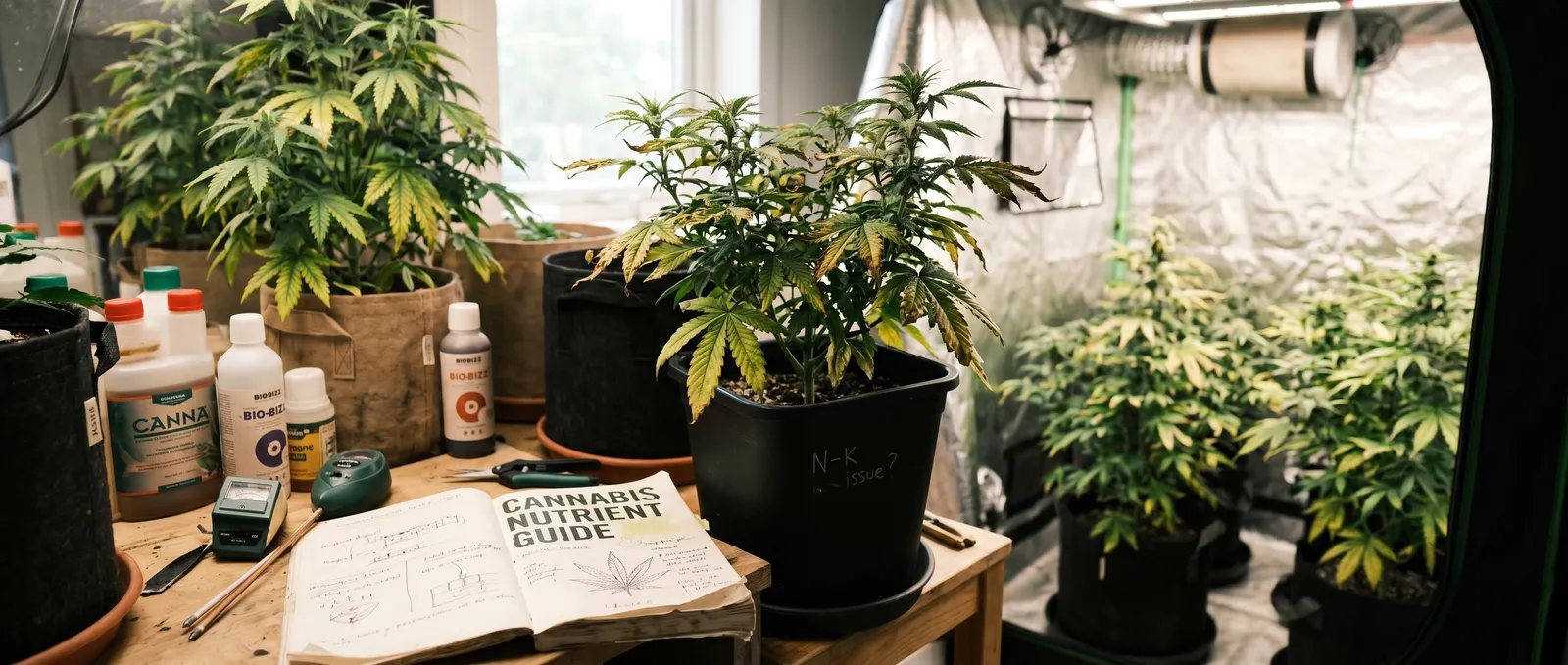
A cannabis nutrient deficiency chart is a diagnostic reference that maps visible leaf symptoms — yellowing, spotting, clawing — to the specific nutrient causing them, using the plant's mobility logic: mobile nutrients damage old leaves first, immobile ones hit new growth. Most apparent deficiencies are actually pH lockouts (Bugbee, 2004).
This guide is educational and written for adult growers. Cultivation rules vary by country and region and change frequently. Before growing, verify current rules for your specific jurisdiction. Azarius does not provide formal advice. Always consult qualified professionals for health, safety, or formal matters relating to cultivation.
The cannabis nutrient deficiency chart at a glance
A cannabis nutrient deficiency chart is a diagnostic table that matches visible leaf symptoms — yellowing, spotting, clawing, purple stems — to the nutrient most likely behind them. It works because cannabis shows remarkably consistent symptom patterns across genetics, and because the mobility of each nutrient inside the plant dictates where on the plant the damage shows up first. Mobile nutrients (nitrogen, phosphorus, potassium, magnesium) get scavenged from old leaves and sent to new growth, so deficiencies appear at the bottom. Immobile nutrients (calcium, iron, sulphur, zinc, boron, manganese, copper) can't be reclaimed, so deficiencies hit the new growth at the top first (Bugbee, 2004).
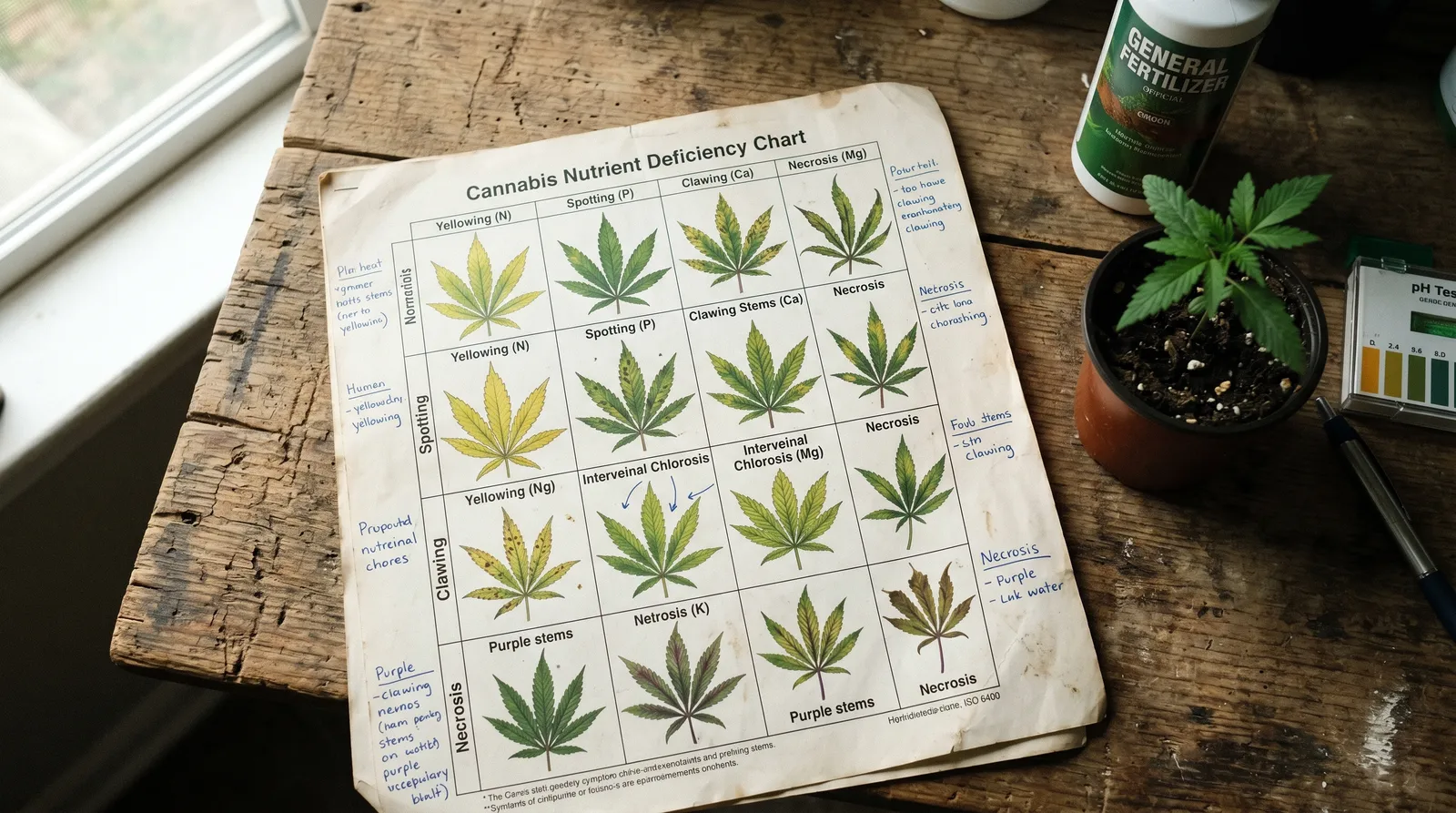
Before you trust the chart: 90% of what looks like a deficiency is actually a pH lockout. Cannabis in soil wants a root-zone pH of 6.0–6.8; in coco and hydro, 5.5–6.2. Outside that window, the nutrients can be sitting right there in the medium and the roots simply can't take them up (Mills & Jones, 1996). Always check pH and EC before you start chasing deficiencies with more feed.
| Nutrient | Mobility | Where symptoms appear | Visible symptoms | Common cause | Corrective action |
|---|---|---|---|---|---|
| Nitrogen (N) | Mobile | Lower / older leaves | Uniform pale green fading to yellow, leaves drop off, lower canopy first | Underfeeding in veg; natural fade in late flower | Raise N-dominant feed; in late flower, leave it — fade is normal |
| Phosphorus (P) | Mobile | Lower leaves | Dark blue-green leaves, red/purple stems, bronze or purple blotches, stunted growth | Cold root zone (below 15 °C), pH below 6.0 in soil | Warm the root zone, correct pH, boost bloom P |
| Potassium (K) | Mobile | Lower / mid leaves | Burnt leaf tips and margins, yellowing between veins, leaves curl and crisp | Often confused with nute burn; high EC lockout | Flush, recheck EC, reintroduce feed at lower strength |
| Calcium (Ca) | Immobile | New / upper growth | Small brown or rust-coloured spots on young leaves, twisted new growth, weak stems | Coco coir without Cal-Mag; soft tap water; low pH | Add Cal-Mag at 1–2 ml/L, especially in coco and RO water setups |
| Magnesium (Mg) | Mobile | Lower / mid leaves | Interveinal yellowing (veins stay green), rust spots, leaf tips curl up | Low pH, RO water, coco without supplementation | Epsom salts (1 tsp/4 L) or Cal-Mag; correct pH |
| Sulphur (S) | Immobile | New / upper growth | Uniform pale yellow on young leaves (looks like N deficiency but on top) | High-pH lockout; rare in bottled feeds | Correct pH; Epsom provides Mg + S together |
| Iron (Fe) | Immobile | New / upper growth | Bright yellow interveinal chlorosis on youngest leaves, veins stay green | High pH (above 6.8 in soil, above 6.3 in hydro) | Drop pH into range; chelated iron foliar as a quick fix |
| Zinc (Zn) | Immobile | New growth | Shortened internodes, distorted small new leaves, yellowing between veins | High pH; rare with balanced feed | Correct pH; micronutrient supplement if persists |
| Manganese (Mn) | Immobile | New growth | Interveinal yellowing with brown necrotic speckles developing | High pH; excess iron blocking uptake | pH correction; check you're not over-dosing Fe |
| Boron (B) | Immobile | Growing tips | Twisted, thickened new growth, dead growth tips, hollow stems | Very dry medium (boron moves with water), RO water | Rewater consistently; trace boron in balanced micro mix |
| Copper (Cu) | Immobile | New growth | Dark blue-green leaves with purple undertone, wilting despite wet medium | Very rare; high pH lockout | pH correction; micronutrient supplement |
Why mobility determines where you look
Mobility tells you where to look first: mobile nutrients damage old leaves, immobile ones damage new growth. This is the single most useful diagnostic trick in cannabis: look at which leaves are damaged before you guess the nutrient. Mobile nutrients travel through the phloem, so when the plant is short on nitrogen, it strips what it has from the oldest fan leaves and redirects it to new growth. You see yellowing at the bottom. Immobile nutrients — calcium and iron being the two you'll meet most often — can't be moved once they've been laid down in older tissue. A shortfall shows up on the new leaves at the top, because the plant simply can't build them properly (Marschner, 2012).
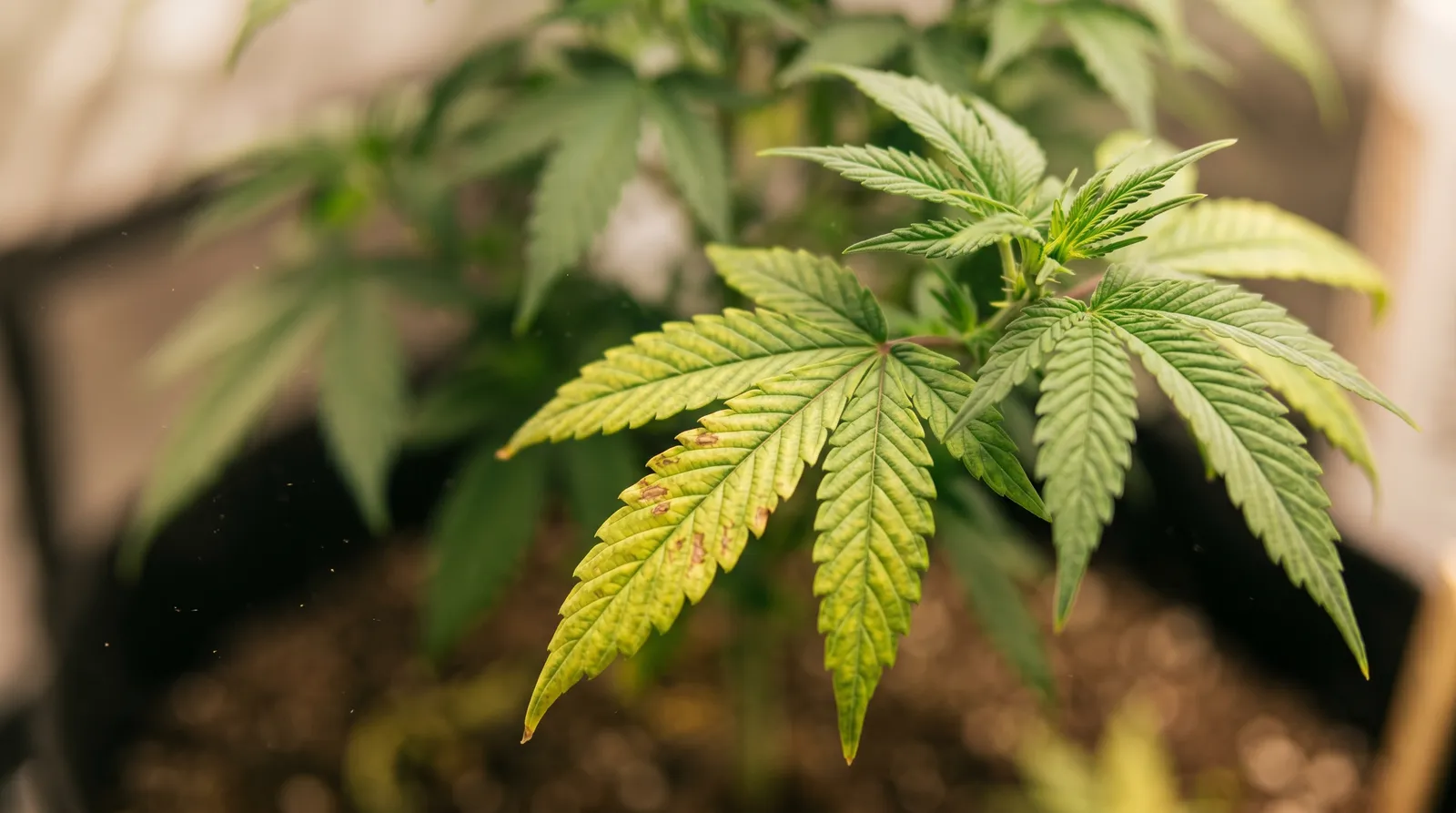
Get this reflex and half the chart diagnoses itself. Yellow bottom leaves = probably nitrogen. Yellow top leaves = probably iron or calcium, and almost always a pH problem rather than an actual shortage in the feed.
pH lockout — the thing that isn't a deficiency
pH lockout is when correctly-dosed nutrients become chemically unavailable to the roots because the root-zone pH has drifted outside the usable window. Nutrient availability is a pH-dependent curve. Iron, manganese, zinc, and phosphorus all drop out of solution above pH 6.5–6.8 in soilless media; calcium and magnesium struggle below 5.5. You can be feeding a perfect blend and still see a textbook iron deficiency because your runoff is reading 7.2 (Bugbee, 2004).
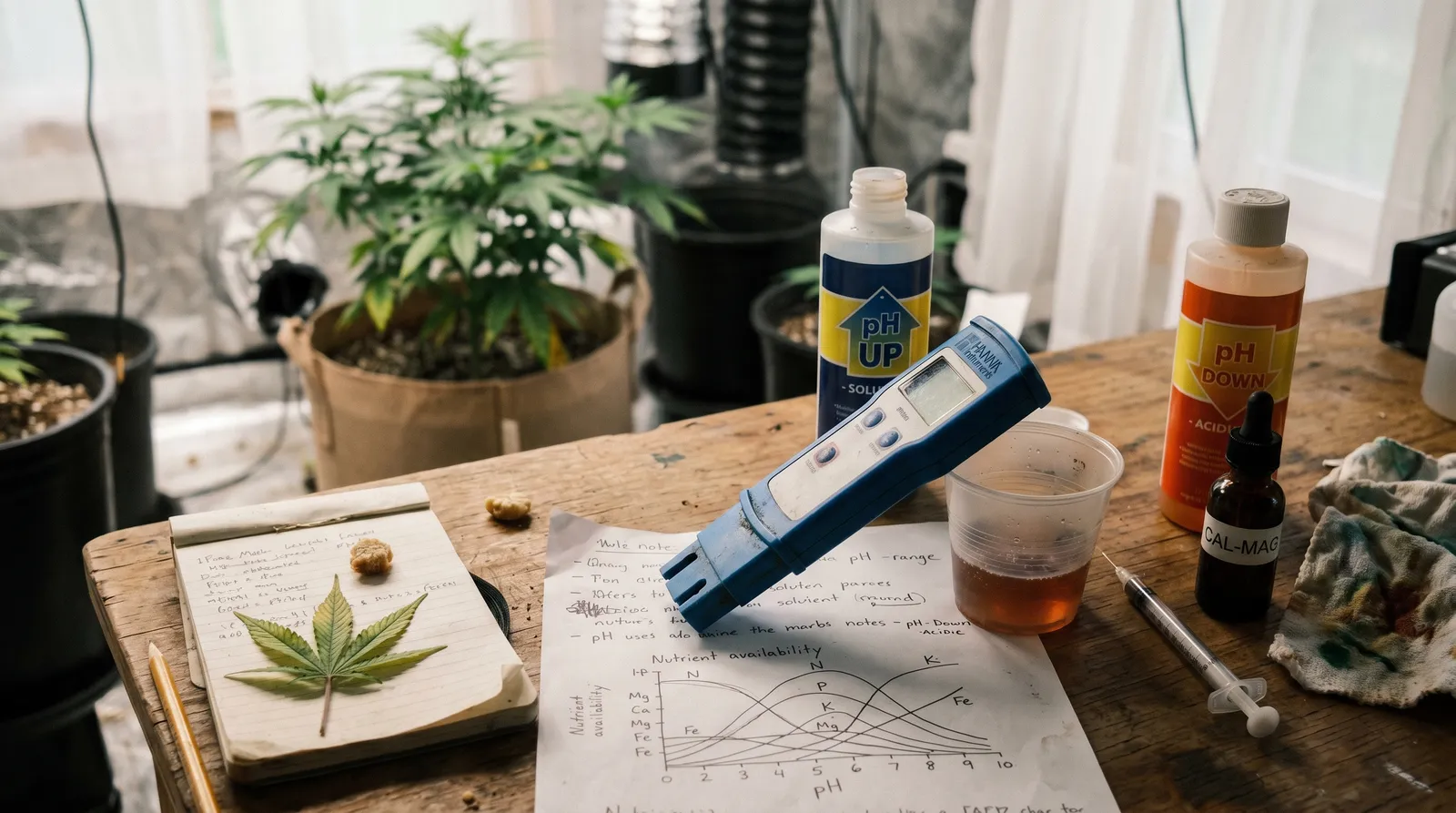
Target ranges we stick to in our own tent:
- Soil: pH 6.0–6.8, EC 1.0–1.8 mS/cm in veg, up to 2.2 in flower
- Coco coir: pH 5.8–6.2, EC 1.2–2.0 mS/cm, feed every watering with Cal-Mag
- Hydroponics (DWC/NFT): pH 5.5–6.0, EC 1.2–1.8 mS/cm, reservoir watched daily
Honest limitation: a cheap pH pen that hasn't been calibrated in a month will lie to you by 0.3–0.5 points, which is enough to fake a lockout that isn't really there. Calibrate before every diagnostic reading, or don't trust the number. If you buy a pH pen, get a decent one with calibration solution in the box — it pays for itself the first time it saves a plant.
If symptoms appear across multiple nutrients at once — iron and calcium together, say — the medium is almost certainly out of range. Fix the pH first, wait 3–4 days, and re-read the plant.
The three confusions that catch everyone
Three symptom patterns get misdiagnosed more than any others: nute burn mistaken for potassium deficiency, coco-related Cal-Mag shortage mistaken for generic yellowing, and natural flower fade mistaken for nitrogen deficiency.
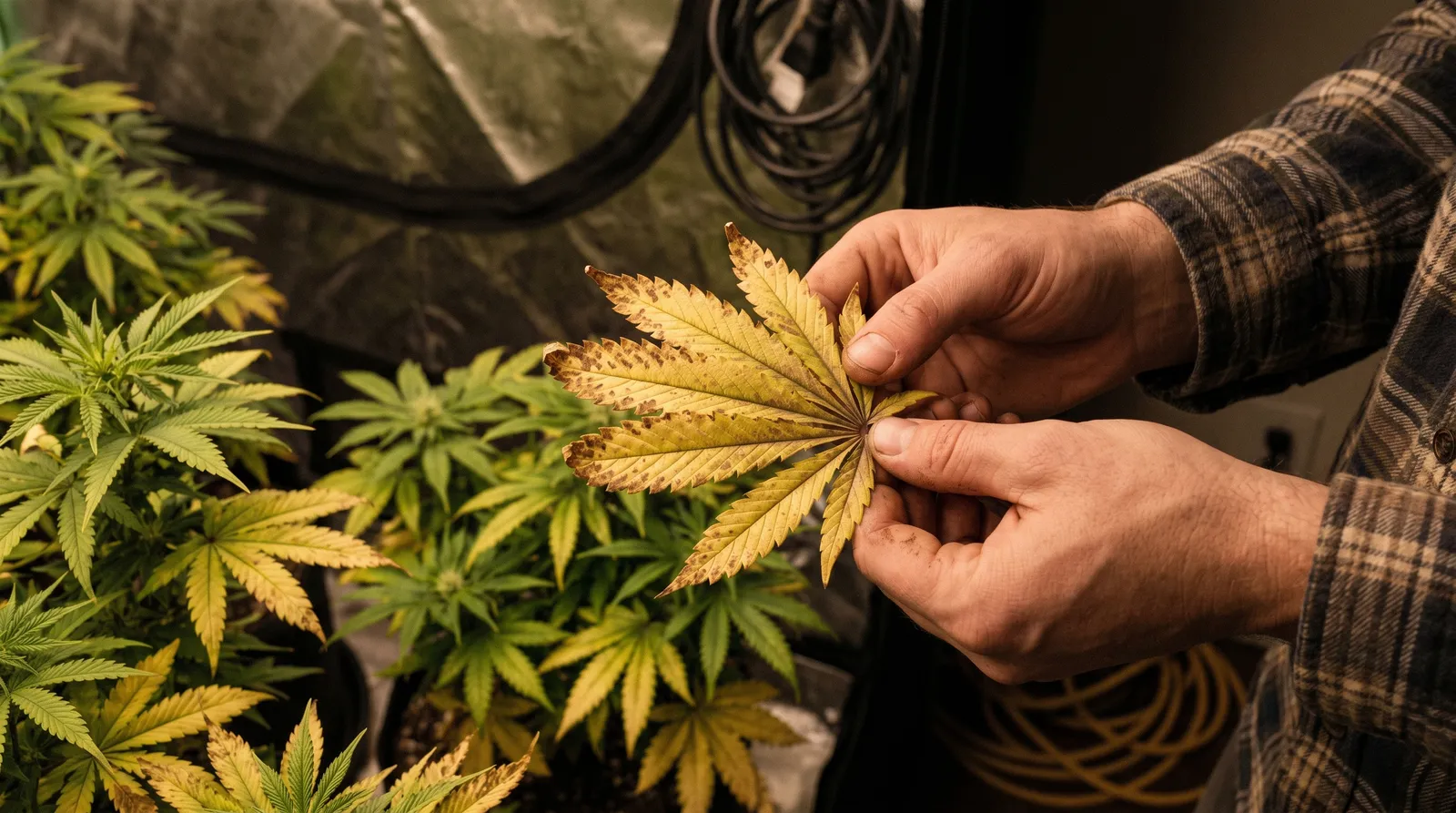
Nute burn vs potassium deficiency. Both give you burnt leaf tips. Nute burn starts uniformly across the canopy with EC too high; K deficiency starts on lower leaves with interveinal yellowing creeping in behind the burn. Check runoff EC — above 2.5 mS/cm in soil and you're overfeeding.
Calcium vs magnesium in coco. Coco coir holds onto potassium and releases it slowly while binding calcium and magnesium. Growers running coco without Cal-Mag supplementation see a predictable cascade: Mg interveinal yellowing on mid-leaves, Ca spotting on new growth, within 2–3 weeks of flip. Add Cal-Mag from day one in coco; it's not optional.
Natural flower fade vs nitrogen deficiency. From week 5–6 of flower onward, fan leaves yellow and drop as the plant remobilises nitrogen into the buds. This is normal and desirable. If the entire plant is yellowing by week 3, that's a real deficiency. If only the lower fans are fading at week 7, leave it alone.
A diagnostic workflow that actually works
Work through four steps in order before you buy another bottle of feed: check runoff, locate the damage, check the environment, then make one change at a time.
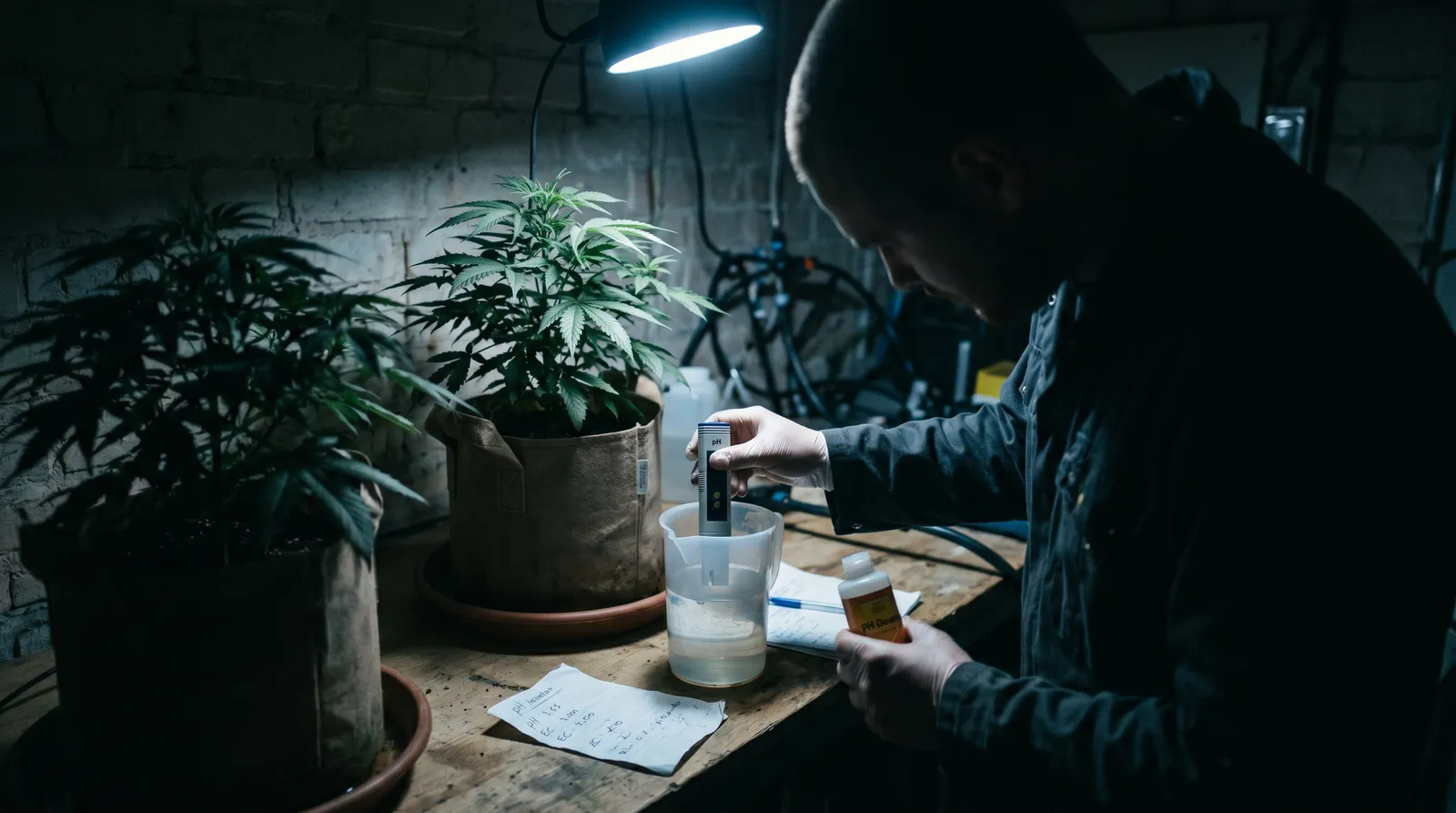
- Check runoff pH and EC. Collect 50 ml of runoff from the next watering. This tells you what the roots are actually experiencing, not what you poured in.
- Locate the damage. Top, middle, or bottom of the plant? New growth or old? Use the mobility logic.
- Check the environment. Root-zone temperature below 15 °C locks out phosphorus. Ambient humidity above 70% reduces transpiration and slows calcium uptake (Hochmuth, 2011).
- One change at a time. Adjust pH, or add Cal-Mag, or reduce EC — not all three at once. Wait 4–5 days. Symptoms stop spreading before damaged leaves recover; judge by new growth, not old.
When it's excess, not deficiency
Excess of one nutrient often shows up as a deficiency of another. Excess nitrogen causes dark, clawing leaves and suppresses calcium uptake. Excess potassium blocks magnesium. Excess phosphorus in flower boosters can lock out zinc and iron. If you've been steadily pushing EC up and the plant is getting more symptoms, not fewer, the answer is usually a flush with plain pH'd water at EC 0.3–0.5, then restart feeding at 60% of previous strength.
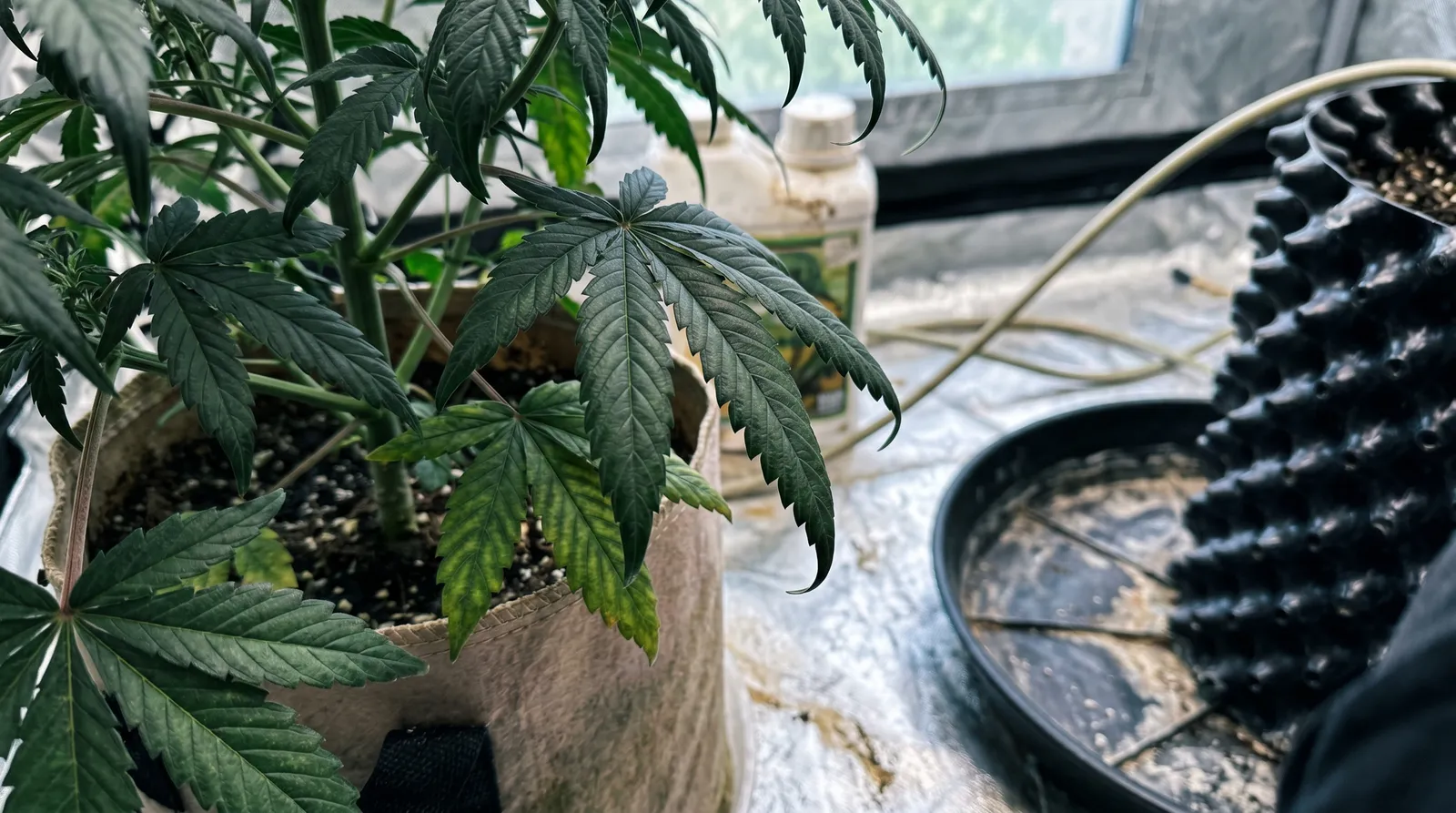
Cannabis does most of its damage to itself through overfeeding, not underfeeding. Published cultivar trials show healthy growth across an EC range of 1.2–2.2 mS/cm depending on stage and genetics (Caplan et al., 2017) — higher isn't better.
Last updated: April 2026
Frequently Asked Questions
8 questionsHow do I tell the difference between nitrogen deficiency and natural flower fade?
Why do my plants show deficiencies even though I'm feeding correctly?
What nutrient deficiencies are most common in coco coir?
Can I fix a nutrient deficiency once the damage is visible?
What does purple or red stem colour mean on cannabis?
Should I flush my plants when I see a deficiency?
How do I know if symptoms are showing on new or old growth, and why does it matter?
What pH range should I maintain to prevent nutrient lockout in different growing media?
About this article


Luke Sholl has been writing about cannabis, cannabinoids, and the broader benefits of nature since 2011, and has personally grown cannabis in home grow tents for more than a decade. That first-hand cultivation experience
This wiki article was drafted with AI assistance and reviewed by Luke Sholl, External contributor since 2026. Editorial oversight by Adam Parsons.
Medical disclaimer. This content is for informational purposes only and does not constitute medical advice. Consult a qualified healthcare provider before use of any substance.
Last reviewed April 24, 2026
References (6)
- [1]Bugbee, B. (2004). Nutrient management in recirculating hydroponic culture. Acta Horticulturae, 648, 99–112.
- [2]Caplan, D., Dixon, M., & Zheng, Y. (2017). Optimal rate of organic fertilizer during the vegetative-stage for cannabis grown in two coir-based substrates. HortScience, 52(9), 1307–1312.
- [3]EMCDDA (2023). Cannabis cultivation in Europe: developments and policy responses. European Monitoring Centre for Drugs and Drug Addiction, Lisbon.
- [4]Hochmuth, G. J. (2011). Plant petiole sap-testing for vegetable crops. University of Florida IFAS Extension, CIR1144.
- [5]Marschner, H. (2012). Marschner's Mineral Nutrition of Higher Plants (3rd ed.). Academic Press.
- [6]Mills, H. A., & Jones, J. B. (1996). Plant Analysis Handbook II. MicroMacro Publishing.
Related Articles
Cannabis Hermaphrodite: Identify, Prevent, Act
A cannabis hermaphrodite is a female plant that develops male pollen sacs or banana-shaped anthers (nanners), self-pollinating and seeding your harvest.
DIY Cannabis Fertilizer: Homemade Nutrient Guide
DIY cannabis fertilizer guide: compost, teas, banana ferments and feed schedules, with safety notes and cited research for home growers.
What To Do With Male Cannabis Plants: 6 Practical Uses
What to do with male cannabis plants: identify, isolate, breed, extract, or compost. A practical 6-step guide with sourcing and safety notes.
Mushroom Grow Kit Temperature & Humidity: Full Setup Guide
A temperature humidity control grow kit is the small set of climate tools — hygrometer, heat mat, humidifier or perlite tray — that keeps a mushroom fruiting…
When to Harvest Mushrooms: Veil Break Timing Explained
Harvest timing veil break is a cultivation technique that uses the tearing of the partial veil on maturing Psilocybe cubensis to mark peak alkaloid content.

First Grow Checklist: What You Need for Mushroom Kits
A first grow checklist is the short list of supplies and environmental conditions needed to run a home psilocybin mushroom kit from inoculated substrate to…
Sclerotia vs Fruit Bodies: Cultivation Comparison
Sclerotia and fruit bodies are two different life stages of Psilocybe fungi: sclerotia are hardened underground mycelial storage bodies (the 'magic…
Storing Dried Mushrooms Long Term: Full Guide
Storing dried mushrooms long term means keeping well-dried Psilocybe fruit bodies in airtight, opaque containers with desiccant, cool and dark, to slow…
Drying Mushrooms Air Desiccant Oven: Methods Compared
Drying mushrooms air desiccant oven refers to the three home methods for reducing fresh fruit bodies from ~90% water to cracker-dry (<5%). Gotvaldová et al.