
This article discusses psychoactive substances intended for adults (18+). If you have a health condition or take medication, consult a doctor before use. Our age policy
Cannabis Mold Bud Rot Prevention: Grower Guide
Definition
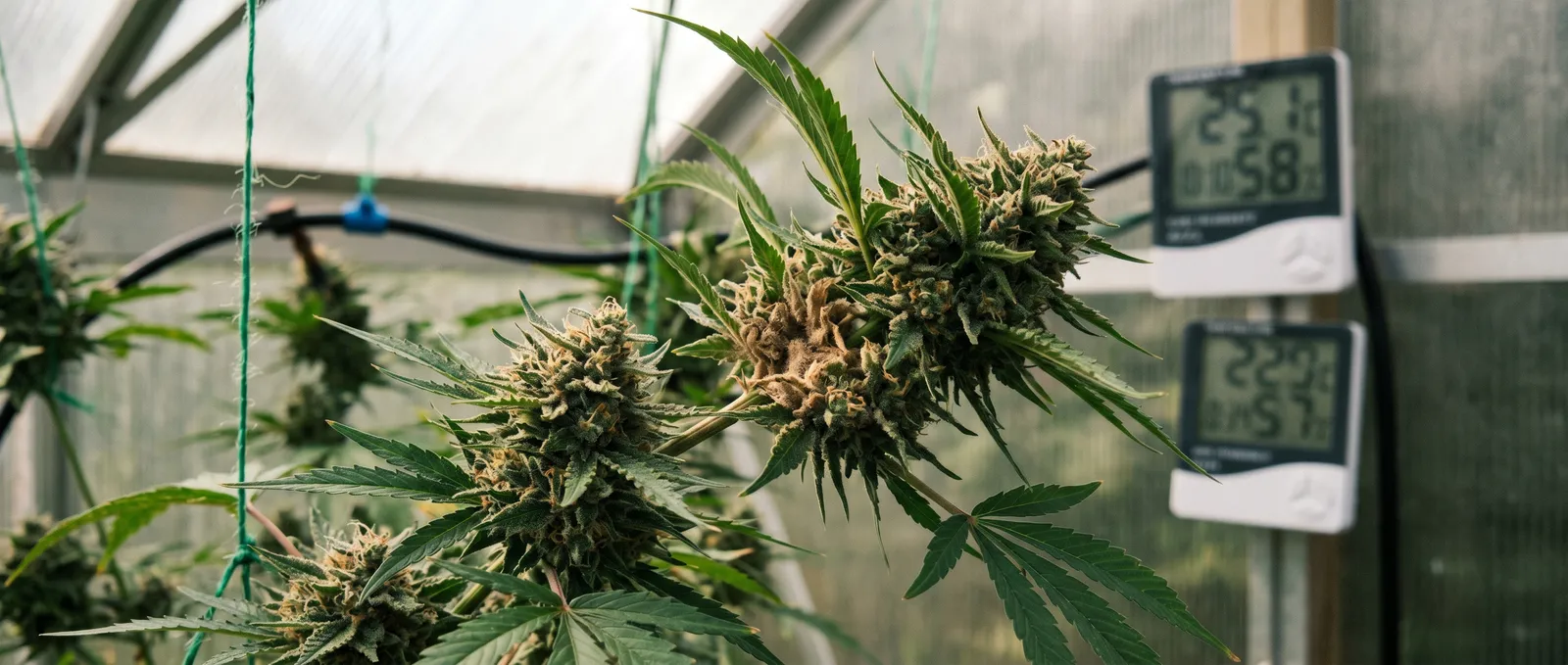
Cannabis mold bud rot prevention is the management of humidity, airflow, training and genetics to stop Botrytis cinerea colonising flowers in late bloom. Punja et al. (2023) identified botrytis as the most damaging post-harvest pathogen in indoor cannabis, with infection often starting endophytically inside stem tissue before any external symptoms appear.
Adult use only — this cultivation guide is written for growers aged 18 and over.
Cannabis mold bud rot prevention is a late-flower environmental discipline that stops Botrytis cinerea colonising dense colas before harvest. Botrytis, the grey mould behind cannabis bud rot, is the pathogen most likely to gut a late-flower harvest in a Northern European tent or greenhouse. It thrives in the exact conditions dense, sticky flowers create in weeks 6–9: high humidity, still air, and temperatures between 15–25°C. Growers who buy quality genetics, order a proper datalogger, and get airflow right can tilt the odds dramatically on cannabis mold bud rot prevention. Skip one link in that chain and you can lose half a colas in 48 hours.
Once B. cinerea has colonised the inside of a cola, there is no spray that will save that flower. Punja et al. (2023), in a Frontiers in Plant Science survey of Canadian cannabis facilities, isolated Botrytis from stem tissue, substrate, and internal flower tissue — meaning infection can be endophytic and invisible until the cola browns. That single finding reframes the whole job: you are not fighting mould on the surface, you are denying it the conditions to wake up from inside the plant.
Honest limitation: no combination of airflow, genetics, and humidity control makes a crop botrytis-proof. Endophytic infection can sit invisible in stem tissue from clone onwards (Punja 2023), so cannabis mold bud rot prevention is a probability game, not a guarantee.
Compared to powdery mildew, which lives on leaf surfaces and responds to foliar intervention, botrytis is a structural and climate problem — you cannot spray your way out of it in week 8.
Step 1 — Know exactly what you're looking for
Bud rot starts deep inside a cola, not on the outside. The earliest signs: a single sugar leaf yellowing and pulling out with zero resistance, a patch of cola that feels slightly soft when you press it, or a wisp of grey-white fuzz tucked into the densest part of the flower. Break that cola open and the interior is brown-grey, dusty, and webby — the tissue effectively turns into compost inside its own skin.
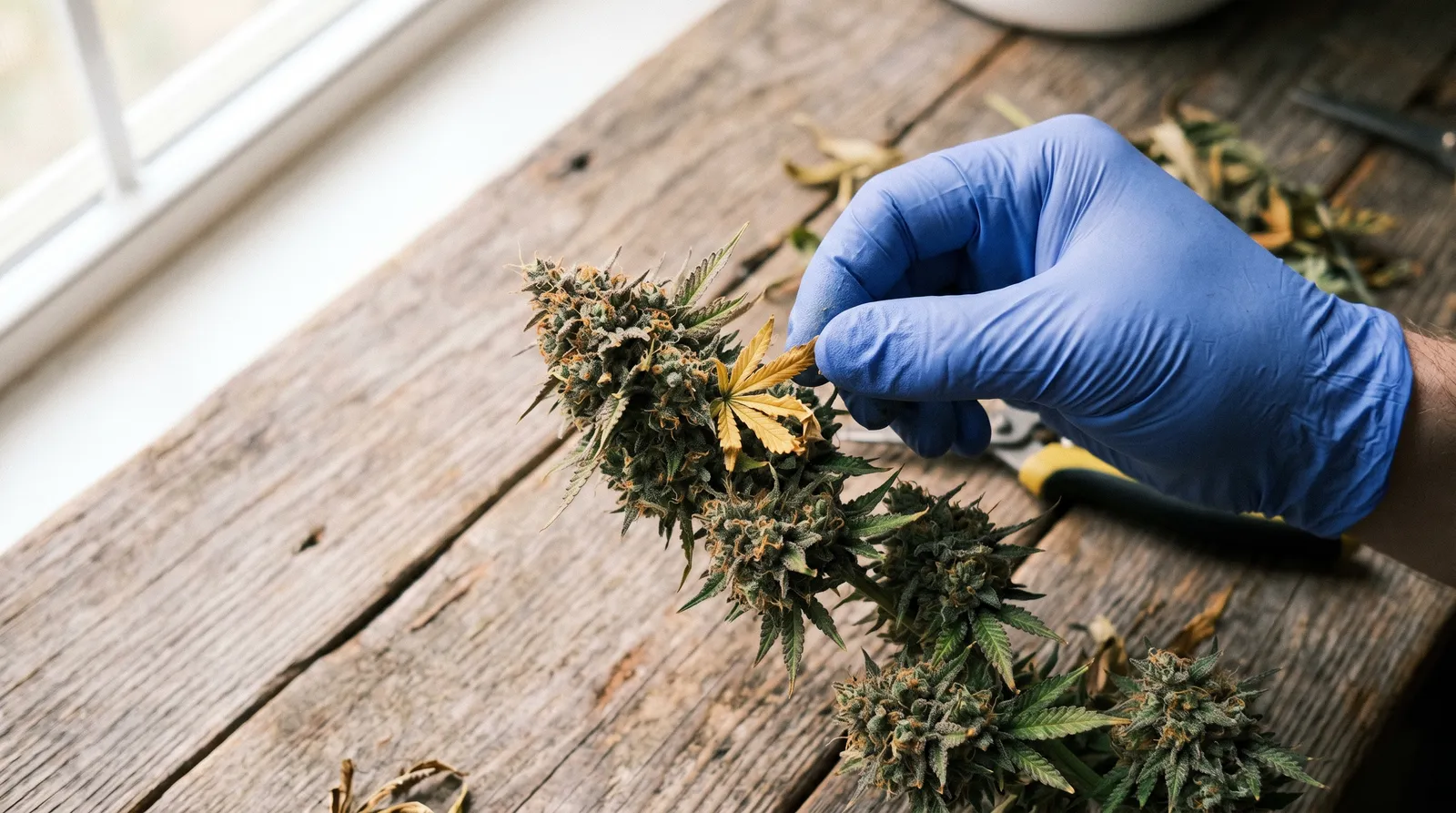
It is not powdery mildew (white dust on fan leaves), it is not trichome senescence (amber glands), and it is not normal pistil browning. If in doubt: grey-brown inside + soft texture + yellow sugar leaves pulling loose = botrytis. Bin the whole cola, with a generous margin, immediately.
Step 2 — Lock relative humidity and VPD for flower
Humidity is the single biggest lever in cannabis mold bud rot prevention. Spores germinate on flower tissue above roughly 80% RH, and Punja & Rodriguez (2018) reported Botrytis as the most-encountered post-harvest pathogen in Canadian indoor grows where humidity crept past that threshold in late flower.
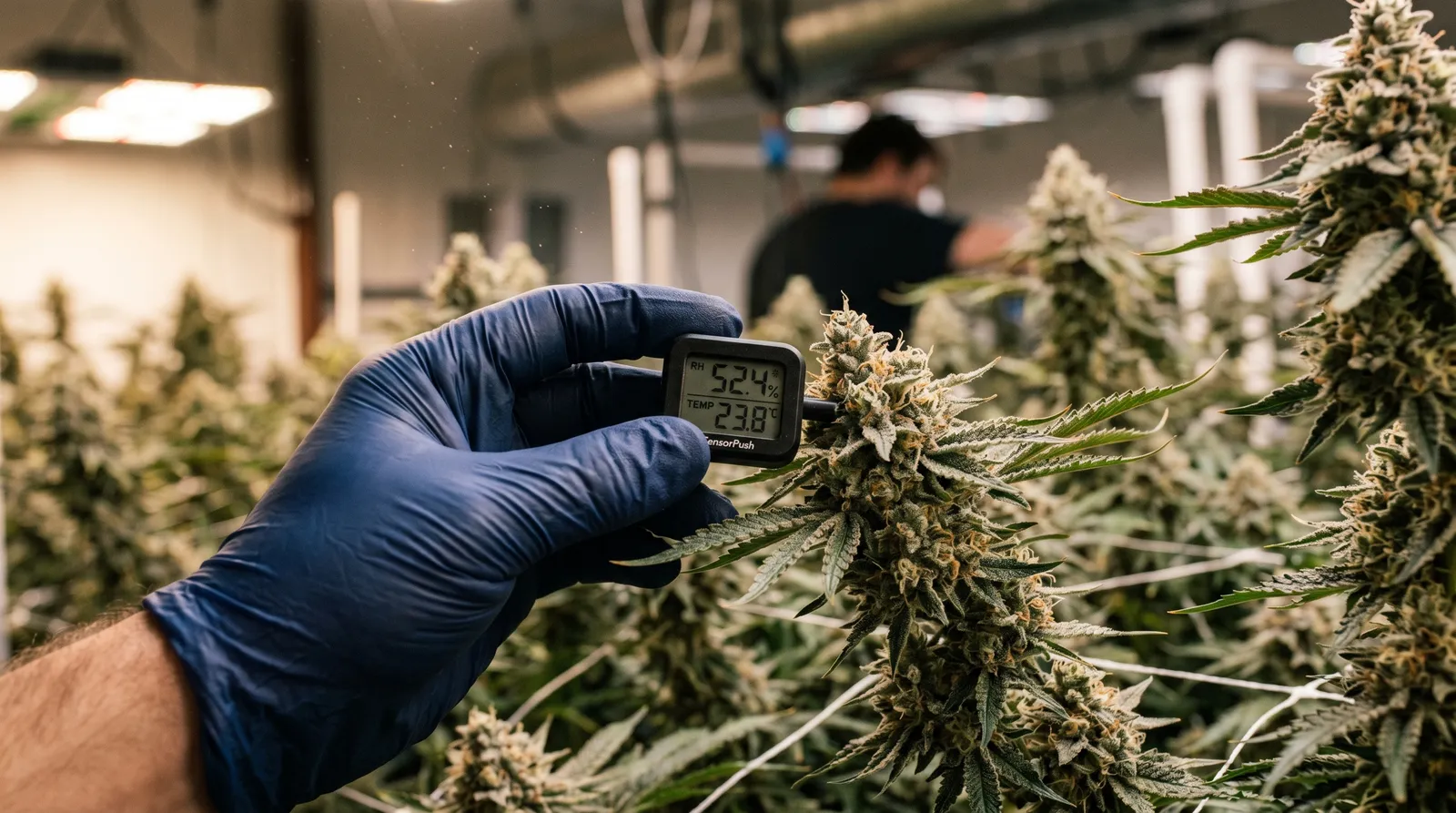
Target ranges for photoperiod flower in a typical indoor tent:
| Flower stage | RH target | Temp (lights on) | VPD (kPa) |
|---|---|---|---|
| Weeks 1–3 | 55–60% | 22–25°C | 1.0–1.2 |
| Weeks 4–6 | ~50% | 22–24°C | 1.2–1.4 |
| Weeks 7 to harvest | 40–45% | 20–22°C | 1.3–1.5 |
Night-time is where most tents fail. When lights go off and temperature drops 4–6°C, RH spikes — that 55% day reading becomes 78% at 3am and you never see it unless you log it. Get a datalogger (Pulse, SensorPush, or a cheap Govee) and check the overnight minimum temperature and maximum humidity, not just the current reading. If overnight RH breaks 65%, you need a dehumidifier, not a stronger fan.
Step 3 — Move air through the canopy, not just past it
Still air inside a dense cola is what lets spores settle and germinate. Exhaust fans remove humidity from the tent; oscillating fans stop microclimates forming in the canopy. Both jobs, two different fans.
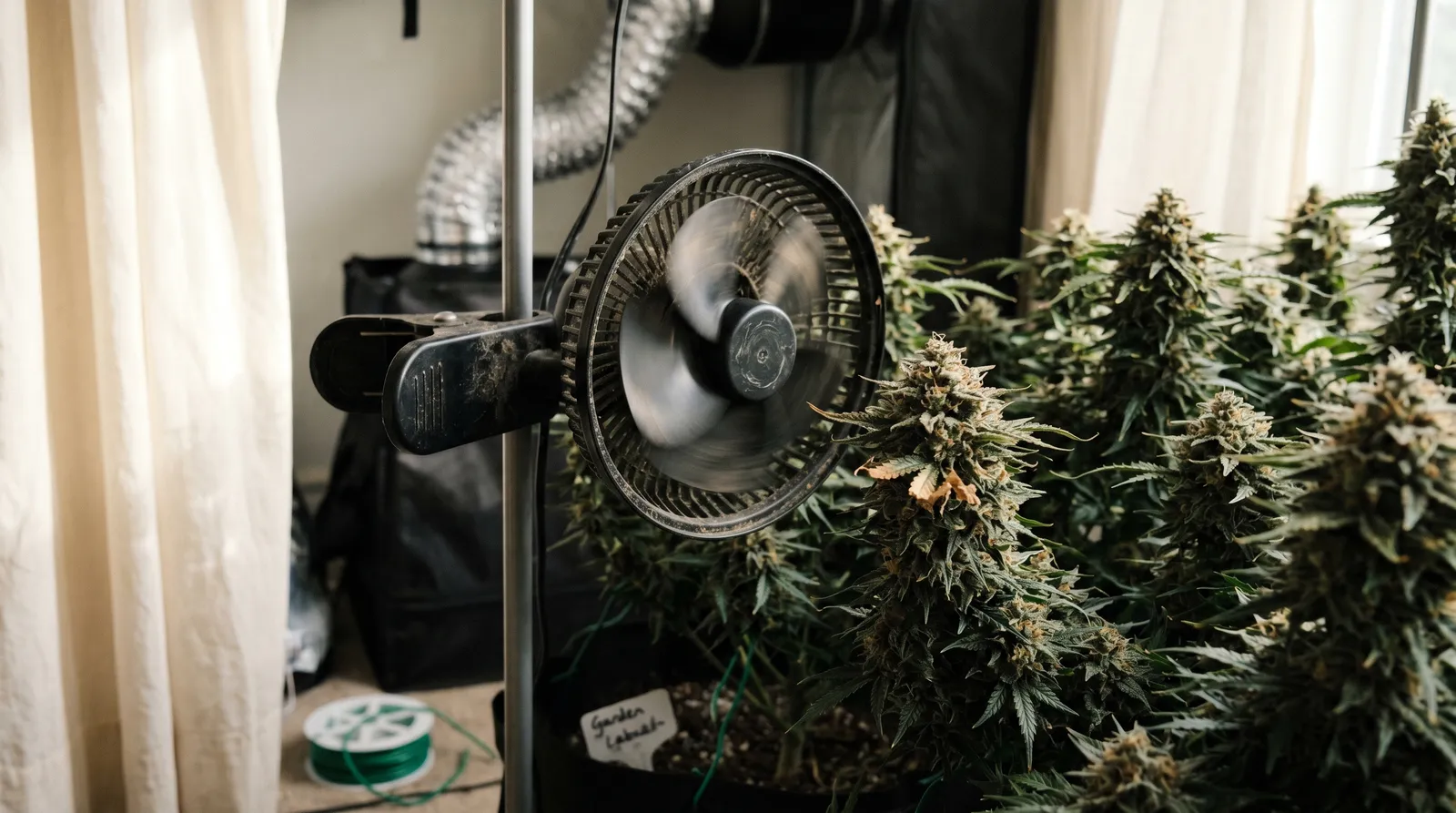
In a 1.2m × 1.2m tent with four flowering photoperiod plants, a sensible setup: one inline extraction fan sized for 3–5 air exchanges per minute through a carbon filter, plus one or two clip-on oscillating fans aimed to ripple fan leaves without blasting the colas. If you can see the leaves gently flickering at every canopy level, airflow is doing its job. If the bottom third is dead-still, bud rot will find it.
Step 4 — Train and defoliate for airflow, not for Instagram
Plant training is a prevention tool, not just a yield tool. Dense, chunky colas on indica-leaning genetics are the classic bud rot victims — the cola interior stays wet, spores germinate, you lose the heart of the flower. Compared to Kush-dominant phenos, airy sativa structures shrug off damp mornings that would rot a Northern Lights solid.
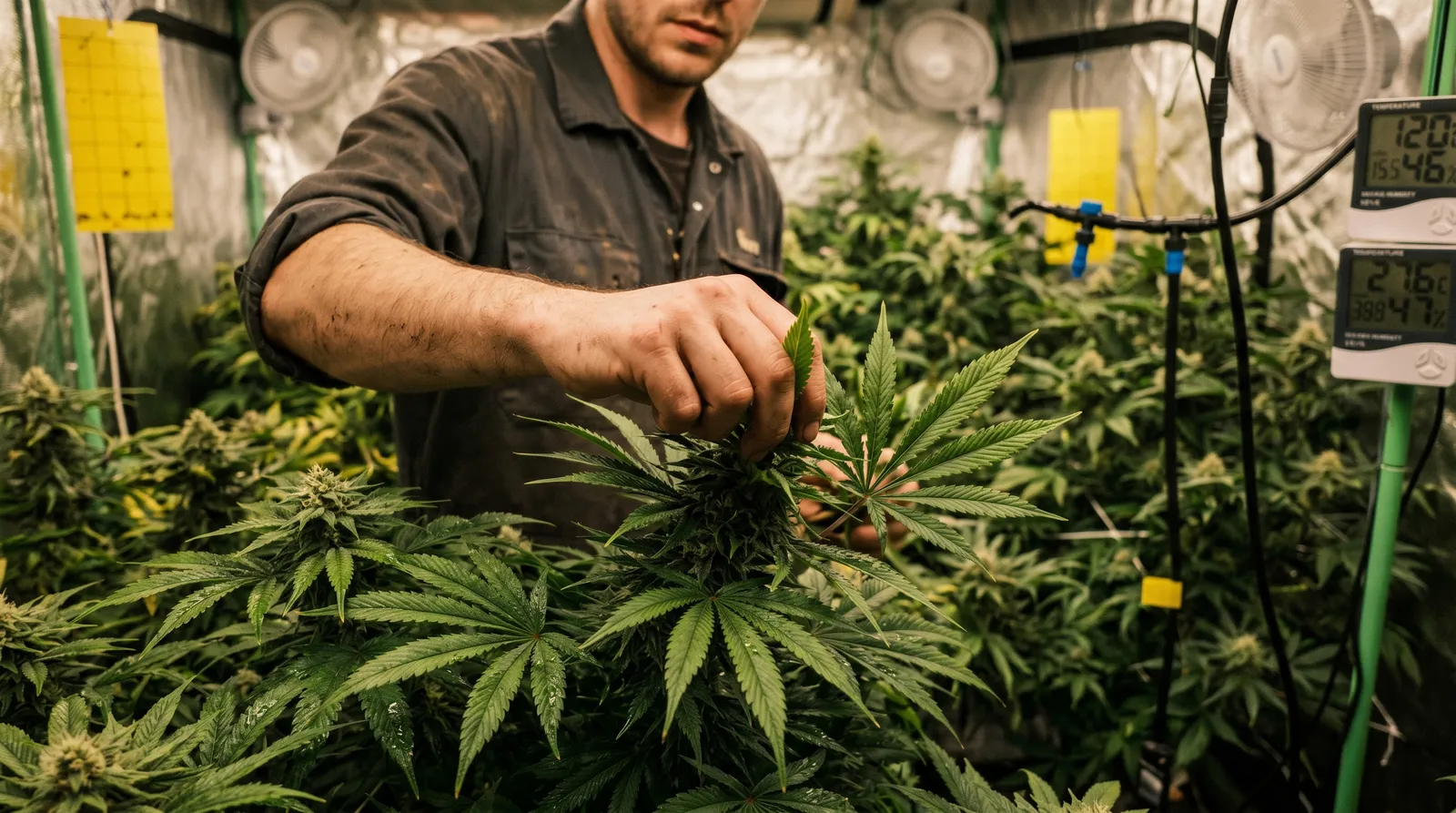
- LST and topping in veg to open the plant up into an even canopy — no single dominant spear cola.
- SCROG for photoperiod plants if you have the patience; it spreads colas across a horizontal plane where every flower gets airflow.
- Selective defoliation at day 21 of flower — remove fan leaves that are physically touching bud sites or trapped inside the cola structure. Not schwazzing (evidence for that remains contested), just targeted leaf removal.
- Lollipop the bottom third — larf that never gets light never produces decent flower and just holds humidity near the pot.
Step 5 — Choose genetics that match your climate
Genetics set the ceiling for how much weather abuse a crop can absorb. If you're growing outdoors or in a greenhouse in the Netherlands, Germany, or the UK, October is bud rot season. Cold, wet autumns and dense indica-dominant flowers are a published disaster pairing. Two strategic options:
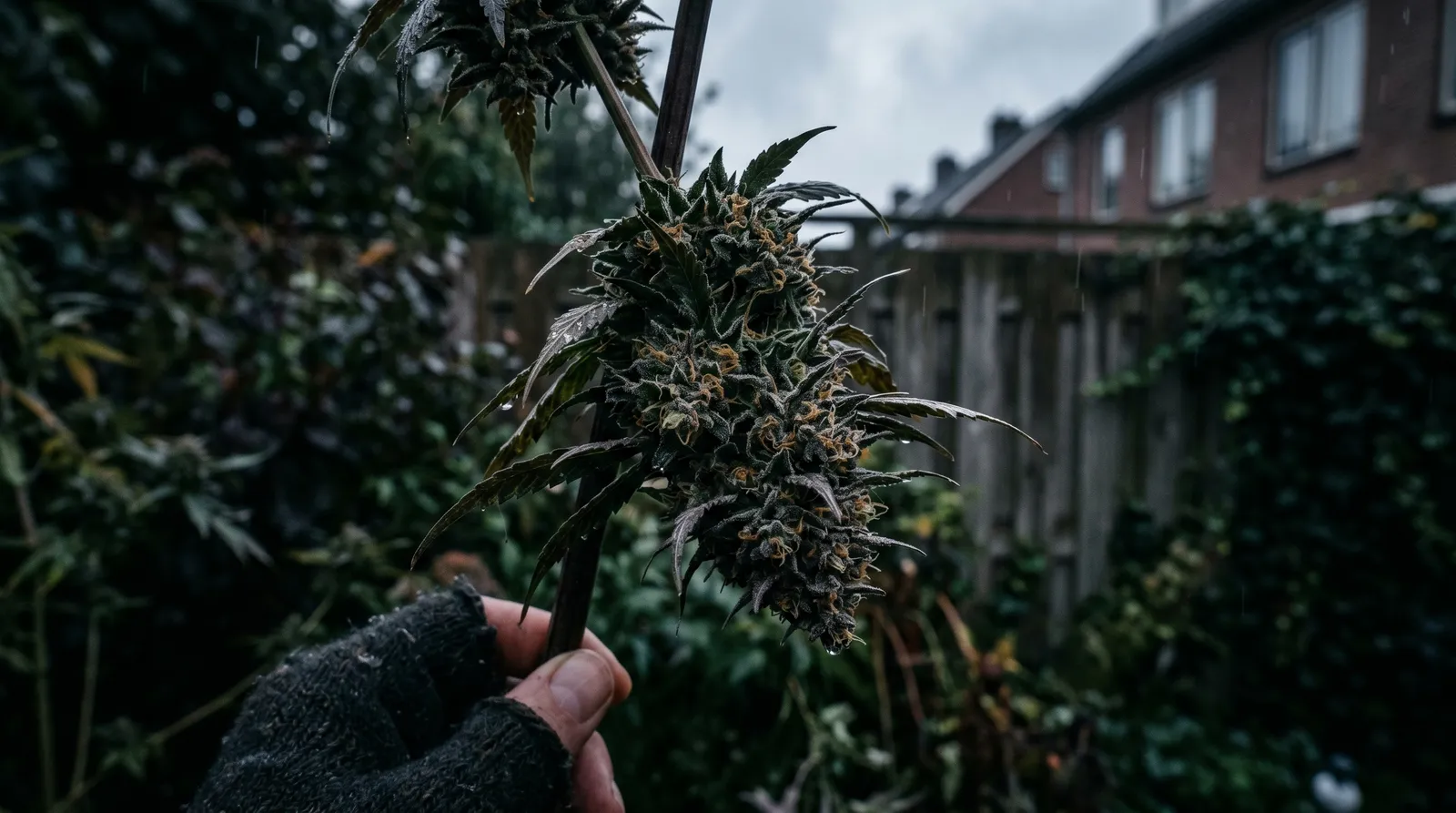
- Autoflowers outdoors: genetics that flower by age (9–11 weeks seed to harvest) let you start in May and harvest in August, dodging the autumn rain window entirely. Order Dutch Passion's Auto line or Royal Queen Seeds' autoflower range — both were bred partly around this Northern European reality.
- Airy sativa-leaning structure: for photoperiod outdoor grows, buy genetics described by the breeder as having open, foxtail-style or wispy flower structure — Durban Poison, Hazes, and many landrace sativas hold up better to damp than a rock-hard Kush cola.
Honest limitation: breeder documentation on "mould resistance" is contested — growers report enormous variation between phenos of the same variety, so treat it as a probability shift, not a guarantee. No seed you can order is rot-proof.
Step 6 — Rain, dew, and the autumn trap
Outdoor bud rot prevention is mostly weather management. A cola that holds overnight dew for three mornings in a row is a cola that will rot. Practical moves:
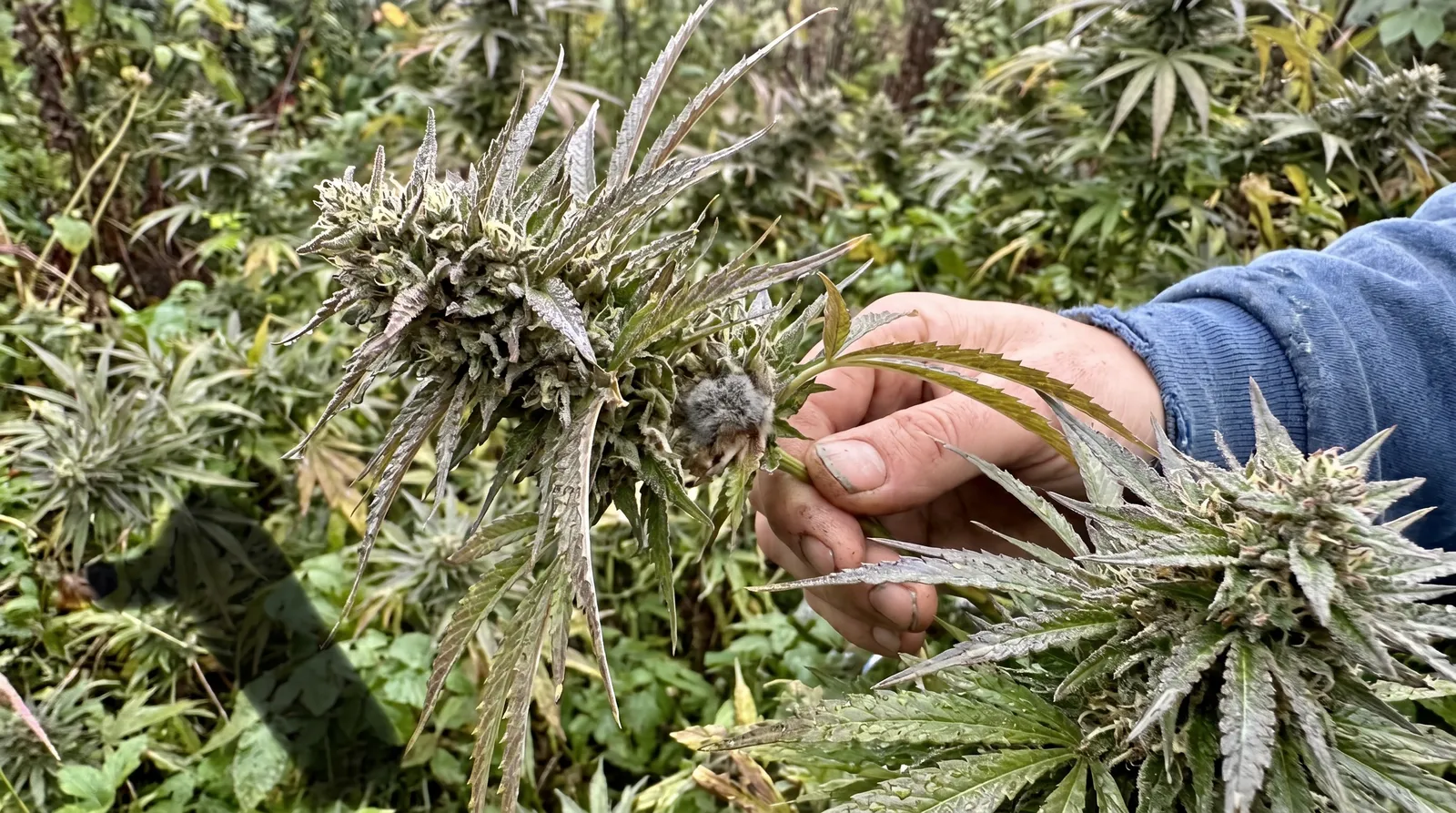
- Shake plants gently every morning after heavy dew or rain — literally bend the stem and let the water fall off. Do it before the sun hits.
- Rig a simple rain cover (poly tunnel, clear tarp on a frame) over plants from late August onwards if you're in a wet climate. Leave the sides open for airflow.
- Consider harvesting early if the forecast shows five straight days of rain in week 8. Slightly under-ripe trichomes beat a mouldy harvest every time.
- Check every cola, every morning, in weeks 7 onwards. A torch helps — shine through the cola from the back and any dark patch is a rot candidate.
Step 7 — Preventive biocontrol, not late-flower fungicide
Any spray on mature flowers is a bad idea — you cannot rinse residue out of sticky trichomes, and most synthetic fungicides have no clearance for use on flowering cannabis. Preventive biocontrol belongs earlier in the cycle.
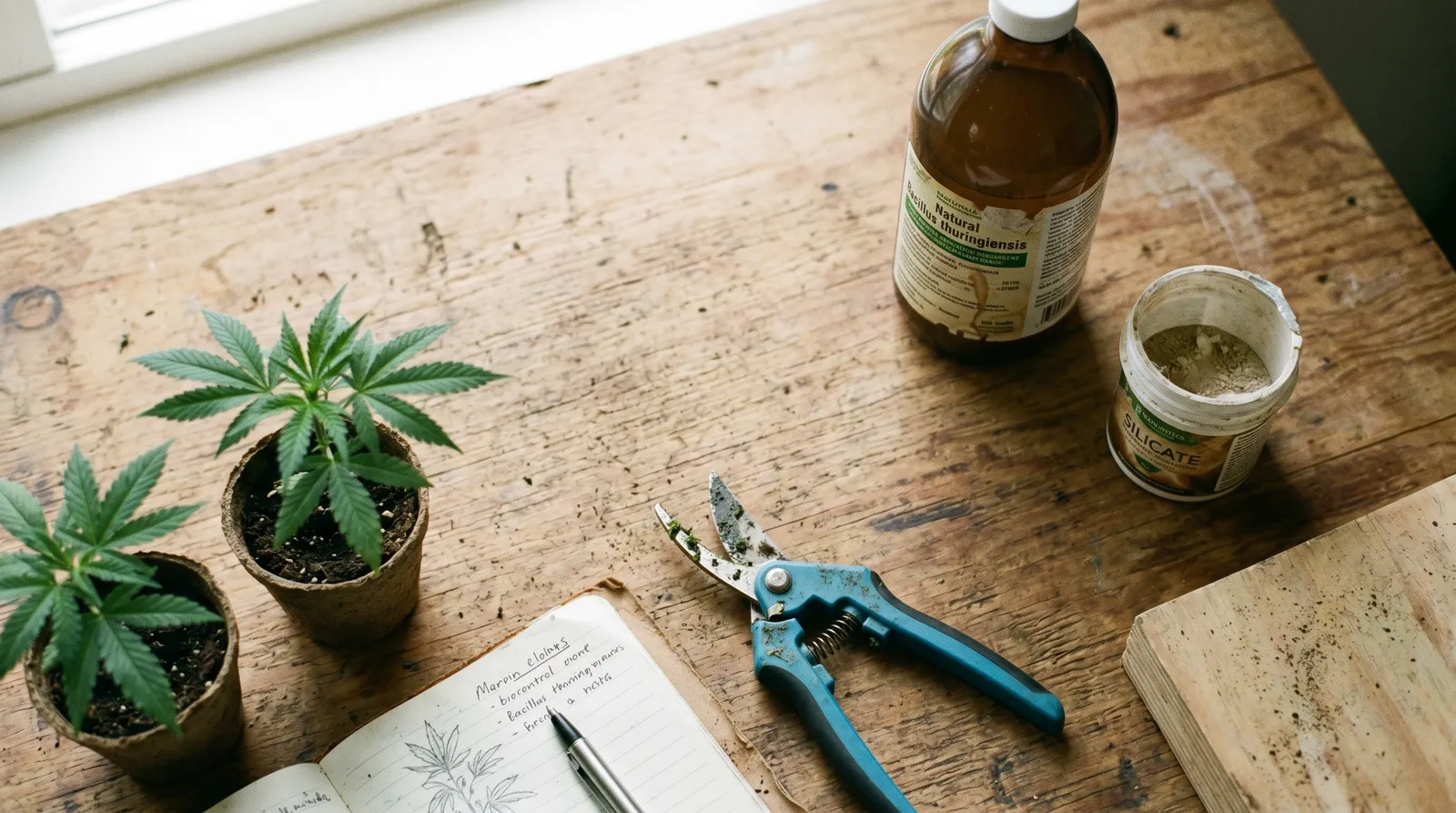
Bacillus subtilis- and Trichoderma harzianum-based products, applied as a foliar spray through late veg and the first two weeks of flower, establish competing microbes on leaf surfaces before botrytis spores arrive. Stop all sprays by day 21 of flower. After that, your only tools are environmental: RH, airflow, and scouting. Products labelled for botrytis exist, but on cannabis flower destined for consumption, the honest answer is they're the wrong tool — the EU has no approved fungicide residue rules for cannabis flower, so there is no safe post-flower-spray window you can verify.
Step 8 — If you find it, triage fast
Speed matters more than precision once rot appears. One infected cola becomes ten in 48 hours if you panic and blow spores around.
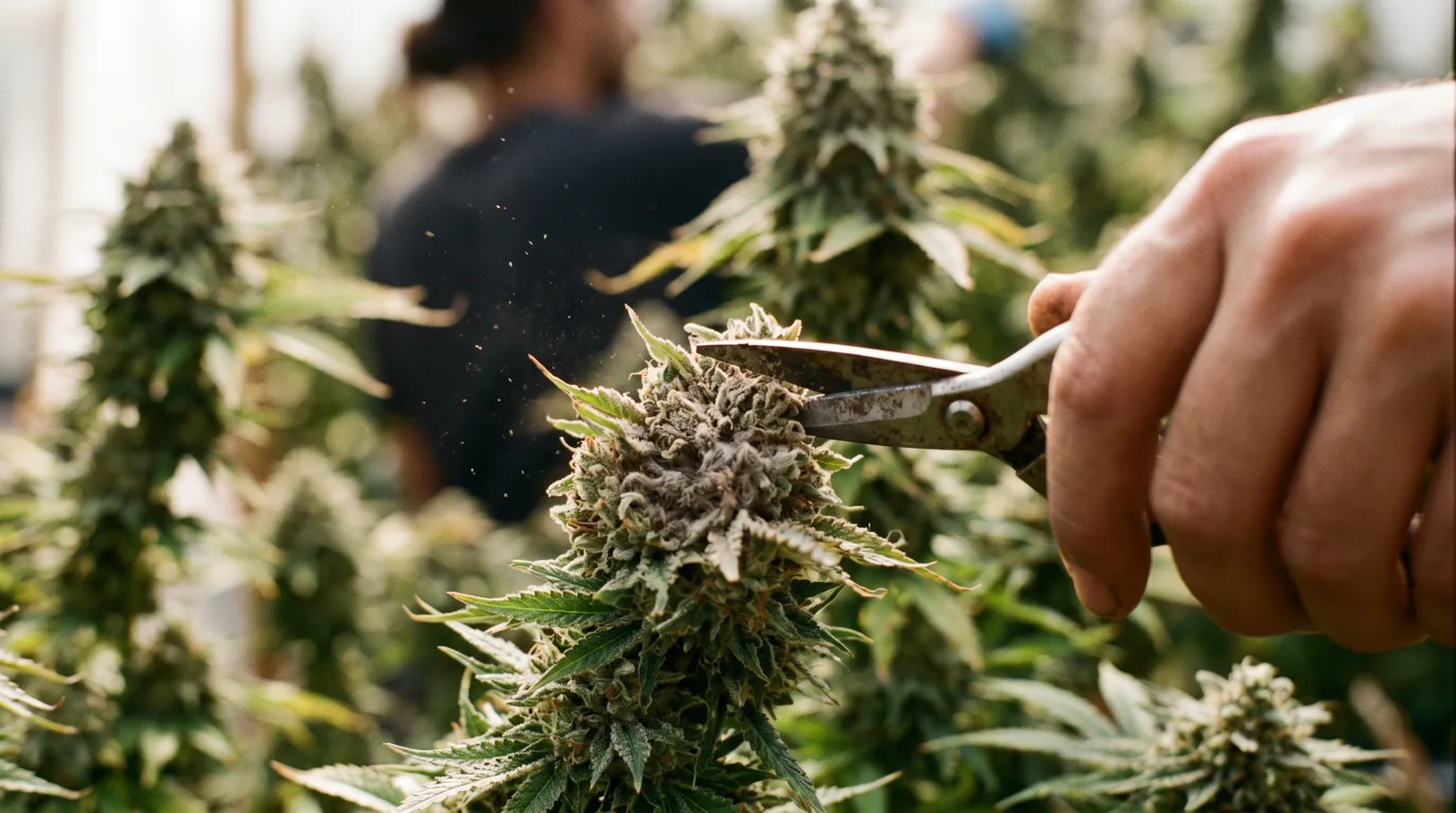
- Turn off the oscillating fans. Blowing spores around is how one infected cola becomes ten.
- Put on disposable gloves. Cut the affected cola plus 5–10cm of healthy tissue above and below the visible rot.
- Bag it immediately — seal, don't flap — and take it out of the grow space.
- Sterilise your scissors with isopropanol between every cut.
- Drop RH to 40% and increase airflow. Inspect the rest of the plant and every neighbouring plant under torchlight.
- If rot is widespread across multiple colas, harvest early. Wet-trim, hang in a room at 18°C / 50% RH with strong airflow, and expect some yield loss — but you'll save most of the crop.
Step 9 — Post-harvest is still bud rot territory
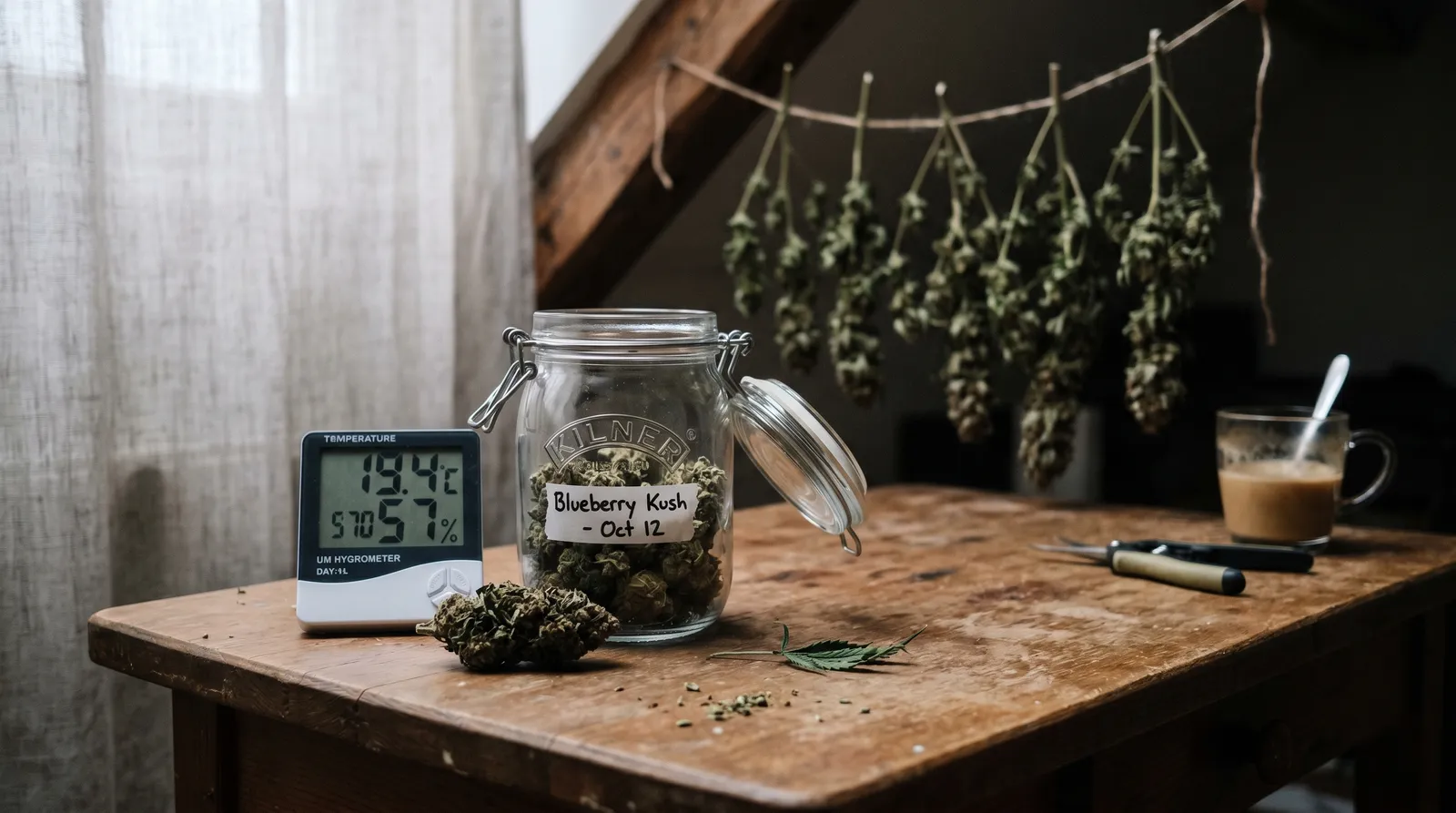
Botrytis doesn't stop at harvest. Buds dried too fast seal moisture inside; buds dried too slow mould in the jar. The range that works: 18–20°C, 55–60% RH, 10–14 days hanging or on racks, until small stems snap rather than bend. Cure in jars with a 58–62% RH two-way humidity pack, burping daily for the first week. If you ever open a jar and smell ammonia or see any dust on the flower, that jar is compost — not smokable, not salvageable.
Common mistakes worth naming
- Relying on the daytime RH reading. Overnight spikes are where rot starts. Log 24 hours.
- One big fan instead of two small ones. Penetration through the canopy matters more than raw CFM.
- Spraying neem or compost teas in late flower. Both add moisture to sticky colas. Stop all foliar sprays by day 21.
- Packing a tent. Four plants in a 1.2m tent is the upper limit for photoperiod — six is a bud rot incubator.
- Jarring flower that isn't properly dry. Small stems should snap. If they bend, the cure becomes a mould farm.
Legal notice: Cannabis cultivation laws vary by country and region and change frequently. This guide is educational. Before growing, verify current laws for your specific jurisdiction. Azarius does not provide legal advice.
Educational cultivation information for adult growers. This guide is not medical or professional advice — consult a qualified agronomist or physician where appropriate. Always follow the rules in force where you live.
Last updated: April 2026
Frequently Asked Questions
8 questionsWhat does bud rot look like in its earliest stages?
What humidity level prevents bud rot in late flower?
Can you save a plant that already has bud rot?
Are autoflowers more resistant to bud rot than photoperiod plants?
Does defoliation actually reduce bud rot risk?
Is it safe to spray fungicide on flowering cannabis?
Why does bud rot appear overnight even when daytime humidity looks fine?
Can bud rot spread from one plant to another in a grow tent?
About this article


Luke Sholl has been writing about cannabis, cannabinoids, and the broader benefits of nature since 2011, and has personally grown cannabis in home grow tents for more than a decade. That first-hand cultivation experience
This wiki article was drafted with AI assistance and reviewed by Luke Sholl, External contributor since 2026. Editorial oversight by Adam Parsons.
Medical disclaimer. This content is for informational purposes only and does not constitute medical advice. Consult a qualified healthcare provider before use of any substance.
Last reviewed April 24, 2026
References (5)
- [1]Punja, Z.K., Collyer, D., Scott, C., Lung, S., Holmes, J. (2023). Pathogens and molds affecting production and quality of Cannabis sativa L. Frontiers in Plant Science.
- [2]Punja, Z.K. & Rodriguez, G. (2018). Fusarium and Pythium species infecting roots of hydroponically grown marijuana plants. Canadian Journal of Plant Pathology, 40(4).
- [3]EMCDDA / EUDA (2024). Cannabis cultivation in Europe — production overview.
- [4]Beckley Foundation, cannabis research briefings (accessed 2026).
- [5]Royal Queen Seeds grower documentation, botrytis prevention protocols (accessed 2026).
Related Articles
Cannabis Hermaphrodite: Identify, Prevent, Act
A cannabis hermaphrodite is a female plant that develops male pollen sacs or banana-shaped anthers (nanners), self-pollinating and seeding your harvest.
DIY Cannabis Fertilizer: Homemade Nutrient Guide
DIY cannabis fertilizer guide: compost, teas, banana ferments and feed schedules, with safety notes and cited research for home growers.
What To Do With Male Cannabis Plants: 6 Practical Uses
What to do with male cannabis plants: identify, isolate, breed, extract, or compost. A practical 6-step guide with sourcing and safety notes.
Mushroom Grow Kit Temperature & Humidity: Full Setup Guide
A temperature humidity control grow kit is the small set of climate tools — hygrometer, heat mat, humidifier or perlite tray — that keeps a mushroom fruiting…
When to Harvest Mushrooms: Veil Break Timing Explained
Harvest timing veil break is a cultivation technique that uses the tearing of the partial veil on maturing Psilocybe cubensis to mark peak alkaloid content.

First Grow Checklist: What You Need for Mushroom Kits
A first grow checklist is the short list of supplies and environmental conditions needed to run a home psilocybin mushroom kit from inoculated substrate to…
Sclerotia vs Fruit Bodies: Cultivation Comparison
Sclerotia and fruit bodies are two different life stages of Psilocybe fungi: sclerotia are hardened underground mycelial storage bodies (the 'magic…
Storing Dried Mushrooms Long Term: Full Guide
Storing dried mushrooms long term means keeping well-dried Psilocybe fruit bodies in airtight, opaque containers with desiccant, cool and dark, to slow…
Drying Mushrooms Air Desiccant Oven: Methods Compared
Drying mushrooms air desiccant oven refers to the three home methods for reducing fresh fruit bodies from ~90% water to cracker-dry (<5%). Gotvaldová et al.