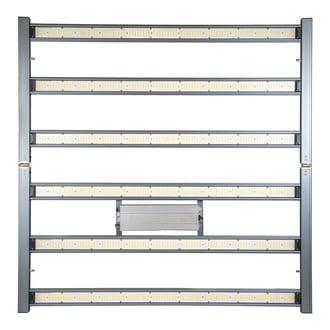
The Phytonaut LED Grow Light 480W is a full-spectrum LED fixture that pushes 1,415 µmol/s of light across a 100×100 cm canopy, built for serious indoor growers running 1.2×1.2 m tents or larger. At 2.9 µmol/J efficacy with Sanan and Osram diodes, it's the panel we'd reach for when a 320W just isn't covering the corners anymore.
Phytonaut LED Grow Light 480W: who this panel is built for
This is the Phytonaut 480W if you're running a 120×120 cm tent or scrogging four to six plants flat across a wide canopy. The 100×100 cm fixture body sits almost edge-to-edge in a 1.2 m tent, and the 120° beam angle spreads light to the walls instead of frying a hotspot in the middle. The smaller Phytonauts (120W, 240W, 320W) cover 60×60, 80×80 and 80×100 tents respectively — once you're past that, you want the 480W.
The Sanan and Osram diodes are the same chip families used in commercial horticultural fixtures. At 2.9 µmol/J, you're getting roughly 1,415 µmol/s of photosynthetic photon flux out of 480 watts at the wall — efficient enough that your electricity bill won't make you cry, and bright enough to push flowering plants hard.
Why the 480W over a Phytonaut 320W or a Pure LED Q420
The honest answer: footprint and headroom. The Phytonaut 320W tops out around an 80×100 tent. The Pure LED Q420 from Pure Factory is a strong 420W alternative we also stock, but it's a different panel shape and chipset. The Phytonaut 480W gives you the full 100×100 cm board geometry, which means more even PAR distribution across a wide SCROG net — fewer shaded lower buds, more uniform colas.
The other thing worth flagging: passive cooling. No fans means no fan noise, no fan failure point after 20,000 hours, and no dust intake fouling the heatsink. The trade-off is that the fixture itself is 8 cm deep and 7.45 kg — it runs warm to the touch, which is normal. You'll want decent tent extraction to keep ambient temps in check, same as with any high-output LED.
Specifications
| Power draw | 480 W |
| PPF (photosynthetic photon flux) | ~1,415 µmol/s |
| Efficacy | 2.9 µmol/J |
| Spectrum | Full-spectrum white + red |
| LED chips | Sanan + Osram |
| Beam angle | 120° |
| Fixture dimensions | 100 × 100 × 8 cm |
| Weight | 7.45 kg |
| Coverage (flower) | 100×100 to 120×120 cm |
| Cooling | Passive (fanless heatsink) |
| Dimming | Manual knob + 0–10 V external |
| IP rating | IP65 (humidity-resistant) |
| Rated lifespan | ≥54,000 hours |
How to set up the Phytonaut LED Grow Light 480W
- Hang the fixture in a 120×120 cm or larger tent using ratchet hangers — the 7.45 kg weight is manageable but don't skimp on hardware.
- Start at 50–60 cm above the canopy during seedling and early veg. Drop to 35–45 cm in flower for full intensity.
- Use the manual dimmer at 25–50% for seedlings and clones — full output will bleach young leaves at close range.
- For multi-light rooms, daisy-chain the 0–10 V dimming signal to a controller for synchronised ramping (sunrise/sunset).
- Keep tent extraction running. Passive cooling means heat radiates upward — without airflow, your tent ceiling temp climbs fast.
- Check canopy distance weekly. Plants stretching to within 30 cm of the fixture should trigger a hang adjustment.
Mounting height and dimming: getting the most from 1,415 µmol/s
At full 480W output, the Phytonaut delivers serious intensity — enough to drive flowering plants to their genetic ceiling, but also enough to stress them if you hang it too close. The 0–10 V dimming input is where this panel earns its keep. Pair it with a basic dimmer controller and you can run a sunrise/sunset ramp instead of a hard on/off, which plants respond to noticeably better.
The manual knob on the driver works fine if you're just running one light and want to set it and forget it. For two or more Phytonauts in the same room, the 0–10 V input lets you control them all from a single signal — much tidier than climbing up to adjust each fixture by hand.
Build quality: IP65, passive cooling, 54,000-hour lifespan
IP65 means the fixture is sealed against dust ingress and protected from low-pressure water jets — relevant if you're running high humidity (70%+ in early veg) or if you occasionally splash the panel during a top-watering session. It's not submersible, but it shrugs off the conditions a real grow room throws at it.
The 54,000-hour rated lifespan works out to roughly 12 years at 12/12 flowering schedules, or about 9 years if you also veg under it at 18/6. Passive cooling helps here — no fan to die at the 5-year mark. The aluminium heatsink is the entire back of the fixture, which is why it's 8 cm deep. Solid build, no flex, no rattles.
Pairs well with a 120×120 cm grow tent and a properly sized carbon filter + extraction fan combo — high-output LEDs still produce heat that needs to leave the tent. If you're scrogging, add a trellis net at 20–25 cm above the medium to flatten your canopy and use that 100×100 footprint properly.
Frequently Asked Questions
What tent size is the Phytonaut 480W designed for?
The 100×100 cm fixture is built for 120×120 cm tents in flower and can stretch to cover 140×140 cm in veg at lower intensity. In smaller tents the footprint won't fit — go for the Phytonaut 320W for 80×100, or the 240W for 80×80.
How far above the canopy should I hang it?
50–60 cm during seedling and veg, dropping to 35–45 cm in flower at full power. If you're dimming to 50%, you can run closer. Watch for leaf bleaching or tacoing — both signs the light is too close or too intense for the stage.
Is passive cooling reliable at 480W?
Yes — the large 100×100 cm aluminium body acts as the heatsink, spreading heat across the full surface area. No fan means no mechanical failure point, but you still need good tent extraction to remove the radiated heat from your grow space.
Can I daisy-chain multiple Phytonaut 480W panels?
The 0–10 V dimming input lets you control multiple panels from one signal, so a controller can ramp them together. Power is supplied individually to each fixture — you don't daisy-chain mains power, only the dimming signal.
How does the Phytonaut 480W compare to the Pure LED Q420?
Both are strong full-spectrum panels in the 420–480W class. The Phytonaut 480W has a slightly larger 100×100 cm footprint and higher PPF at 1,415 µmol/s, while the Pure LED Q420 from Pure Factory is a different chip layout. Pick based on tent size — Phytonaut for 120×120, Pure Q420 for 100×120.
Does the IP65 rating mean I can rinse it off?
IP65 protects against dust and low-pressure water jets, so the occasional splash or wipe-down is fine. It's not submersible and shouldn't be sprayed at high pressure. Always unplug before any cleaning.
Last updated: April 2026