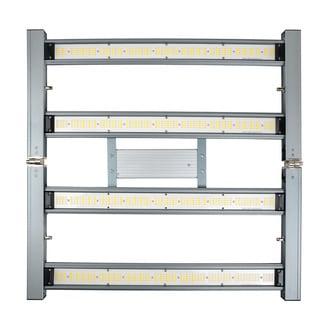
The Phytonaut LED Grow Light 240W is a full-spectrum LED grow panel that delivers around 700 µmol/s PPF at 2.82 µmol/J efficacy — built by Zamnesia's growshop arm to cover an 80×80 or small 100×100 tent without cooking your electricity bill. At 240 watts pulling from Sanan and Osram diodes, it sits squarely in the sweet spot between starter panels and the heavy-hitting 320W and 480W models in the same Phytonaut line.
Phytonaut 240W: who this grow light is built for
This is the panel we'd reach for if you're running a single 80×80 or pushing a small 100×100 tent and want one fixture doing the job from seedling to harvest. The 240W draw, paired with a 120° beam over a 60×60 cm fixture, lays a wide and even light footprint without hot-spotting the canopy directly underneath. At 3.8 kg it's not going to stress your tent bars either.
Full-spectrum output means you don't swap bulbs between veg and bloom — the diodes cover the blue-through-red range plants actually use. Sanan and Osram chips aren't budget no-names; they're the same brands you'll see inside fixtures costing significantly more. The efficacy figure of 2.82 µmol/J is solid mid-tier territory — not Samsung LM301H flagship numbers, but a long way from the cheap blurple panels that flooded the market a decade ago.
Phytonaut 240W specifications at a glance
Here's everything you need to know on paper before deciding if it fits your space.
| Power draw | 240 W |
| PPF (photosynthetic photon flux) | ~700 µmol/s |
| Efficacy | 2.82 µmol/J |
| Spectrum | Full-spectrum white + red |
| Beam angle | 120° |
| Fixture dimensions | 60 × 60 × 7 cm |
| Weight | 3.8 kg |
| Diodes | Sanan + Osram |
| Cooling | Passive (no fans) |
| IP rating | IP65 (dust/moisture resistant) |
| Lifespan | ≥54,000 hours |
| Dimming | Manual knob + 0–10V external controller |
How the Phytonaut 240W compares to its siblings
The 240W sits in the middle of a four-model Phytonaut range, and picking the right wattage is mostly about matching your tent footprint. Going bigger than your space wastes light spilling onto tent walls; going smaller starves the canopy.
| Model | PPF | Best for | Fixture size |
|---|---|---|---|
| Phytonaut 120W | ~350 µmol/s | 60×60 cm tents, single plant | Compact panel |
| Phytonaut 240W | ~700 µmol/s | 80×80 cm, small 100×100 | 60×60×7 cm |
| Phytonaut 320W | Higher output | 100×100 cm tents | Larger panel |
| Phytonaut 480W | Highest output | 120×120 cm and up | Largest panel |
Honest take: if you're growing in a 60×60, the 120W is enough and the 240W will need dimming. If you're in a 100×100, the 320W will give you more headroom. The 240W's sweet spot is the 80×80 — which happens to be the most popular tent size we sell.
Passive cooling and IP65: why these matter day-to-day
No fans means no noise. That's the immediate, obvious benefit — you can grow in a bedroom or office and the only sound is your extraction fan. Passive cooling also removes the most common failure point on LED panels: the fan bearings. Fanless designs typically outlast active-cooled ones by years, which is partly how the Phytonaut hits its ≥54,000-hour rated lifespan. That's roughly 12 years at 12 hours a day.
The IP65 rating means the fixture is sealed against dust and resistant to water jets. In practice, that matters because a grow tent at 70% humidity during late veg is a damp environment. Condensation, accidental spray from foliar feeding, the occasional leaky reservoir — IP65 shrugs that off where a non-rated panel might develop corrosion on the driver contacts.
Dimming: manual knob plus 0–10V control
The Phytonaut 240W gives you two ways to dim. The onboard knob lets you set output manually — useful for dialling back during seedling and early veg when full power would scorch tender leaves. The 0–10V input lets you plug into an external controller (the kind that ramps light up and down automatically to simulate sunrise/sunset, or links multiple fixtures to one dimmer).
Complete your setup: Pair the Phytonaut 240W with an 80×80 cm grow tent, a carbon filter and extraction fan combo, and a basic timer or 0–10V controller. If you're new to growing, a complete grow tent kit will save you sourcing parts separately.
How to set up and use the Phytonaut 240W
- Mount the fixture using the included hangers or rope ratchets, centred over your canopy.
- Start at 60–80 cm above seedlings, with the light dimmed to roughly 40–50%.
- Set your timer for 18/6 during veg, 12/12 to trigger flowering.
- Lower the light to 40–50 cm during flower and ramp dimming up to 100% over the first two weeks of bloom.
- Check leaf temperature with the back of your hand — if it feels warm, raise the fixture 10 cm.
- Connect the 0–10V input to a controller if you want automated sunrise/sunset ramping.
- Wipe the diode face with a dry cloth every few weeks — dust on the lens kills efficiency.
Honest limitations to know about
The 240W isn't the answer for everything. If you're running a tent bigger than 100×100, this single panel will leave the corners light-starved — you'd need two, or step up to the 320W or 480W. The fixture also doesn't include a controller or hanging hardware in the box, so budget for rope ratchets separately. And while 2.82 µmol/J is respectable, it's not flagship efficiency — if you're chasing the absolute lowest electricity bill per gram, there are pricier panels that edge it out.
Frequently Asked Questions
What size tent does the Phytonaut 240W cover?
The 240W is sized for an 80×80 cm tent at full power, or a small 100×100 cm tent if you keep expectations modest. The 60×60 cm fixture and 120° beam spread evenly across that footprint without major hot spots.
Is 240W enough for flowering cannabis?
Yes, in an 80×80 tent. ~700 µmol/s PPF puts you in the 600–900 µmol/m²/s range at canopy height, which is the standard target for flowering cannabis. For larger tents you'd want the Phytonaut 320W or 480W.
Does the Phytonaut 240W run hot?
It runs warm to the touch but uses passive cooling — no fans. The aluminium heatsink dissipates heat into the tent, so you'll still need extraction, but the fixture itself is silent and stays well within safe operating temps over its 54,000-hour lifespan.
Can I daisy-chain multiple Phytonaut 240W panels?
You can run multiple fixtures from a single 0–10V controller, which lets one dimmer signal control several lights at once. Power-wise each panel needs its own socket — they don't daisy-chain power, only the dimming signal.
What's the difference between the Phytonaut 240W and the Pure LED Q240?
Both are 240W full-spectrum panels in a similar price bracket. The Phytonaut is 60×60 cm with Sanan + Osram diodes and 0–10V dimming; the Pure LED Q240 is 45×45 cm with a different diode mix. The Phytonaut spreads light wider over a larger fixture footprint.
Do I need a separate controller to dim it?
No — there's a manual knob on the driver for basic dimming. The 0–10V input is only needed if you want automated ramping or want to sync multiple fixtures. Most home growers use the manual knob and a simple timer.
Last updated: April 2026