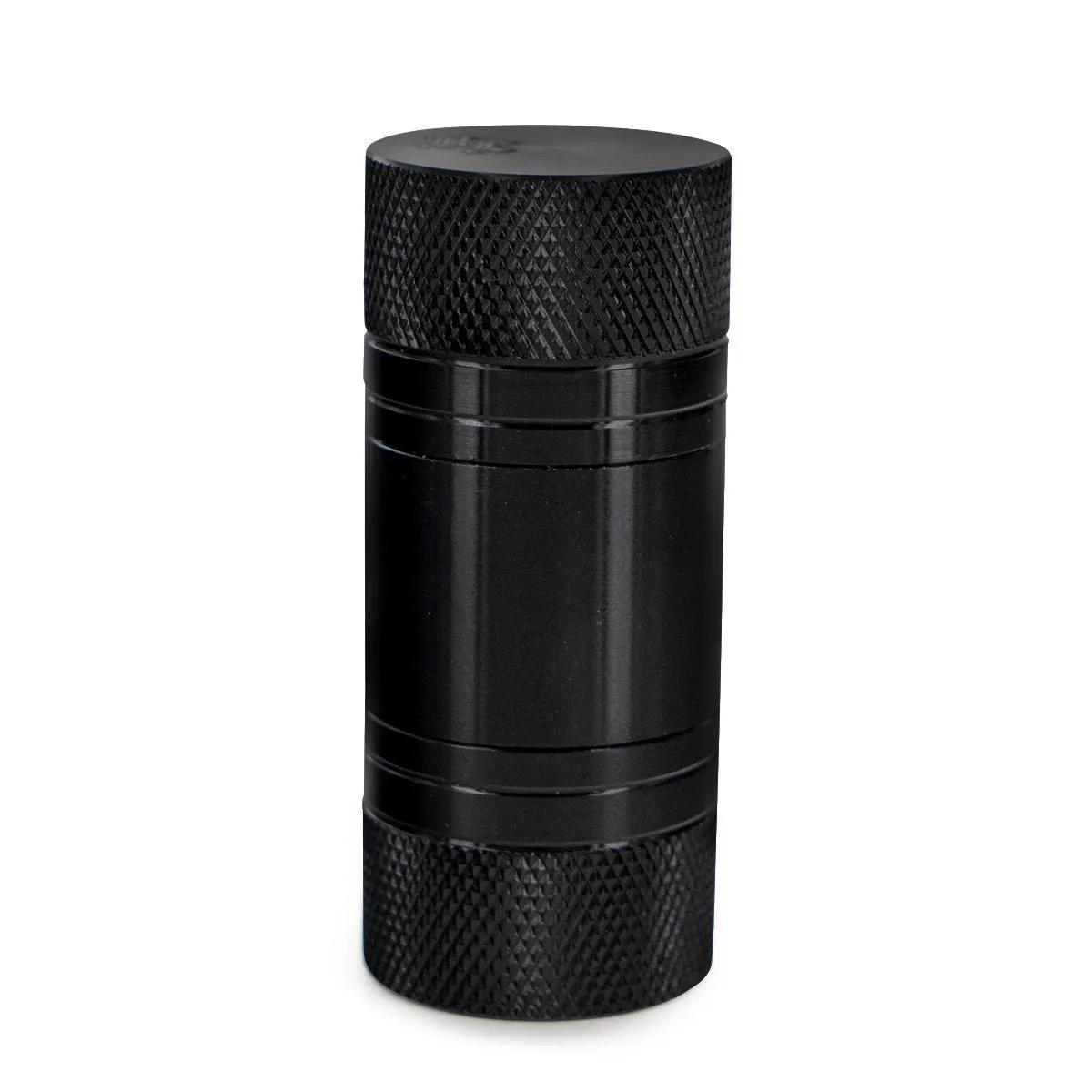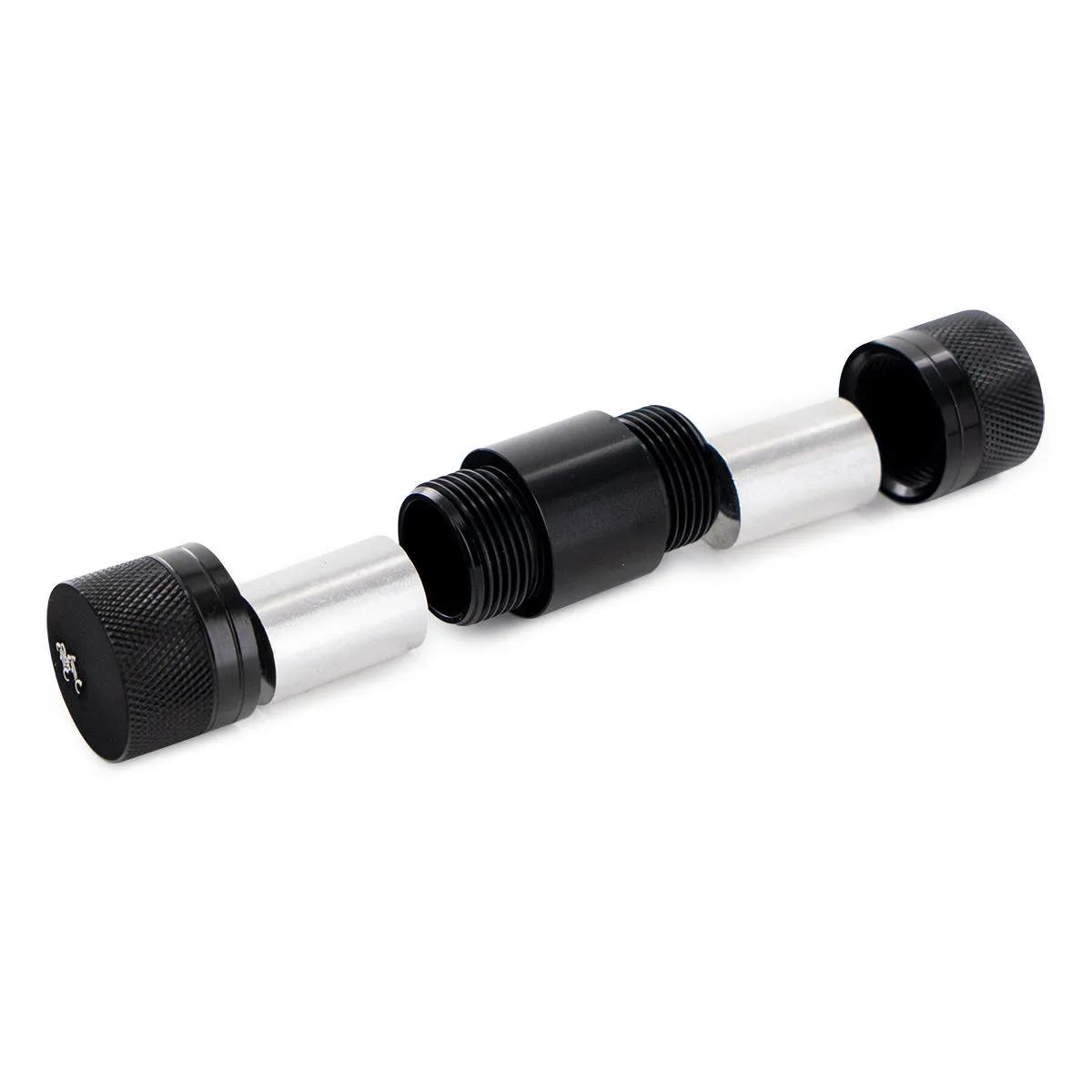
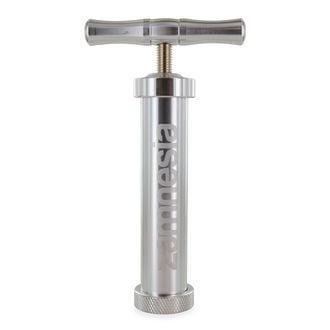
The Super Pollen Press is a CNC-machined T-handle pollen press that compresses loose kief into solid hash pellets using hand-twist pressure alone. No hammer, no vice, no mess — just drop your sift into the 29 mm bore, screw the handle down, and walk away while the trichomes fuse into a proper coin. It extends from 21 cm closed to 34 cm fully cranked, which gives you the use to compact even stubborn dry sift without breaking a sweat.
Why the Super Pollen Press earns its name
The Super Pollen Press swaps the mallet for a T-handle screw mechanism, which means the pressure is steady, even, and entirely controllable by hand. You feel the resistance build as the kief packs down, and you stop when the puck feels solid — no guessing, no over-hammering, no dented kitchen counter.
The 29 mm bore is the sweet spot for personal-batch hash coins. Big enough to press a meaningful amount in one go, small enough that you're not waiting forever to collect enough kief to fill it. CNC-machining means the threads run true and the piston slides without binding — the kind of fit-and-finish you only notice when a cheaper press starts grinding on you three months in.
Aluminium or stainless steel — which Super Pollen Press to pick
Both variants share the same 29 mm bore, the same 21→34 cm extension range, and the same CNC-machined T-handle. The choice comes down to weight, feel, and how hard you plan to push it.
| Spec | Aluminium | Stainless steel |
|---|---|---|
| Weight in hand | Lighter — easier to travel with | Heavier — feels planted on the bench |
| Corrosion resistance | Good | Excellent — won't pit over years |
| Thread durability | Solid for personal use | Effectively bulletproof |
| Best for | Occasional pressing, lighter loads | Heavy use, long-term workhorse |
If you're pressing once a month after grinding sessions, aluminium is the easy pick. If you're emptying a kief catcher every week and want something that'll still be on your bench in ten years, go stainless.
Super Pollen Press vs the other presses on our shelf
We stock three pollen presses, and they solve different problems. The Pocket Pollen Press is a small fixed cylinder — bolt on each end, tap with a mallet, pocketable. The Black Leaf Pollen Press is a classic aluminium tube press, also mallet-driven. The Super Pollen Press is the only one with a hand-twist T-handle and the only one that extends from 21 cm to 34 cm for added use.
| Feature | Super Pollen Press | Mallet-style presses |
|---|---|---|
| Pressing mechanism | Hand-twist T-handle | Tap bolts with a mallet |
| Bore | 29 mm | Varies (typically smaller) |
| Length | 21 cm closed → 34 cm extended | Fixed |
| Noise level | Silent | Loud — neighbours will hear |
| Construction | CNC-machined | Standard machined |
Honest limitation: the Super Pollen Press is bigger than the Pocket Pollen Press. At 21 cm closed it's not going in a jacket pocket. If discretion and portability matter more than use and quiet operation, the Pocket version is the call.
Pick aluminium if you want a lighter tool for occasional pressing.
Pick stainless steel if you want a heavier, near-indestructible workhorse for regular use.
Both share identical dimensions: 29 mm bore, 21→34 cm extension.
How to use the Super Pollen Press
- Unscrew the T-handle and remove the piston from the 29 mm cylinder.
- Tip your collected kief into the bore. Don't overfill — leave a few millimetres of headroom so the piston has somewhere to travel.
- Slide the piston back in on top of the kief.
- Screw the T-handle down by hand. As you turn, the press extends from 21 cm toward 34 cm and the piston compresses the kief.
- Once the handle resists firmly, leave it under pressure for 10–20 minutes. Longer for denser, harder coins. Some people leave it overnight.
- Unscrew the handle, push the piston back through, and the finished hash puck slides out.
- Wipe the bore clean with isopropyl alcohol on a cotton bud between uses. Resin builds up fast.
Pairs with a four-piece grinder with a kief catcher — that's where your raw material comes from. A small set of digital scales is handy if you want to know exactly how much kief is going into each coin.
Specifications
| Bore diameter | 29 mm |
| Length (compressed) | 21 cm |
| Length (extended) | 34 cm |
| Material options | Aluminium or stainless steel |
| Construction | CNC-machined |
| Mechanism | Hand-twist T-handle |
| Brand | Zamnesia (own-brand growshop) |
Frequently Asked Questions
How much kief do I need to fill the Super Pollen Press?
The 29 mm bore comfortably takes a few grams of dry sift per press. You don't need to fill it — even half-full will compress into a usable puck. Just leave headroom for the piston to travel.
How long should I leave the press under pressure?
Minimum 10–20 minutes for a basic coin. For a harder, denser puck, leave it screwed down for several hours or overnight. The longer the pressure, the more solid the finished hash.
Does the Super Pollen Press work on hash, or only kief?
It's designed for loose kief and dry sift — the trichome powder that collects in a grinder's kief catcher or in a sieve. Already-pressed hash won't compress further in any meaningful way.
Aluminium or stainless steel — which lasts longer?
Both are CNC-machined and built to last, but stainless steel has the edge on corrosion resistance and long-term thread durability. Aluminium is lighter and perfectly fine for personal use; stainless is the workhorse choice.
How do I clean it?
Wipe the bore and piston with isopropyl alcohol on a cotton bud after each use. Resin and trichome residue build up quickly and will eventually make the piston harder to slide. A quick clean every session keeps it running smooth.
How is this different from the Pocket Pollen Press?
The Pocket Pollen Press is a small, mallet-driven cylinder — compact and pocketable. The Super Pollen Press is bigger (21–34 cm), uses a hand-twist T-handle instead of a mallet, and applies steady screw pressure rather than impact force. Quieter, more controlled, but not pocket-sized.
Last updated: April 2026